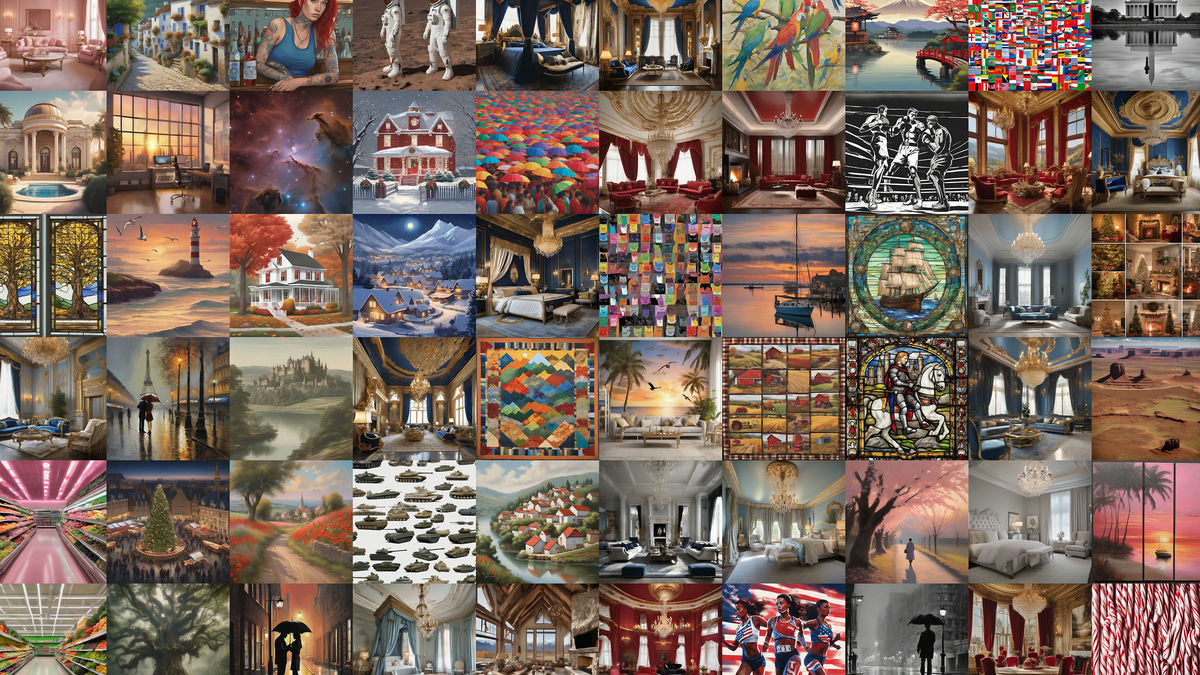
Researchers from Dalarna University in Sweden have revealed that the use of generative AI for image creation may not be as diverse as initially thought. A study led by data analytics specialist Erlend Hintze, published on December 25, 2025, indicates that repeated autonomous image generation can lead to a convergence of styles, ultimately resulting in only 12 distinct visual motifs. This finding raises questions about the limitations of AI creativity and its implications for industries reliant on image generation.
The research, conducted with the image generation model Stable Diffusion XL and the image recognition AI LLaVA, employed a self-referential loop to explore the creative capabilities of AI. The team executed a text-to-image-to-text cycle without human intervention, repeatedly generating images based on descriptions derived from the previously created visuals. As a result, the original image was often lost after multiple iterations, similar to the game of telephone, where messages vary as they are passed along.
In their experiments, the researchers provided Stable Diffusion XL prompts such as, “Sitting alone, surrounded by nature, I came across eight pages of an old book. It contained a story written in a forgotten language, waiting to be read and understood.” After generating an image, LLaVA would describe it textually, and that description would serve as a new prompt for Stable Diffusion XL. Through over 100 rounds of this process, the researchers observed that the resulting images began to exhibit considerable similarities.
The researchers noted that, unlike the human experience in a game of telephone, where individual interpretations can lead to varied outcomes, AI creativity tends to converge. Their study found that this convergence arises from the limited options available to the AI, which resorts to familiar visual motifs rather than exploring a broader array of creative possibilities. Hintze remarked, “The results are strikingly counterintuitive. Despite the probabilistic nature of both image generation and text description, the creative cycles of the autonomous AIs consistently converge to remarkably similar outputs.”
Across more than 2000 experimental runs, the study identified 12 recurring visual motifs that dominated the generated images. Among these were themes such as sports and action, formal interior spaces, coastal scenes featuring lighthouses, urban night vistas with atmospheric lighting, and images of rural landscapes. The research also highlighted motifs like luxurious interior designs and dramatic natural landscapes, suggesting that the images produced were influenced by commonly photographed subjects or widely utilized visuals in AI training datasets.
This convergence of styles raises concerns about the potential for reduced originality and cultural diversity in AI-generated content. As AI technology becomes increasingly embedded in advertising, design, film, and gaming, relying on a limited set of motifs could stifle creative expression. The researchers caution that even when users provide unique prompts, the inherent constraints of AI creativity may lead to repetitive outcomes.
In conclusion, the findings from this study underscore the necessity for ongoing discussions around the evolution of AI technologies. As the industry continues to explore the creative potential of AI, the implications of reduced diversity in generated imagery warrant careful consideration, particularly for sectors that prioritize unique and culturally rich visual content. The balance between leveraging advanced AI and maintaining a spectrum of creativity remains a critical challenge for the future.
See also China Files 700 Generative AI Models as HarmonyOS Devices Exceed 1.19 Billion Units
 Study Uncovers 73 Risks of Large Language Models, Urges Urgent Ethical Governance
 Roblox Launches 4D Generative AI Tools, Revolutionizing Metaverse Creation with Open-Source Cube Model
 Generative AI Japan Awards 2025: COLOPL’s ‘Tsukuyomi’ Wins Grand Prix Among 8 Honorees
 Study Reveals Hidden Risks of Large Language Models: Phishing, Bias, and More