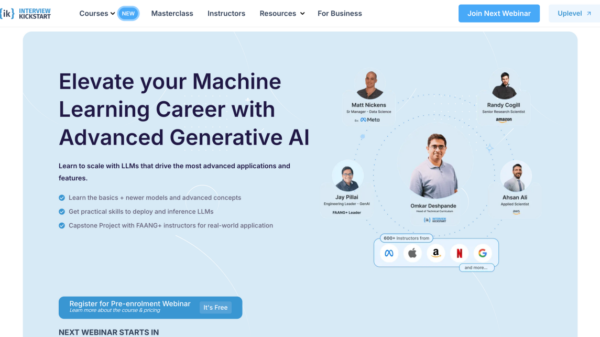
SANTA CLARA, CA, Dec. 29, 2025 (GLOBE NEWSWIRE) — Leading edtech platform Interview Kickstart has launched a new Agentic AI Course designed for developers, engineers, and managers, in response to the growing skills gap in the artificial intelligence industry. The rapid transition of the agentic AI market from experimentation to production deployment in 2025 has created significant shortages of qualified personnel across engineering organizations globally. According to industry data, 94 percent of engineering leaders have reported critical gaps in agentic AI expertise, with about one-third facing shortages that impact 40 to 60 percent of necessary roles.
As the urgency for adoption accelerates, surveys indicate that 41 percent of organizations plan to implement agentic AI capabilities within the next six months. Additionally, 86 percent expect substantial changes to job roles and responsibilities within the year. Despite this momentum, 75 percent of organizations are expanding hiring for AI-focused positions while simultaneously reducing headcount in traditional technical roles. This shift reflects not merely a cyclical downturn but a fundamental reorganization in how engineering work is conducted, with autonomous systems becoming increasingly integrated into development, operations, and infrastructure teams.
The skills shortage is particularly pronounced in emerging, high-value specializations that were largely undefined just two years ago. Companies are in search of professionals capable of designing and architecting multi-agent systems, where autonomous agents collaborate to tackle complex tasks. Demand is also surging for platform engineers who can build infrastructure to support agentic workloads, including inter-agent communication, state management, and system observability. Moreover, infrastructure and DevOps engineers are expected to deploy, monitor, and scale autonomous agents across distributed environments.
Leadership roles within engineering are evolving as well. Engineering managers must now oversee teams developing agent-driven automation strategies, while technical program managers are charged with assessing feasibility, managing cross-functional execution, and mitigating risks related to autonomous system deployment. Traditional educational pathways have struggled to keep pace with these changes, compelling organizations to either upskill their existing workforce or compete for a limited pool of specialists.
As the adoption of agentic AI expands, many companies are restructuring their technology departments to accommodate both traditional engineering teams and those focused on autonomous system development. New roles, such as agentic architecture specialists and multi-agent orchestration engineers, are increasingly common and often come with premium compensation due to limited supply. Organizations are thus transitioning senior software engineers, platform engineers, and DevOps professionals into these agentic-focused roles.
Early adopters of agentic AI are reportedly experiencing competitive advantages. Current estimates suggest that approximately half of large enterprises have agentic AI systems operating in production, supporting a range of functions from infrastructure optimization to development automation. These organizations are developing institutional knowledge, governance frameworks, and technical maturity that could prove challenging for late adopters to replicate. By 2026, agentic AI adoption is expected to reach 40 to 50 percent across the technology sector, narrowing the window for first-mover advantage significantly.
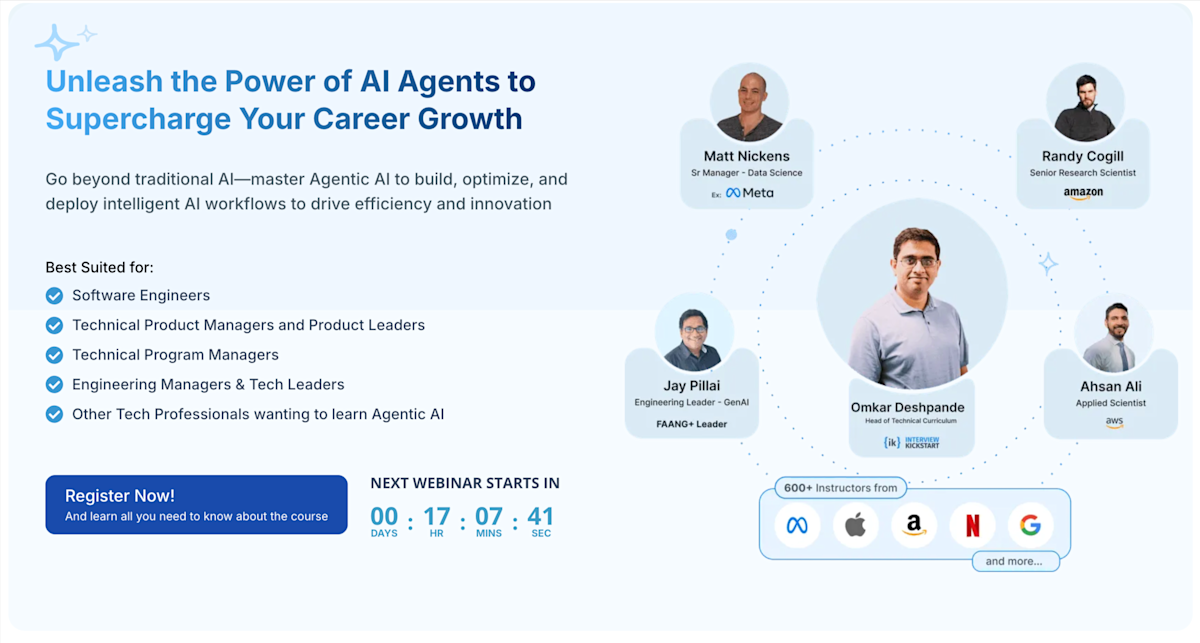
To aid engineering leaders in preparing for this shift, Interview Kickstart has introduced the Agentic AI Career Boost, a structured training program aimed at experienced technology professionals working with autonomous systems. This 14-week program emphasizes practical skills required in production environments, including building autonomous AI agents, designing multi-agent systems, and orchestrating agent-driven workflows.
The curriculum encompasses distinct professional tracks. Software and AI engineers focus on agent architecture and deployment patterns for autonomous systems, while platform engineers study infrastructure design for agentic workloads. DevOps and infrastructure engineers examine operational governance and deployment orchestration for autonomous environments. Engineering managers receive training in both the technical fundamentals of agentic AI and leadership strategies for managing teams involved in building autonomous systems.
Industry observers caution that the window for proactive upskilling is narrowing. Organizations are actively hiring agentic AI specialists, and early technical leadership is already shaping long-term competitive positioning. Engineering leaders who invest in structured, expert-led training are better equipped to guide their organizations through this transition, whereas those who delay may find themselves overseeing systems they lack the expertise to evaluate or optimize effectively.
As autonomous systems become pivotal to modern technology infrastructures, expertise in agentic AI is poised to emerge as a defining capability for engineering leadership in the years to come. For more information, visit Interview Kickstart at interviewkickstart.com.
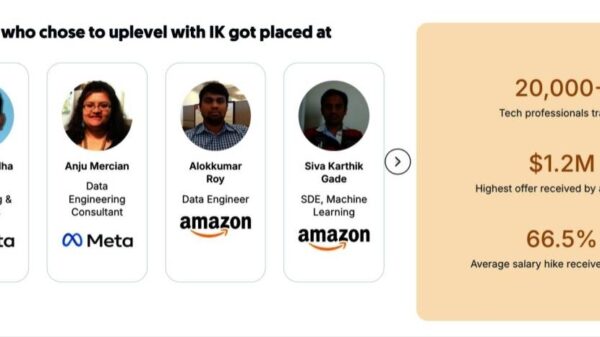
Founded in 2014, Interview Kickstart provides structured upskilling programs for software engineers, data professionals, and technical leaders aiming for career advancement in technology. The platform has assisted over 20,000 learners across various disciplines, including artificial intelligence, machine learning, and systems design.
For further inquiries about Interview Kickstart, contact:
Interview Kickstart
Burhanuddin Pithawala
+1 (209) 899-1463
[email protected]
4701 Patrick Henry Dr Bldg 25, Santa Clara, CA 95054, United States
 Apple Reaches $4 Trillion with Privacy-First AI, Launches Apple Intelligence Ecosystem
 Swansea Man Paralysed by Wave Walks Again with AI-Enhanced Rehabilitation Technology
 Amazon Enhances AI Workflows with GenAI Learning Systems for Global Enterprises
 ByteDance Plans $14B Nvidia AI Chip Purchase to Boost Computing Power by 2026
 AI Workshop Reveals Effective Strategies for Implementing AI in AEC Projects