Guwahati, Jan 4 — Assam Chief Minister Himanta Biswa Sarma has described the transformative impact of artificial intelligence and machine learning as merely “the tip of the iceberg.” Speaking at an event on Sunday, he urged students to remain vigilant and prepare for an increasingly dynamic world shaped by rapid technological advancements.
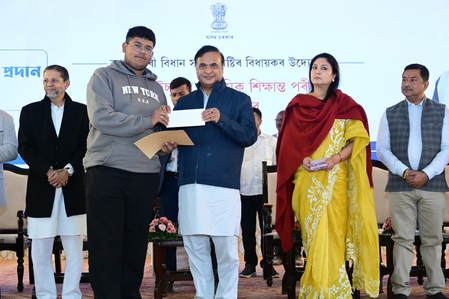
Sarma emphasized that traditional textbook knowledge is insufficient in today’s job market, urging students to acquire practical skills aligned with the demands of Industry 4.0. He noted that the state government is actively adapting its policies and initiatives to keep pace with these rapid changes. His comments came during a ceremony in Changsari, Kamrup district, where he honored 1,534 students from Bezera and Sualkuchi for their outstanding performance in the HSLC and HS Examinations of 2025.
Reflecting on the evolution of technology, Sarma recalled a time when typewriters were the norm, followed by the advent of electronic typewriters, bulky computers, and eventually laptops. He noted that artificial intelligence has now permeated nearly every aspect of life, declaring that the era of traditional software has concluded.
The Chief Minister also addressed the significant shifts in food production, citing advancements that allow laboratories to create food tailored to human needs. He pointed to the emergence of bioengineered food in the market as indicative of these changes.
On healthcare, Sarma remarked on the evolution from reactive treatment to preventive care, highlighting the introduction of genetic screening, which enables individuals to identify potential future health issues. “People can now learn in advance about diseases that may occur 10 years later and take preventive steps,” he stated, adding that this capability will eventually allow for early identification of hereditary diseases during childhood.
Technological innovations have also revolutionized medical procedures. Sarma noted, “Earlier, doctors performed surgery by opening the body. Later, surgeons inserted cameras through small openings to operate. Now, in many cases, robots perform surgery while doctors guide them from a distance.” He referenced the use of robotic surgery already implemented at Guwahati Medical College, suggesting a future where remote operations become commonplace.
Sarma also discussed the rise of augmented reality and virtual reality, predicting that these technologies will foster closer interactions among people from a distance and could allow for classroom learning without a physical teacher present. He cited Tesla‘s advancements in self-driving car technology as a harbinger of a future where many professions, such as those of doctors, engineers, and teachers, could be significantly altered within the next 10 to 15 years.
As the state embraces these changes, Sarma’s remarks serve as both a warning and a call to action for the younger generation to adapt and prepare for the future. The implications of these technological advancements extend beyond individual careers, potentially reshaping entire industries and societal structures. In a world increasingly driven by technology, the need for continuous learning and adaptation becomes paramount.
See also Bell and Queen’s University Plan Next-Gen Sovereign AI Supercomputer for Canada
 Pre-K Teachers Embrace AI with 30% Adoption Rate; Demand for Training and Resources Grows
 Luca Secures $8 Million to Transform AI Education for 30 Million Students in Mexico
 King’s College London Announces Four AI+ Professorships to Enhance Interdisciplinary Research
 Google Launches Gemini AI Podcast Lessons in Classroom, Enhancing Digital Education in 2026