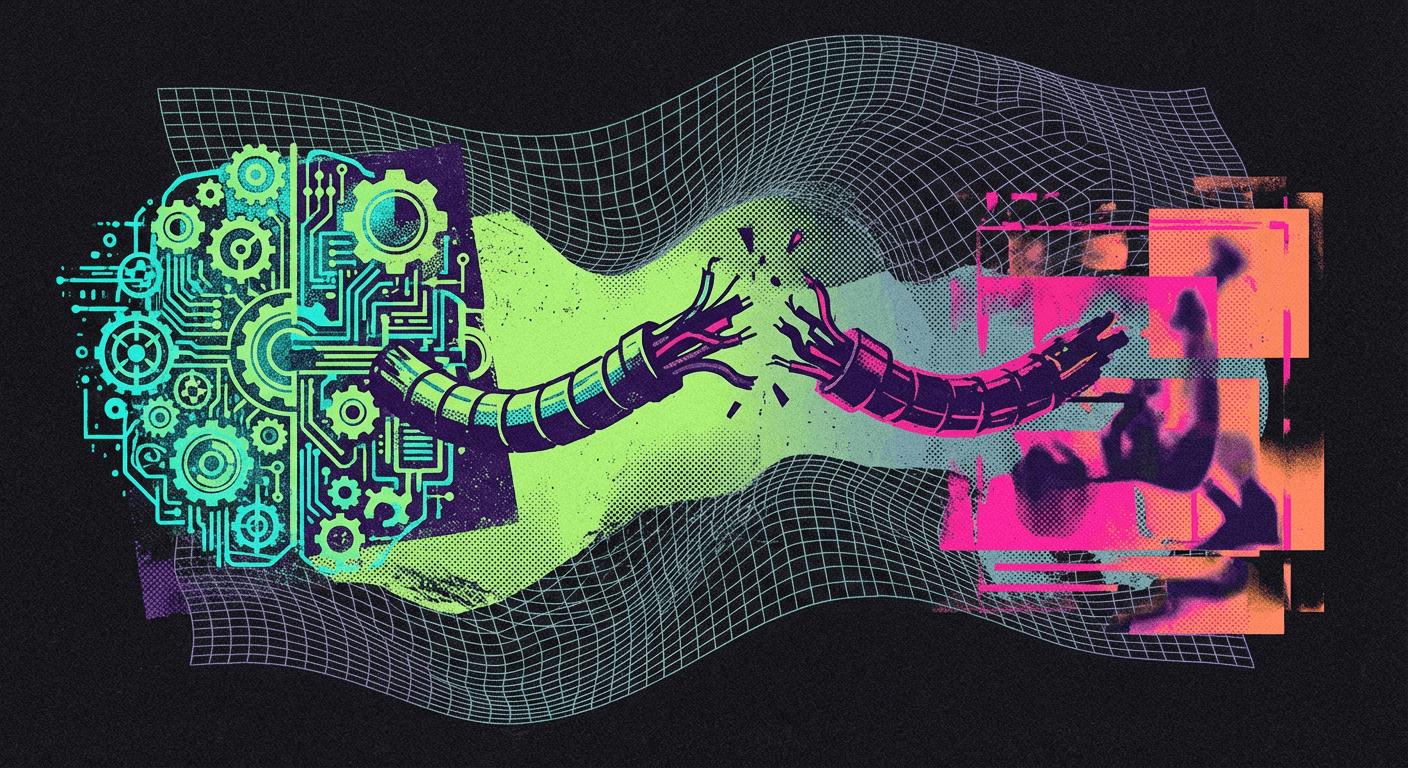
Chinese researchers have introduced UniCorn, a framework aimed at enhancing the capabilities of multimodal AI models by enabling them to recognize and rectify their weaknesses. These advancements come from a collaborative effort involving the University of Science and Technology of China (USTC) and other institutions. While some multimodal models can comprehend and generate images, they often exhibit a disconnect between these functions. For instance, a model might accurately note the location of a beach and waves in an image but fail to generate a corresponding image with the same arrangement.
The researchers have termed this phenomenon “Conduction Aphasia,” drawing a parallel to a neurological disorder in which patients can understand language but struggle to reproduce it correctly. UniCorn serves as a solution to this problem by bridging the gap between understanding and generation.
UniCorn’s core premise is straightforward: if a model can evaluate images more effectively than it can generate them, that evaluative capability should enhance its generation skills. The framework divides a single multimodal model into three interdependent roles that function within the same parameter space. The “Proposer” generates a range of diverse and challenging text prompts. The “Solver” then produces multiple image candidates for each prompt, specifically eight variants, each with different parameters. Finally, the “Judge” assesses these generated images on a scale of 0 to 10, offering detailed reasoning for its evaluations.
Training occurs in a subsequent phase, where the interactions are transformed into four training formats. The model learns not only to generate quality images from prompts but also to describe its own images. Additionally, it trains on evaluating image-text pairs and enhancing poorly generated results. The researchers stress that all three components are essential; focusing solely on generation data could jeopardize the model’s understanding capabilities.
According to the researchers, fine-tuning takes approximately seven hours using eight Nvidia H800 GPUs, which represents a relatively short time frame given the improvements achieved. Notably, the training process does not require external datasets or superior teacher models.
New Benchmark Tests Cycle Consistency
To assess whether these improvements genuinely reflect multimodal intelligence or are merely task-specific optimizations, the team developed the UniCycle benchmark. This benchmark evaluates a model’s ability to reconstruct key information from its own generated images. The assessment follows a text-to-image-to-text loop: the model first generates an image based on a text description and subsequently answers questions about that image. An external model then verifies whether these answers correspond to the original description, thereby determining if the model comprehends what it has generated.
In experimental trials, the researchers utilized BAGEL as the foundational model and tested UniCorn across six different benchmarks. The results demonstrated consistent enhancements over the base model, indicating that the method employed is effective. UniCorn particularly excelled in tasks requiring structured understanding, such as object counting and spatial arrangements. The framework also made significant strides in knowledge-intensive tasks that necessitate cultural or scientific background knowledge.
On the DPG benchmark, which assesses the capability to generate complex scenes with multiple objects and attributes, UniCorn outperformed GPT-4o. In the new UniCycle benchmark, the framework scored nearly ten points higher than the base model, suggesting that these improvements are substantial and contribute to a coherent relationship between understanding and generation, according to the research team.
The researchers further explored the potential benefits of employing a more advanced external model as the Judge in their framework. They tested Qwen3-VL-235B, a significantly larger model, but found minimal performance improvement; in fact, performance on the UniCycle benchmark declined. The team speculated that the model may struggle to adapt to the more complex evaluation patterns of a more powerful teacher. Their findings suggest that self-assessment using the model’s own judgments is more effective than relying on external supervision.
Despite these advancements, the researchers acknowledge that UniCorn encounters limitations with specific tasks. It shows no appreciable improvements in areas such as negations—exemplified by prompts like “a bed without a cat”—and precise object counting. These tasks pose inherent challenges for multimodal models, and the self-play methodology hasn’t proven effective in addressing these difficulties. Additionally, the model undergoes the improvement process only once; it gathers data, trains, and that concludes the cycle. An iterative approach, where the model continues to collect new data for further optimization, remains a future goal for the researchers.
Another limitation pertains to its understanding capabilities: while image generation has seen significant improvements, scores in pure understanding benchmarks largely remain unchanged. UniCorn mainly enhances one aspect of the equation, although it does maintain a baseline of understanding that would collapse under purely generative training without supplemental data formats, the team reports. As multimodal AI continues to evolve, the implications of such frameworks as UniCorn may pave the way for more nuanced integrations of understanding and generation in AI models.
See also AI Video Generators Revolutionize Content Creation with Advanced Machine Learning and Cloud Tech
 Relativity Launches aiR for Case Strategy, Enhancing Legal Insights by 70% Faster Extraction
 Locai Labs Bans Under-18s and Image Generation Amid AI Safety Concerns
 New Mexico Advocates for AI Leadership to Mitigate High-Stakes Risks