






















































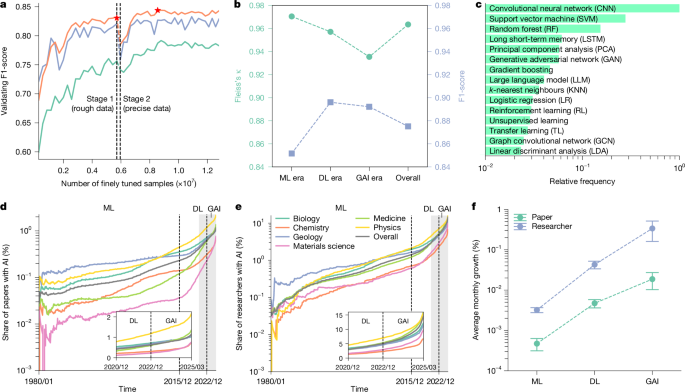
In a significant development for the intersection of artificial intelligence and scientific discovery, researchers are increasingly leveraging AI tools to enhance their research capabilities. A recent article in Nature by Wang et al. details how AI is fostering new avenues for scientific exploration and innovation, emphasizing the growing reliance on these technologies to accelerate research outcomes.
The utilization of AI extends across various fields, including healthcare, education, and fundamental scientific research. With advances in machine learning and data analysis, AI has proven instrumental in tasks such as protein structure prediction and large-scale data processing, fundamentally altering the traditional research landscape. For instance, the introduction of AlphaFold has revolutionized protein structure prediction, achieving remarkable accuracy in modeling complex biological molecules, as detailed in the works of Jumper et al. in 2021.
Moreover, the foundational principles of AI, as articulated in earlier studies by pioneers like Geoffrey Hinton and Yann LeCun, continue to influence the development of new algorithms and models that enhance computational efficiency. Hinton’s work on neural networks and deep learning, specifically his 2006 paper on dimensionality reduction, has set the stage for contemporary applications in various scientific domains.
In education, AI tools like ChatGPT are being explored for their potential to transform pedagogy and scholarly communication. Recent studies suggest that these advanced language models can assist researchers in writing and abstract generation, enhancing clarity and effectiveness in scientific communication. Research by Hwang et al. is particularly relevant, as it evaluates the quality of scientific abstracts produced by AI compared to traditional methods.
The ethical implications of integrating AI in education and research are also gaining attention. A study by Akgun and Greenhow highlights the necessity for addressing ethical challenges associated with using AI in K-12 educational settings, ensuring that the deployment of these technologies does not compromise academic integrity or student learning outcomes.
In healthcare, the call for regulatory oversight of large language models has intensified, as articulated by Meskó and Topol. Their 2023 study emphasizes the importance of establishing guidelines to govern the use of generative AI in medical contexts, given its growing influence on diagnosis and treatment approaches.
As AI continues to evolve, its role in scientific research becomes increasingly pivotal. Articles such as Gao and Wang’s upcoming work on quantifying the use and potential benefits of AI in research further underscore this trend. The incorporation of AI tools not only enhances research efficiency but also opens new avenues for interdisciplinary collaboration, as evidenced by the work of Varadi et al. on expanding protein-sequence space.
Looking ahead, the integration of AI into scientific research and education presents both opportunities and challenges. While AI-driven tools promise to accelerate progress and innovation, careful consideration of their ethical implications is paramount. The ongoing discourse among researchers aims to balance the transformative potential of AI with the necessity of maintaining rigorous academic standards and ethical guidelines, shaping the future of research in the age of artificial intelligence.
See also AI Orchestration Platforms Enhance Collaboration Workflows, But Face Data Governance Challenges
 Syracuse Research Corporation Secures $24M US Air Force Contract for Embedded AI Development
 Ralph Wiggum Technique Revolutionizes AI Coding with Iterative Autonomy for Developers
 Kenyan Students Win US-Kenya AI Challenge with App to Reduce Maternal Mortality by 50%
 Google Trends Enhances Explore Page with Gemini for Easier Search Insights















