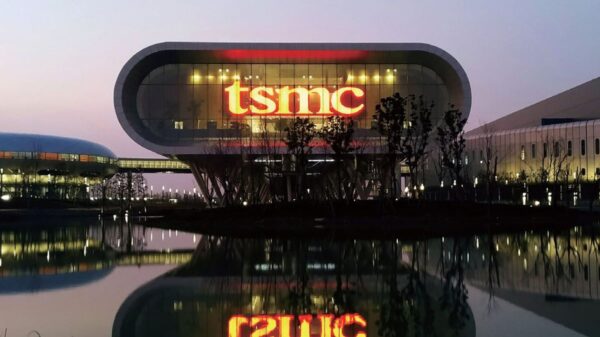
Taiwan Semiconductor Manufacturing Company (NYSE: TSM) reported a record-breaking fourth-quarter 2025 financial performance on January 15, 2026, highlighting the continuing momentum of the artificial intelligence revolution. The world’s largest contract chipmaker exceeded even the most optimistic analyst expectations, achieving a remarkable net income of $16.01 billion and a gross margin of 62.3%. More significantly, TSMC raised its 2026 capital expenditure (capex) guidance to between $52 billion and $56 billion, marking a considerable commitment to the sustainability of the AI infrastructure boom.
The implications of TSMC’s results reverberate throughout the global market. The semiconductor sector responded positively, alleviating concerns that heavy spending on AI hardware by hyperscalers might be tapering off. By declaring that its high-end capacity is “overwhelmed” by demand for its next-generation 2-nanometer (2nm) chips, TSMC has positioned itself for a prolonged growth cycle in high-performance computing (HPC) and mobile technology.
TSMC’s financial figures demonstrate a company operating at peak capacity. The quarterly revenue hit $33.73 billion, a 25.5% increase year-over-year. This surge was primarily driven by the swift adoption of its 3nm and 5nm process technologies, which together accounted for over 60% of TSMC’s total wafer revenue. CEO C.C. Wei noted in a bullish conference call that demand for AI accelerators is growing at a compound annual growth rate (CAGR) of mid-to-high 50% and is projected to continue until at least 2029.
The timeline leading to this moment has been marked by intense efforts to enhance capacity. Throughout 2025, TSMC worked to launch its 2nm production facilities in Hsinchu and Kaohsiung. Despite initial concerns about the challenges of transitioning to the new Gate-all-around (GAA) transistor architecture, Wei confirmed that mass production has begun with higher-than-expected yields. Following the report, TSMC shares surged by over 6%, while European lithography leader ASML (NASDAQ: ASML) saw its stock rise 7% as investors anticipated a wave of new equipment orders to support TSMC’s increased capex.
The most notable winner from TSMC’s updated guidance is NVIDIA (NASDAQ: NVDA), a leading player in the AI hardware space that relies on TSMC for its cutting-edge Blackwell and Rubin GPU platforms. TSMC’s commitment to invest up to $56 billion in new capacity signals strong confidence in NVIDIA’s product trajectory. Post-earnings, NVIDIA’s stock increased by 3.2%, as the market interpreted the news as confirmation that the “supply-constrained” environment for AI chips will endure, preserving high pricing power for the GPU leader. Similarly, equipment manufacturers like Applied Materials (NASDAQ: AMAT) and Lam Research (NASDAQ: LRCX) stand to benefit significantly as TSMC expands its infrastructure for the A16 (1.6nm) node.
Conversely, pressure is mounting for integrated device manufacturers such as Intel (NASDAQ: INTC) and Samsung (KRX: 005930). While Intel presses on with its “five nodes in four years” strategy to regain process leadership, TSMC’s record-high margins and the burgeoning demand for its 2nm node indicate that the gap between market leaders and followers remains significant. Despite Apple (NASDAQ: AAPL) poised to benefit from TSMC’s 2nm ramp for future iPhone processors, its shares dipped slightly by 0.67% due to unrelated regulatory news. Nevertheless, Apple maintains a crucial role as TSMC’s anchor customer, ensuring its devices retain a performance edge over rivals.
The significance of TSMC’s Q4 report extends beyond its own financials and serves as a benchmark for the entire technology sector. In late 2025, debates among economists focused on whether AI investment represented a “bubble” or a fundamental shift. Wei directly addressed these concerns, asserting, “AI is real,” and disclosed that he spent months confirming demand with global cloud giants. This validation is expected to stimulate further investment across the AI stack, from software developers to infrastructure providers.
Historically, TSMC’s increases in capex have acted as indicators for global technology cycles. The leap from $30 billion to a potential $56 billion is unprecedented and suggests an industry entering a new phase, where silicon content in various sectors—from automotive to consumer electronics—is significantly increasing. This development also carries geopolitical implications, as TSMC expands its operations in Arizona, Japan, and Germany, complicating its role as a “silicon shield” for Taiwan and necessitating continued collaboration with global regulators to ensure supply chain resilience.
Looking ahead, the next 12 to 18 months will focus on ramping the volume production of the N2 (2nm) node. TSMC has indicated that demand for 2nm is already surpassing that of 3nm at a similar stage, driven largely by AI integration in edge devices like smartphones and personal computers. Closely trailing is the A16 process, which will feature innovative backside power delivery to enhance performance and efficiency. This roadmap indicates that TSMC is not merely maintaining its lead but is accelerating its development cycle to meet the “insatiable” needs of AI developers.
However, challenges persist. The substantial capital required to stay at the forefront introduces financial risks. TSMC’s management acknowledged some trepidation regarding the $56 billion capex projection, which necessitates high capacity utilization to remain profitable. Furthermore, the global semiconductor market faces potential headwinds, including talent shortages in the U.S. and Europe and the ongoing threat of trade restrictions that could affect the flow of advanced chips to various regions.
TSMC’s impressive Q4 earnings and ambitious 2026 guidance have solidified its role as a cornerstone of the modern digital economy. For investors, the key takeaways are clear: the AI boom is not merely stable; it is expanding in both scale and complexity. The company’s ability to sustain gross margins above 60% while reinvesting record amounts back into its business signifies an operational excellence that is unparalleled.
As the market looks for the first “tape-outs” of 2nm designs from major clients, attention will also be on any signs of cooling hyperscale cloud spending. Currently, the “TSMC effect” has invigorated the tech sector, suggesting that the semiconductor supercycle still has significant room for growth. Investors should closely monitor quarterly capacity utilization rates and the progress of the expansions in Arizona and Kaohsiung as key indicators of whether this ambitious growth trajectory remains viable.
This content is intended for informational purposes only and is not financial advice.
See also Radware’s ZombieAgent AI Vulnerability Sparks Valuation Concerns Amid High P/E Ratio
 Microsoft Launches ‘Community-First AI Infrastructure’ to Support Local Communities
 AI Ethics and Law: South Africa’s Legal Sector Faces Urgent Ethical Risks Amid AI Adoption
 MetaMask Launches Native Tron Support, Enabling $21B Daily Transfers and Cross-Chain Management
 Marvell Technology’s Stock Rises as RBC Upgrades to “Moderate Buy” Post $540M Acquisition