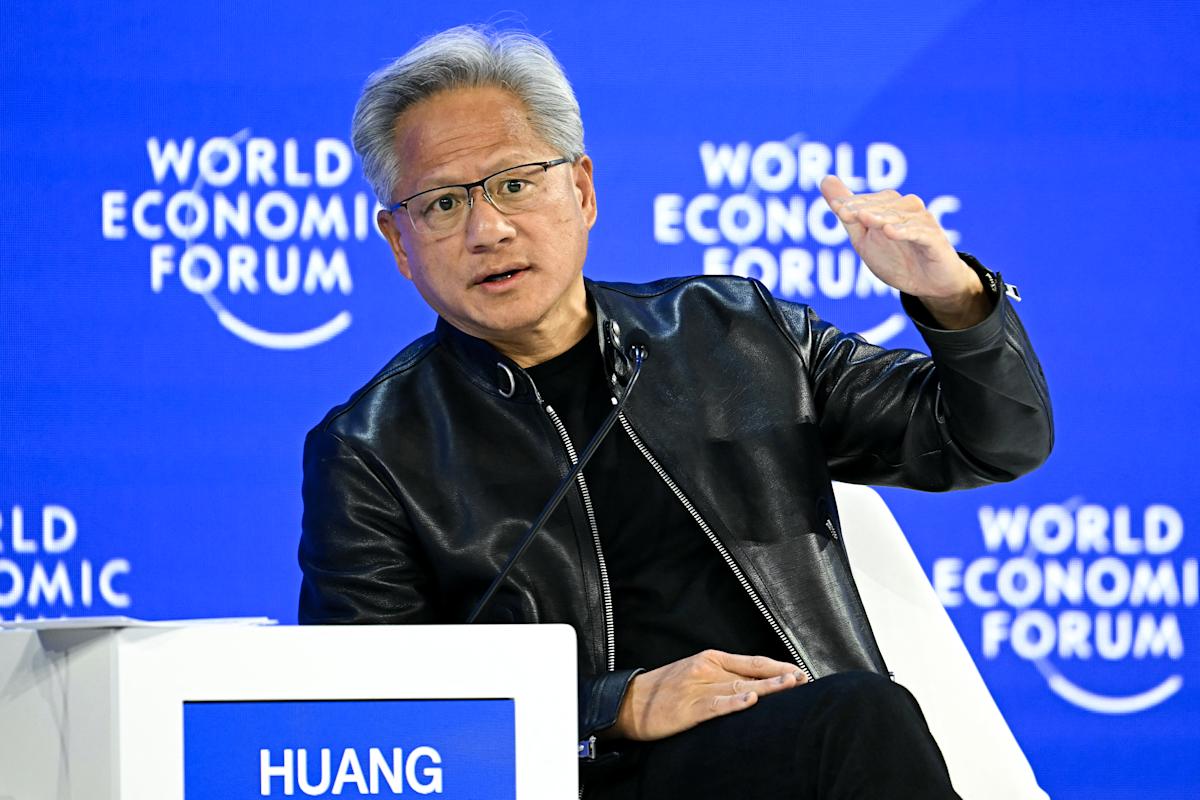
Nvidia (NVDA) CEO Jensen Huang engaged in a discussion with BlackRock CEO Larry Fink at the annual World Economic Forum in Davos, Switzerland, on Wednesday, focusing on the profound impact of artificial intelligence (AI) on various sectors, including the labor market and Europe’s energy supply. Huang characterized the current surge in AI as the catalyst for “the largest infrastructure buildout in history,” emphasizing that despite substantial investments already made by companies—amounting to hundreds of billions of dollars—there remains a significant amount of spending needed.
According to Huang, “There are trillions of dollars of infrastructure that needs to be built out.” He highlighted that 2025 marked one of the most extensive years for venture capital funding, with most investments directed toward what he termed “AI native companies.” These companies span multiple industries, including healthcare, robotics, and financial services, and are receiving substantial financial backing.
Huang noted that these investments stem from the increasing effectiveness of AI models, which enable companies to develop applications applicable across various sectors. “This application layer could be in financial services, it could be in healthcare, it could be in manufacturing. This layer on top ultimately is where economic benefit will happen,” he stated.
The rapid growth in AI infrastructure has raised concerns about the potential formation of an AI bubble, echoing sentiments from the tech bubble of the late 1990s. Critics on Wall Street express fears that the massive investments in data centers and AI chips could lead to an abrupt halt, negatively impacting the economy. However, Huang countered these concerns, suggesting that the significant investments are indicative of extraordinary opportunities in the AI domain.
Huang and Fink also touched upon the critical need for Europe to bolster its energy supply to support AI infrastructure investments. “I think that it’s fairly certain that you have to get serious about increasing your energy supply so that you could invest in the [AI] infrastructure layer so that you could have a rich ecosystem of artificial intelligence here in Europe,” he explained.
On the topic of job displacement, Huang mentioned that AI was initially perceived as a major threat to jobs in radiology. Contrary to those fears, he remarked that the number of radiologists has actually increased, allowing them to devote more time to patient care as demand for medical treatment rises. Fink acknowledged that while certain roles are being created in the data center industry—like those for plumbers and electricians—AI is increasingly replacing positions traditionally held by analysts in law firms and financial institutions.
In a separate discussion at Davos, Kristalina Georgieva, managing director of the International Monetary Fund, offered a sobering perspective on AI’s effect on the labor market. She stated that “on average 40% of jobs are touched by AI either enhanced or scrapped or changed quite significantly without implications for better pay,” describing the expansion of AI as a “tsunami” impacting employment. Georgieva expressed concern that even the most prepared countries may not be adequately equipped to handle these changes.
As the conversation surrounding AI continues to evolve, both Huang and Fink’s insights shed light on the dual nature of technological advancement—promising increased efficiency and new opportunities, while also presenting significant challenges for the workforce and infrastructure at large. The future implications of AI investment and its transformative potential remain a point of critical focus for policymakers, industry leaders, and the workforce alike.
See also BlackRock Launches AI Framework to Enhance Data Quality in Financial Models
 AI Agents Drive $6.54B Financial Services Market with 40.5% Bank Share by 2035
 SAP Integrates AI Agents to Transform Finance and Procurement into Strategic Powerhouses
 dForce Partners with Sage to Deliver AI-Enhanced Accounting Solutions for Scale-Up Finance Leaders