






















































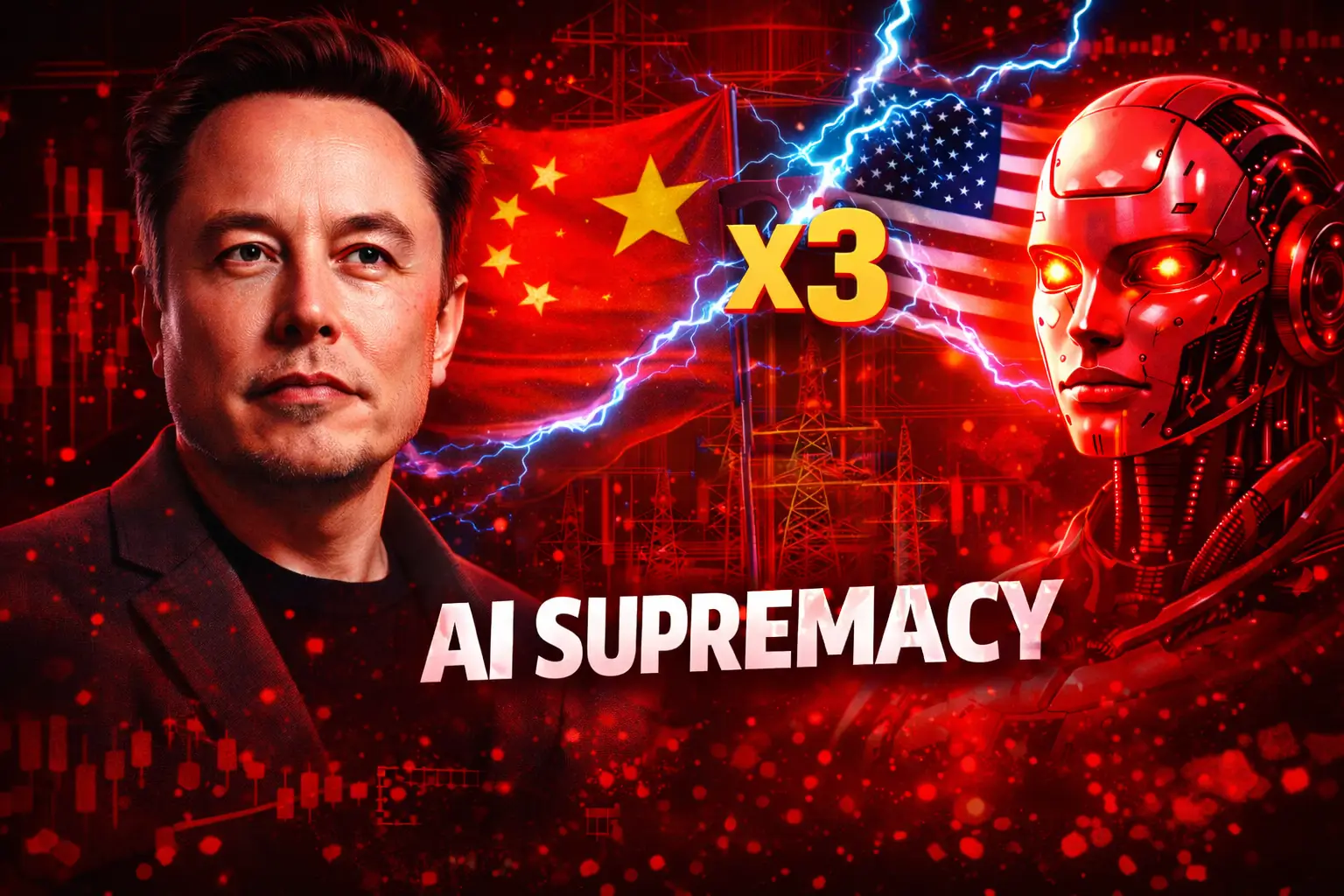
The global race for artificial intelligence supremacy is shifting focus from silicon availability to energy capacity, as China rapidly develops its grid infrastructure to meet immense computing demands. This strategic pivot could define technological sovereignty, particularly as Elon Musk projects that by 2026, China’s power generation capacity will triple that of the United States. This anticipated capacity gap signals an impending bottleneck that could derail AI ambitions worldwide.
While the West grapples with silicon shortages, it faces an even more formidable challenge: energy scarcity. Musk’s assessment underscores a brutal reality in the ongoing AI cold war: electricity, not chips, will determine the victor of the compute race. Without sufficient energy resources, high-performance computing clusters become ineffective, rendering cutting-edge designs obsolete.
Data center energy costs are projected to reach $580 billion by 2025, highlighting the shift towards infrastructure that is increasingly reliant on substantial energy inputs. This trend is underscored by the dramatic rise in energy consumption associated with advanced AI models, which can consume ten times more power than traditional computational tasks. By 2030, energy demands from AI could surge past the 1,000 terawatt-hour threshold, a figure that current grids may struggle to accommodate.
The urgency of this situation has prompted figures like Sam Altman to advocate for a staggering $1.4 trillion infrastructure overhaul, a figure that exceeds the GDP of many nations. This reflects a growing consensus that the hunger for computational power is boundless.
China’s Infrastructure Edge
China’s ability to generate and distribute power is crucial in this context. Regulatory hurdles that hinder infrastructure projects in the West do not exist in China, where central planning allows for rapid deployment of energy resources. The country is actively scaling its nuclear and renewable energy facilities, significantly outpacing its rivals in terms of speed and efficiency. This creates a surplus of energy that can be directed toward advanced computing.
Ultra-high voltage (UHV) transmission lines serve as the arteries of China’s energy grid, capable of transporting massive loads over long distances with minimal loss. This infrastructure not only secures a competitive advantage in AI energy supply but also ensures that computing resources are aligned with energy production.
In a notable geographic shift, data centers are moving westward to take advantage of renewable energy sources such as wind and solar, which are plentiful in regions like Inner Mongolia and Gansu. This synchronization of computing power with localized energy supplies enhances efficiency and minimizes latency. As machine learning models optimize energy management, the operational integration of energy and data becomes increasingly seamless.
China’s dominance extends beyond its borders, creating dependencies that may cause concern in Washington. The nation controls a significant share of the global supply chain for critical minerals used in renewable energy technologies, including an impressive 94% of the polysilicon production capacity and 85% of cobalt refining. This leverage poses a strategic challenge for the West, which finds itself reliant on China for essential components in green energy infrastructures.
In regions like Chifeng, AI algorithms are being employed to optimize hydrogen production based on real-time wind conditions, showcasing China’s commitment to maximizing energy efficiency. Additionally, recycling efforts for electric vehicle batteries are creating a circular economy that supports the infrastructure needed for advanced AI systems, reducing waste and costs.
As Beijing expands its influence through energy partnerships across the Global South, including significant investments in the Middle East and Southeast Asia, the implications for the United States become increasingly clear. This strategic alignment not only enhances China’s energy security but also grants it critical access to local data streams, further consolidating its position in the AI landscape.
Meanwhile, the U.S. is frantically working to secure its energy independence, focusing on natural gas and nuclear power to support its tech industry. Protecting domestic power networks is now a key priority, as any lapses in energy efficiency could jeopardize American technological dominance.
The stakes in this energy-driven compute race have never been higher. As China positions itself with a robust energy infrastructure that can support massive AI demands, the U.S. must adapt rapidly to avoid falling behind. The future of technological leadership now hinges on energy abundance, marking a significant shift in the geopolitical landscape of AI development.
See also AI Transforms Education: 85% of Teachers Utilize AI for Personalized Learning in K-12
 Crypto.com Co-Founder Launches ai.com for Autonomous AI Agents on February 8, 2026
 SEO Evolves: Embrace AI SEO, GEO, and AEO for Enhanced Brand Visibility
 AI’s Resource Demand Soars: Data Centers Consume Billions of Gallons, Strain Power Supply















