






















































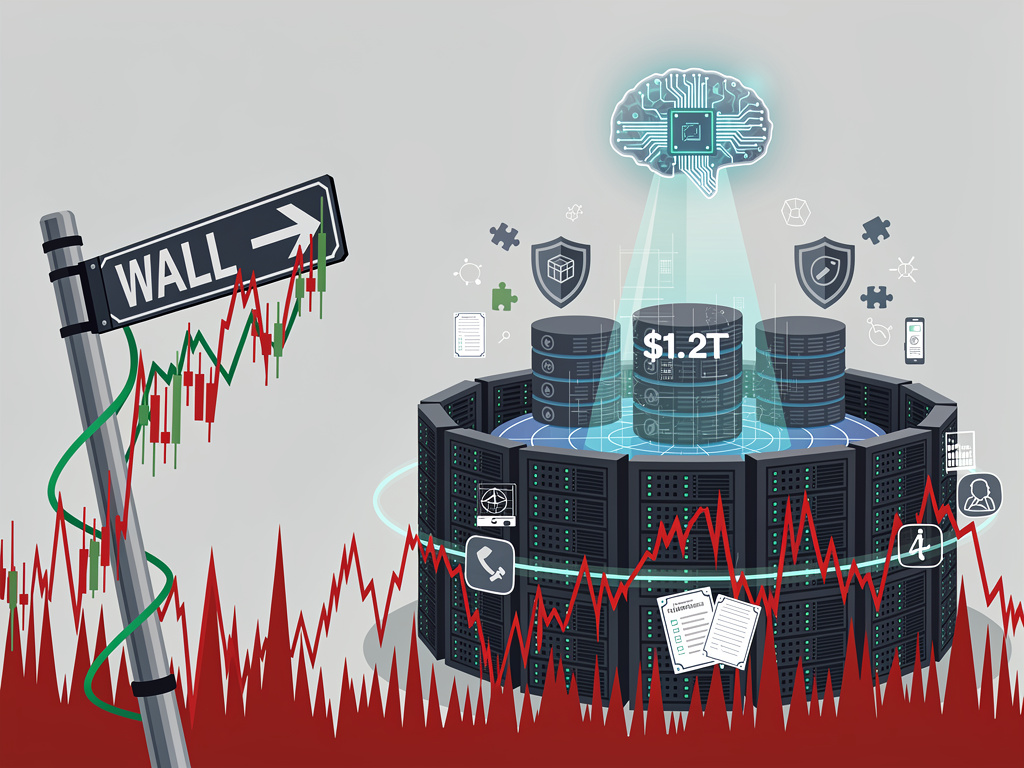
In a dramatic shift within the enterprise software sector, investors witnessed the loss of over a hundred billion dollars in market capitalization within a week, spurred not by economic downturns or regulatory actions, but by a significant upgrade to a chatbot. The catalyst was the launch of enhanced features for Anthropic’s Claude Cowork AI assistant, which showcased capabilities such as automating workflows, reviewing legal contracts, and conducting financial analyses—all through natural language prompts. This prompted a wave of panic among investors, leading to a mass selloff as they envisioned a future where companies could create their own tools and abandon traditional software subscriptions.
The repercussions were immediate and severe. Shares of Salesforce fell more than 10%, while Intuit and ServiceNow experienced similar downturns. The IGV software index, a key indicator of the sector’s performance, plummeted nearly 30% from its late September high. In an industry valued at $1.2 trillion, this decline signals an existential crisis, though it may be more rooted in fear than in robust evidence.
Market Reaction to Anthropic’s Innovations
The rapid chain of events began with Anthropic’s introduction of new plug-ins for Claude Cowork about a week ago. These updates allow for extensive review of legal documents and execution of industry-specific tasks with minimal human intervention. A further enhancement released shortly thereafter that improved financial analysis capabilities seemed to validate the anxieties of software incumbents: AI might actually be poised to replace the specialized tools that companies invest billions in annually.
As the situation unfolded, response from corporate America was swift. Authentic Brands Group, which owns Reebok and Champion and employs around 600 staff members, found its Chief Digital Officer Adam Kronengold inundated with inquiries regarding whether to adopt Anthropic’s tool for contract reviews instead of the specialized software they currently utilize. Kronengold assured his team that they would be granted access to the AI tool while still maintaining existing systems, emphasizing that employees felt empowered to explore its integration.
Despite the trading floor’s turmoil, leaders within the industry quickly contested the prevailing narrative. At a San Francisco conference, Nvidia CEO Jensen Huang dismissed the idea that the software sector was on the brink of collapse due to AI. He labeled such thoughts “the most illogical thing in the world,” illustrating his point with an analogy about a humanoid robot choosing between a screwdriver and inventing one. This suggested that AI should be viewed as a tool to enhance existing systems rather than replace them entirely.
JPMorgan analyst Mark Murphy echoed Huang’s sentiment, arguing against the market’s expectation that companies would suddenly begin developing bespoke software to replace their established digital tools. Alphabet CEO Sundar Pichai also weighed in, asserting that companies seizing the moment have substantial opportunities ahead.
The case for the survival of enterprise software hinges on several key factors that market panic appears to have largely overlooked. First, companies like Salesforce and Oracle offer more than just lines of code; they provide deeply integrated systems fortified by years of industry expertise and proprietary datasets. This integration is so complex that detaching these systems would require extensive time and financial investment.
A widely shared analysis on Reddit articulated this perspective sharply: “Stop asking ‘Can AI build this software?’ Start asking ‘Who absorbs the blame when this software fails?’” The post proposed that organizations prefer established systems that offer accountability and reliability over untested AI-generated alternatives. When critical systems fail at inconvenient times, companies need vendors with established support teams and legal contracts—attributes that AI systems currently lack.
The skepticism from industry professionals has starkly contrasted with Wall Street’s panic. On social media, tech practitioners have voiced their doubts regarding the replacement of established software. One user derided the notion that major companies would discard their integrated systems for untested AI solutions. Another procurement director pointed out that the narrative of AI ending Software as a Service (SaaS) does not align with the slow pace of institutional change.
Real-world implementations of AI further illustrate this divide. At Danish jewelry company Pandora, while AI tools manage a significant portion of customer interactions, Chief Digital and Technology Officer David Walmsley remains cautious, emphasizing the importance of reliable systems for critical operations. “I’m not going to industrialize my world around a bunch of vibe code,” he stated.
Another critical component often overlooked is the long-term ownership and liability associated with AI-generated code. While AI can facilitate rapid development, managing, maintaining, and ensuring the compliance of that code presents different challenges. As the Reddit analysis pointed out, companies must consider who is accountable when failures occur, underlining the necessity of established vendors.
As the market grapples with its uncertain future, a wave of mergers and acquisitions may reshape the software landscape. Analysts predict that the rise of AI will give customers more negotiating power, potentially leading to consolidation among smaller firms struggling to compete. The reality is that while AI introduces new efficiencies, it does not eliminate the need for comprehensive, well-integrated software platforms.
Ultimately, the enterprise software sector may witness a transformation rather than an extinction. The prevailing view among many analysts and practitioners suggests that AI will augment existing platforms rather than render them obsolete. This evolution could turn the current panic into an opportunity for established players willing to adapt. As history has shown, technology panics often yield more complexity than predicted, enabling incumbents to evolve and emerge stronger. The future of enterprise software may well depend on how these companies integrate AI as a powerful ally rather than a formidable adversary.
See also Jon Gray: Market Bubbles in AI and Private Credit Foster Investor Caution
 Kilkenny’s Tech Thursday Reveals AI’s Impact on Business Structures and Markets
 Korea’s Venture Market Shifts Focus: ₩28.5 Billion Funded to 10 Startups in February
 Target Improves In-Stock Performance by 150 Bps with AI-Driven Inventory Planning
 Octobotics Secures $1.1M Seed Funding to Advance AI-Enabled NDT Robotics Solutions














