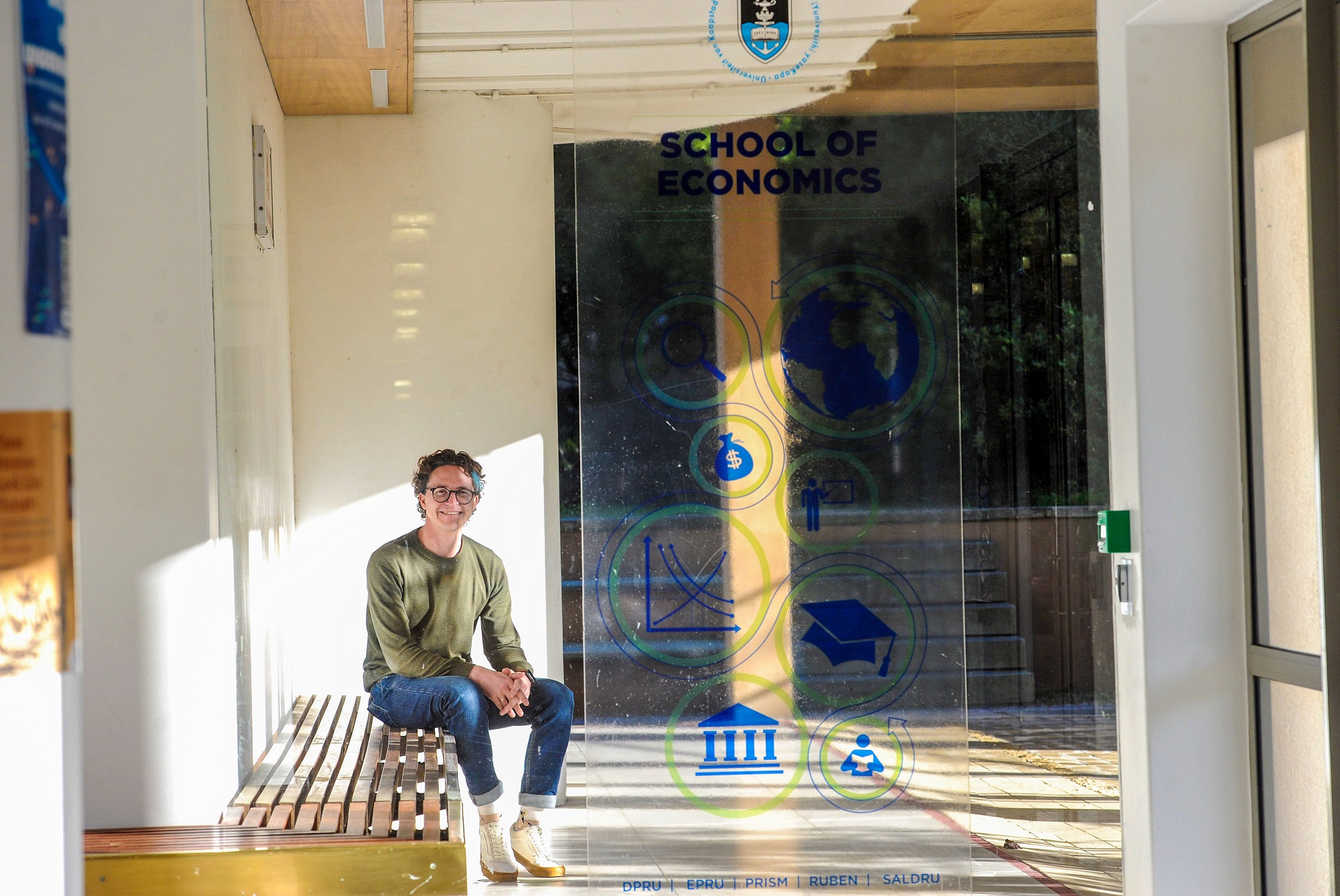
A University of Cape Town (UCT) researcher has secured a prestigious international grant to explore the potential of artificial intelligence (AI) in enhancing employment prospects for unemployed youth in South Africa, bringing local concerns into a global dialogue about the future of work.
Dr. Tim Köhler, a senior research officer at UCT’s Development Policy Research Unit (DPRU), is among 19 early-career researchers worldwide to receive funding from Schmidt Sciences’ AI at Work program, which is allocating over US$3 million (approximately R48 million) for studies on generative AI’s impact on labor markets. Köhler’s project is uniquely positioned as the only South African-led study within this international cohort.
The initiative aims to provide rigorous evidence on how a generative AI-driven career guidance tool affects job-search outcomes for unemployed youth within a developing-country context. Youth unemployment in South Africa poses a significant socio-economic challenge, with Statistics South Africa reporting that approximately 60% of individuals aged 15 to 24 and 40% of those aged 25 to 34 are unemployed—figures that rank among the highest globally, impacting nearly five million young people. This ongoing exclusion from the labor market exacerbates inequalities and poverty, hindering skills development, confidence, and long-term opportunities.
“Various factors contribute to these high unemployment rates, but severe information constraints particularly hinder young job seekers,” Köhler stated. “They may lack knowledge of viable career paths, the skills employers require, or how to navigate both formal and informal job markets.” This situation underscores South Africa’s critical role in understanding AI’s potential impact on environments characterized by structural unemployment and scarce opportunities.
Köhler articulated the broader implications of the research: “If AI can assist young people in navigating these complexities, the insights gained are likely to resonate with many other countries across the continent and the Global South.”
A global programme with local relevance
The AI at Work program, managed by the non-profit Schmidt Sciences based in the United States, focuses on examining how AI influences worker productivity, wages, and career trajectories. Researchers were chosen from a pool of over 300 applicants, representing institutions from eight different countries. Schmidt Sciences aims to generate credible, real-world evidence as AI rapidly integrates into workplaces, often outpacing the development of corresponding policy and regulation.
Nobel laureate economist Daron Acemoglu, who reviewed proposals for the program, emphasized the uncertainty surrounding AI’s transformative effects. “The labour market is particularly vulnerable,” he noted in a press release from Schmidt Sciences.
Dr. Köhler’s selection highlights UCT’s status as a globally recognized institution for research on inequality and labor markets. “This award positions UCT—and South Africa more broadly—at the forefront of an emerging global conversation about AI and work,” he remarked, adding that existing discussions have primarily reflected evidence from high-income countries.
The study will evaluate an AI-based career guidance tool developed specifically for unemployed youth and co-designed with a local tech firm. The tool’s design is informed by collaboration with NGOs, researchers, and government stakeholders engaged in youth employment initiatives. Functioning in low-bandwidth settings and powered by large language models, the tool will serve as a personalized, interactive assistant accessible via mobile phones or computers.
“Through a simple conversational interface, users can receive guidance tailored to their circumstances,” Köhler explained. “This might involve identifying realistic job opportunities, enhancing a CV, preparing for interviews, or considering training and self-employment options when formal jobs are scarce.” The focus is on not just providing more information but delivering better-quality, relevant information.
Köhler highlighted the common issue of generic advice often failing to account for local labor market conditions or individual needs. “We aim to determine whether more personalized and dynamic guidance can improve decision-making and, ultimately, well-being,” he said.
What sets this project apart is its methodology: a randomized controlled trial (RCT), considered the gold standard for evaluating causal relationships in research. By randomly assigning access to the AI tool, the study will isolate its effects on employment outcomes, job search behavior, confidence, and expectations.
“While there’s considerable enthusiasm for AI, there is still a lack of rigorous evidence, particularly in developing nations,” Köhler remarked. “This approach enables us to move beyond assumptions and assess what genuinely works, who benefits, and why.” The research will also scrutinize potential unintended consequences, such as reinforcing existing inequalities or raising expectations without improving access to real opportunities.
Given South Africa’s youth face a labor market shaped by spatial inequality, skills mismatches, and limited entry-level job prospects, Köhler cautioned against viewing AI as a standalone solution. “Our expectation is not that AI is a silver bullet for unemployment,” he clarified. “However, if well designed, it may alleviate specific constraints young people encounter while navigating the labor market.”
If effective, the tool could suggest scalable, low-cost methods to support young job seekers, complementing existing labor market policies such as public employment initiatives, training, and job-readiness programs. “For policymakers, the findings can inform whether and how digital tools should integrate into broader youth employment strategies,” Köhler said. “For educators and training providers, the results might underscore the importance of personalized guidance.”
This project aligns closely with UCT’s commitment to socially responsive, evidence-based research aimed at fostering development in South Africa and beyond. “Youth unemployment is one of the country’s most pressing development challenges,” Köhler concluded. “Identifying interventions that can effectively alleviate it is crucial for creating inclusive and effective policy.” The overarching goal remains to support grounded and responsible approaches to leveraging technology as part of a broader effort to enhance opportunities for young people and mitigate poverty and inequality.
See also MIT Develops AI System to Analyze Figure Skating Jumps, Enhancing Performance Metrics
 Harvard Study Reveals Employees Work Harder with AI, Risking Burnout and Fatigue
 ByteDance Launches Seedance 2.0, Revolutionizing AI Video Creation with Multimodal Inputs
 Baylor College Unveils AI Model Achieving 100% Sensitivity in Detecting Placenta Accreta Spectrum