






















































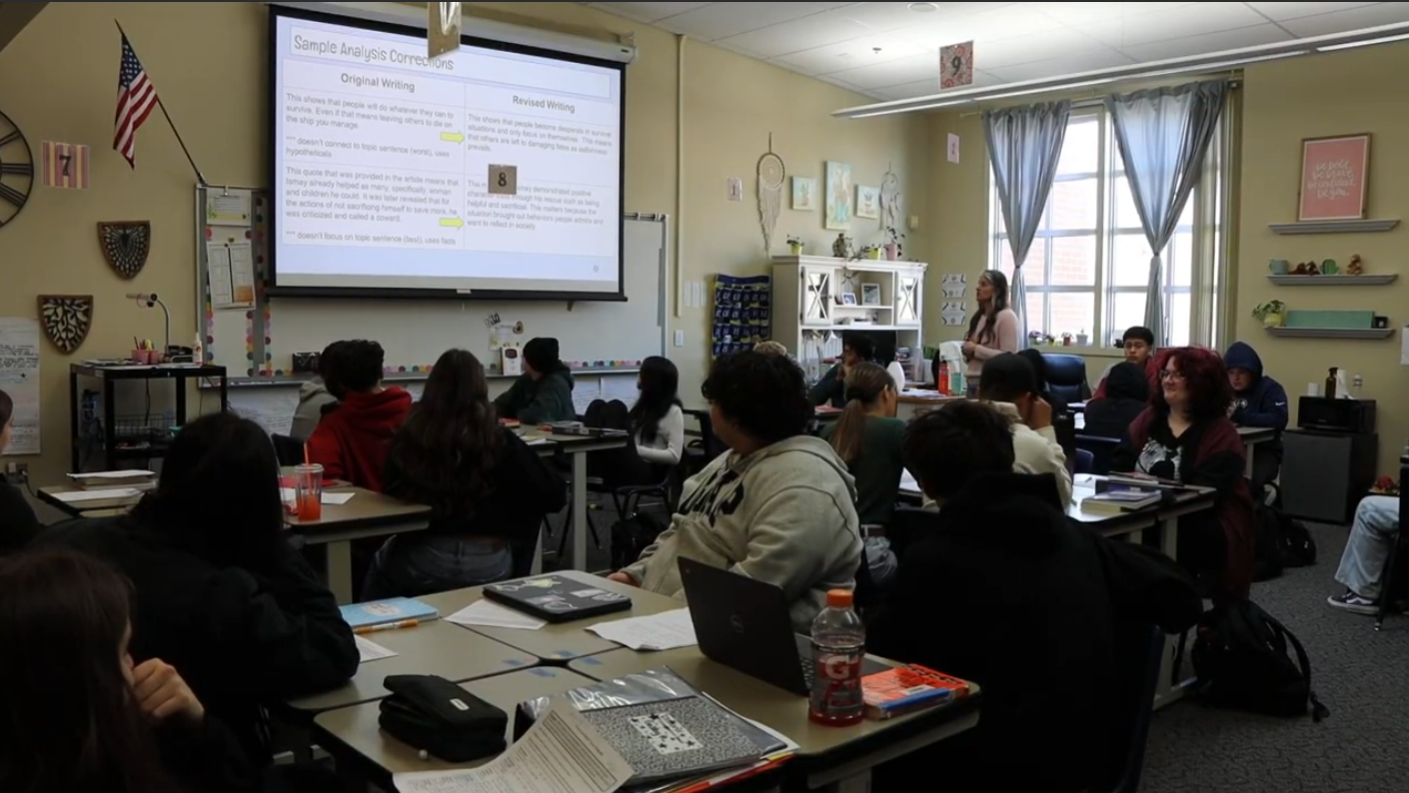
Students at Roseville High School may soon experience stricter regulations regarding the use of artificial intelligence (AI) in their English classes. The English department is currently drafting a policy aimed at addressing concerns that AI tools could undermine students’ ability to think critically and write independently. According to English department head, Handling, the proposed policy will adopt a zero-tolerance stance on the use of AI to produce original content. “If students use AI to create original content, or they claim it’s their content, they’ll receive a zero for it,” Handling stated.
A significant component of the policy involves logging any misuse of AI as a pre-referral in the school’s Aeries system. This approach is intended to track instances of AI use across various classes, allowing educators to address habitual misuse. “We have some students who have used AI in numerous classes. As long as we’re documenting it along the way, we can be more proactive in changing that behavior,” Handling added.
While the policy is still in draft form, students have begun to express their thoughts on its potential implications. Junior Nathan Marquez believes that an immediate zero for first-time offenders is excessive. “I think the first time being zero tolerance is kind of unfair to the student. I think that you should be given a chance. In the future, then I’d say it’s more okay to kind of punish the student,” he commented.
Conversely, junior Zacharie Abingosa argues that the policy is justified, noting that many peers utilize AI for their assignments. “Yeah, it’s fair because I know a bunch of kids who do use AI to complete their assignments. So, I think it’s pretty fair,” he said. Fellow junior Lucas Chen acknowledged that there may be initial confusion leading to zeros for some students, but he believes the policy will ultimately encourage more authentic writing practices. “I think at first people might get zeros because maybe they don’t know about the policy or they just choose not to follow it, but I think eventually it will even out,” he stated.
Abingosa further suggested that teachers should clearly communicate the new policy in their syllabi. “I feel like teachers should put that on their syllabus that if you use AI, you get an automatic zero,” he remarked. Chen also noted that the policy might lead teachers to adopt a more relaxed approach, assuming students will refrain from using AI. “I think teachers will have to be less strict on their students and be more laidback because they expect their students not to use AI because of the policies that are in place,” he added.
Handling emphasized that the intention behind the proposed policy is to prepare students for future academic challenges. “In college, if you use AI and you’re caught, you will automatically fail the class. It’s not an F for the assignment; you will lose credit for the entire course. So the theory here is that we are setting you up for success by teaching you early on that it’s a zero-tolerance policy,” she explained.
As educational institutions grapple with the implications of AI on learning, policies like the one being considered at Roseville High School highlight the ongoing debate about technology’s role in education. The English department’s initiative reflects a growing concern that reliance on AI could hinder students’ development of critical skills essential for their academic and professional futures.
See also New York Governor Hochul Launches Office to Oversee AI Regulation and Digital Safety
 BECU Unveils Agentic AI Tools to Enhance Financial Guidance for All Members
 Mrinank Sharma Resigns from Anthropic, Warns of AI-Induced Global Peril Ahead of Summit
 AI-Enabled Arbitration Revolutionizes Dispute Resolution Amid Legal Challenges















