






















































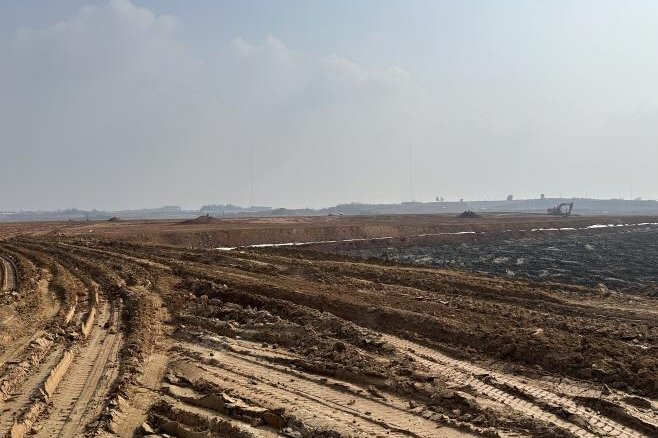
Construction is currently underway for the National AI Computing Center in the Solarisdo development located in Haenam County, South Jeolla Province. This initiative is part of a broader government-backed project aimed at creating a new corporate city, also named Solarisdo, set to support the growth and implementation of artificial intelligence technologies.
The site, situated in Sani-myeon, was once an area where tidal flats met the sea. Over the past two decades, construction vehicles have transformed the landscape, carving deep tracks into the reclaimed land. The National AI Computing Center, marked by a sign identifying it as a “Data Center,” is projected to commence operations in 2029.
Solarisdo will encompass a vast area of 6.32 million pyeong—approximately 20.8 million square meters—designed as a self-sufficient urban environment capable of housing over 60,000 residents. The name Solarisdo integrates “solar,” “sea,” and “do,” the Korean term for province, reflecting its commitment to renewable energy, waterfront development, and smart city infrastructure.
The center is intended to function as a high-performance computing hub under a public-private partnership, aimed at bolstering artificial intelligence research and development. While no official groundbreaking date has been announced, officials indicated that the center’s operational launch is set for 2029.
Anticipated to have a capacity of 40 megawatts, the facility will require approximately 2.4 million liters of water daily for cooling purposes. Jeollanam-do Province is also looking to attract over 20 additional data centers to the area, which could increase total daily water consumption to as much as 60 million liters—equivalent to the water usage of more than 200,000 people.
Provincial officials maintain that there are adequate water resources to support this demand, citing the nearby Yeongam Lake, Geumho Lake, and the Yeongsan River. The average daily availability of freshwater in the region is reported to reach around 1 billion liters. To meet the expected electricity demand, a solar power plant and new substations are planned within the Solarisdo project.
However, local civic groups have raised concerns that the establishment of large-scale data centers may exacerbate regional inequality and stress local resources. An official from the Gwangju Environmental Movement Coalition noted that previous large industrial projects tended to prioritize national interests over local needs, referencing the semiconductor complex in Yongin. The coalition questions whether the data center will provide substantial long-term employment and warns of increased pressure on water and electricity supplies.
In response to these concerns, Jeollanam-do officials highlighted that the AI center is projected to create around 100 research and development jobs, particularly benefiting graduates from local universities. They have also indicated that the project could attract startups and related businesses, contributing to a more diversified regional economy. To encourage further investment, additional government support, including lower utility fees and rental assistance, may be required.
The progression of the National AI Computing Center is emblematic of South Korea’s broader ambitions in the field of artificial intelligence, underscoring the nation’s commitment to becoming a global leader in AI technology. As construction advances, the project not only aims to enhance technological capabilities but also faces mounting pressures to balance local resource management with ambitious developmental goals.
See also Massachusetts Launches OpenAI-Powered ChatGPT Assistant for 40,000 State Employees
 Government Mandates AI-Generated Content Labelling, Reduces Takedown Times to 2-3 Hours
 Lorong AI Launches Singapore’s New AI Park to Foster Collaboration Among 4,000 Innovators
 Andhra Pradesh Partners with Gates Foundation for AI-Driven Healthcare Reforms
 UAE Unveils World’s First AI-Native Government with $3.5B Investment for Transformation






