






















































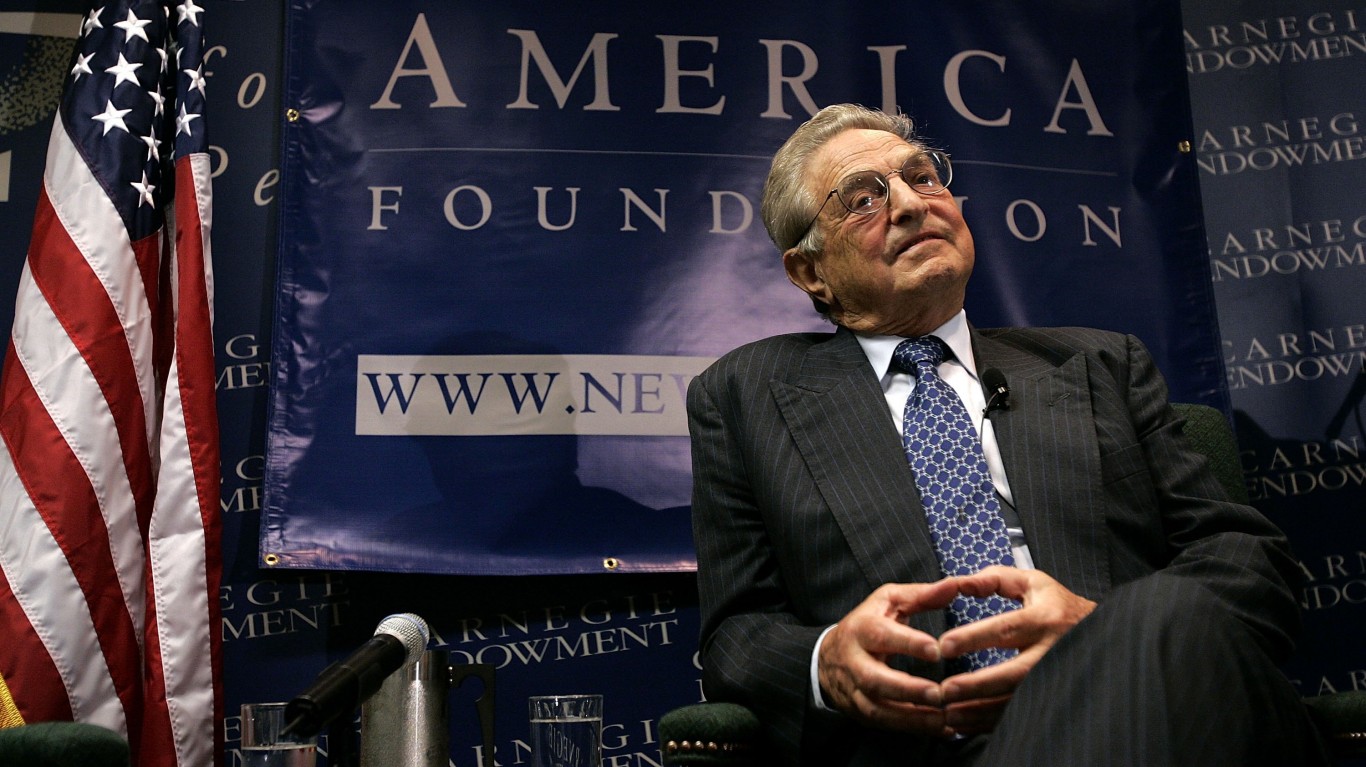
Billionaire George Soros, known for his controversial investment strategies, has made headlines again with recent moves in the stock market. Soros, who famously shorted the British pound in 1992 and earned $1 billion during the Bank of England’s Black Wednesday, continues to wield influence through his Soros Fund Management. The fund recently disclosed its fourth-quarter 13F filings with the SEC, revealing investments in a mix of stocks, including significant positions in the artificial intelligence (AI) sector, specifically with Broadcom (NASDAQ:AVGO) and Tesla (NASDAQ:TSLA), totaling approximately $69 million.
These investments signal a bet on the recovery of AI-driven companies amid broader market declines, prompting an exploration of what may have attracted Soros to these particular stocks. Soros Fund Management acquired 102,379 shares of Broadcom, valued at about $35.4 million, with an average purchase price near $345 per share. Despite Broadcom’s recent closing price of around $325, reflecting a 5.7% drop, the company is navigating significant challenges this year, including uncertainties regarding U.S. export licenses for high-end AI chips to China. Delays in orders from Chinese customers, combined with geopolitical tensions and concerns over profit margins, have affected investor sentiment.
However, Soros may recognize the potential in Broadcom’s strong foothold in the AI semiconductor market. The company’s AI chip revenue surged to $6.5 billion in Q4, marking a 74% increase year-over-year, and management expects this to reach $8.2 billion in Q1, indicating 100% growth. This growth is driven by demand for custom AI accelerators from major clients like Alphabet (NASDAQ:GOOG)(NASDAQ:GOOGL) and Meta Platforms (NASDAQ:META), which are looking to lessen their dependence on Nvidia (NASDAQ:NVDA).
Broadcom’s dominance in the silicon market for high-speed switching, as well as custom accelerators, is bolstered by its technological leadership and scale. Analysts predict that AI semiconductor sales will double as a part of Broadcom’s revenue by 2026, potentially comprising over half of total sales by year-end. Overall revenue is projected to grow by 52% in fiscal 2026, reaching around $94 billion, fueled by AI and infrastructure software from the acquisition of VMware. With hyperscale clients, including Google, planning to increase capital expenditures for AI infrastructure significantly, Broadcom’s pipeline of custom chips may position the company favorably for sustained growth.
In tandem with the investment in Broadcom, Soros also acquired 56,661 shares of Tesla, valued at about $25.5 million, with an average price of $450 per share. Tesla’s stock has since declined roughly 7%, trading around $417 per share. The drop is attributable to a sharp decrease in sales across Europe, with new registrations plummeting over 40% in key markets such as France, the Netherlands, and Norway due to diminished incentives and increasing competition from both Chinese manufacturers like BYD and legacy automakers like Volkswagen.
Recent quarters have seen Tesla’s overall revenue dip by 2.9% year-over-year, coinciding with decreasing vehicle deliveries and rising capital demands for AI and robotics initiatives, estimated to range between $30 billion and $70 billion. The company’s leadership transitions and broader market sell-offs linked to geopolitical issues have amplified the pressures on its stock value.
Despite these challenges, Soros may be betting on Tesla’s evolution into a leader in AI and robotics, which could drive its stock higher. The electric vehicle maker is making substantial investments in AI programs, including the development of unsupervised Full Self-Driving (FSD) software, the Cybercab robotaxi, and the Optimus humanoid robot. This year’s capital expenditures are expected to exceed those planned for 2025, as the company ramps up its AI initiatives.
Tesla’s strategy involves utilizing end-to-end neural networks for vehicle and robot autonomy, aiming for significant advancements in AI capabilities. With production of the Optimus robot set to increase, targets of 50,000 to 100,000 units by 2026 have been established, alongside a new facility at Giga Texas. Elon Musk has projected that these developments could account for 80% of Tesla’s long-term value.
Recurring revenue from FSD subscriptions and ongoing robotaxi deployments in cities like Austin and the Bay Area signify a shift in Tesla’s valuation focus from electric vehicles to software. A recent $2 billion investment in xAI, which merged with SpaceX, further supports potential collaborations, with Musk’s 2026 deadline for AI breakthroughs underscoring the company’s ambitious objectives in this field. Analysts are now forecasting Tesla’s net income to reach around $6.1 billion by 2026, as the company’s pivot towards AI could counterbalance weaknesses in its auto division, with some analysts even speculating about a $5 trillion market cap if its robotics ventures succeed.
See also Nvidia CEO Jensen Huang Cancels India Summit Visit Amid Global AI Competition
 OpenAI’s Sherwin Wu Predicts AI Will Spark Golden Age for Small Startups
 Intel Acquires AI Startup SambaNova, Unveils Z Angle Memory Prototype for Data Centers
 Nvidia, Broadcom, and TSMC Lead 5 Best AI Stocks to Buy This February
 Psychoanalysis Surges Amid Authoritarianism: Freud’s Insights Resonate with Modern Crisis















