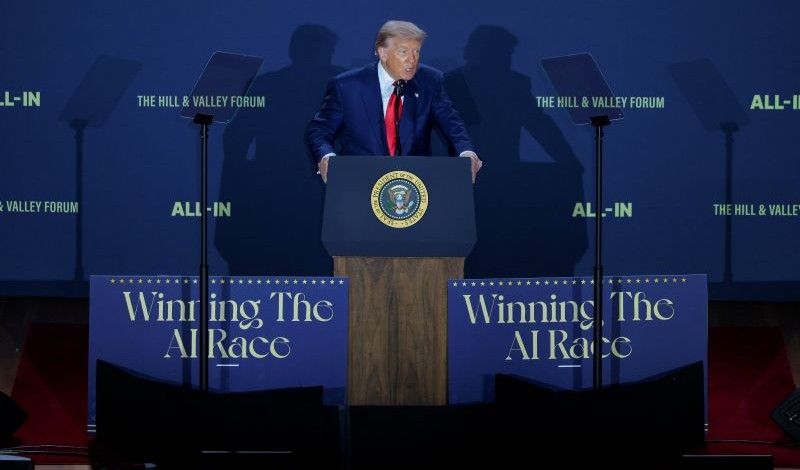
A recent executive order by the Trump Administration seeks to limit state regulations on artificial intelligence (AI). Signed in December 2025, this order aims to streamline the regulatory landscape for AI as it becomes increasingly woven into daily life. By discouraging states from adopting or enforcing conflicting AI regulations, the administration is positioning itself to foster innovation in the sector.
The executive order, titled Ensuring a National Policy Framework for Artificial Intelligence, establishes a litigation task force and directs federal agencies to review both state and federal laws that may hinder AI development. Notably, it authorizes the withholding of federal funds from states that do not comply with the new policies. The intention is to ensure that U.S. AI companies can innovate without facing “cumbersome regulations,” while also preventing states from imposing regulations that extend beyond their borders.
To facilitate these goals, the AI task force will challenge state laws that it deems unconstitutional or conflicting with federal statutes. In a significant move, the U.S. Secretary of Commerce is tasked with reviewing existing state AI laws, and any potentially unlawful provisions will be referred to the task force for action. This could include the withdrawal of funds from the Broadband Equity, Access, and Deployment Program, a federal grant initiative aimed at enhancing state infrastructure.
In addition to these measures, federal agencies are assigned new responsibilities. The Federal Communications Commission is expected to consider adopting a national reporting and disclosure standard for AI models, which would override conflicting state requirements. The chairman of the Federal Trade Commission must also clarify how the Federal Trade Commission Act might apply to AI models.
The order further seeks to prevent states from implementing what the administration terms “ideological bias” within AI models. Citing a new Colorado law that bans “algorithmic discrimination,” the order asserts such laws may produce “false results” to avert disparate impacts on protected demographic groups. The Colorado law, effective since February 1, 2026, is notable for being the first in the nation to legislate against algorithmic discrimination, specifically addressing bias in AI systems that influence critical areas like hiring, education, and banking.
Moreover, the executive order directs presidential advisors to prepare legislative recommendations aimed at establishing a uniform federal framework for AI regulations. This framework would preempt conflicting state laws, although some narrow exceptions are included, such as regulations concerning child safety and state government AI use.
However, the order faces a complex political landscape in Congress. Significant opposition emerged last year when a proposed federal ban on state AI regulations divided Republicans. Key lawmakers from both parties, including U.S. Representatives Chip Roy (R-Tex.) and Thomas Massie (R-Ky.), as well as U.S. Senators Ed Markey (D-Mass.) and Elizabeth Warren (D-Mass.), have voiced concerns about the implications of a federal ban.
State officials have echoed these sentiments, with over 280 lawmakers from both parties signing a letter urging Congress to reject any legislation prohibiting state AI regulations. A bipartisan coalition of 36 state attorneys general has made similar appeals. “I agree on not overregulating,” stated South Carolina State Representative Brandon Guffey (R-York), “but I don’t believe the federal government has the right to take away my right to protect my constituents if there’s an issue with AI.”
Critics have also raised questions regarding the legality of the executive order. While the President’s AI advisor, David Sacks, suggested that the federal government has the authority to override state AI laws in the interest of regulating interstate commerce, some legal experts disagree. John Bergmayer, legal director of the nonprofit Public Knowledge, pointed to the 2023 Supreme Court ruling in National Pork Producers Council v. Ross, which concluded that California’s law restricting pork sales did not improperly regulate interstate commerce.
As the debate intensifies, opponents of the executive order are expected to file lawsuits challenging its legitimacy. Colorado Attorney General Phil Weiser confirmed that the state plans to contest the order in court, while California State Senator Scott Wiener (D-San Francisco), author of California’s recent AI safety bill, vowed to take similar action. “If the Trump Administration tries to enforce this ridiculous order, we will see them in court,” Wiener declared.
The outcome of this legal and legislative battle could significantly shape the future of AI regulation in the United States, balancing innovation against the need for ethical standards and consumer protection.
See also India Advocates Principles-Based AI Governance Model at AI Summit 2026 Over Standalone Law
 EU Proposes AI Omnibus to Streamline Compliance for Businesses Ahead of 2026 Deadlines
 AI Regulation Evolves: Guardian Agents and Constitutional AI Tackle Governance Gaps
 New Westminster Council Proposes Citywide AI Policy Following Resident Concerns