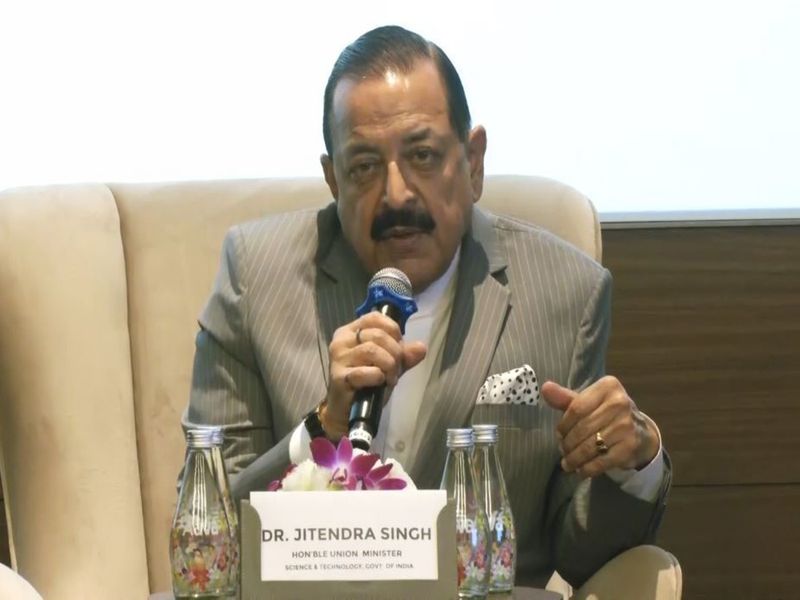
Mumbai (Maharashtra) [India], November 25 (ANI): During a visit to IIT Bombay, Union Minister of State (Independent Charge) for Science & Technology Dr. Jitendra Singh lauded “BharatGen” as India’s inaugural sovereign multilingual and multimodal AI-driven Large Language Model. The Minister engaged with the core team behind BharatGen and reviewed the project’s progress, receiving an extensive presentation on its development.
Ganesh Ramakrishnan, Professor-in-Charge of BharatGen, elaborated on the model’s functionality, objectives, and its significance as a national AI asset. BharatGen is designed to reflect India’s linguistic, cultural, and social diversity, supporting over twenty-two Indian languages and integrating three major modalities—text, speech, and document vision—to understand, generate, and interpret information as Indian citizens naturally communicate.
The initiative aims to foster an inclusive digital future, ensuring representation of every Indian language and dialect in the country’s AI capabilities. This project aligns with the broader national vision articulated by Prime Minister Narendra Modi, emphasizing the importance of developing technology rooted in India’s strengths and addressing its unique needs while contributing to the global landscape.
In a question-and-answer session, Singh remarked on the importance of initiating projects with government support before transitioning to private sector involvement. He noted, “Most of the successful countries don’t even have time and energy to run the government offices. So if we have to be a global player, we have to follow global strategies.” He highlighted that the private sector was previously unprepared for such initiatives, including the recent openings in the nuclear and space sectors.
The presentation emphasized that BharatGen is supported under the National Mission on Interdisciplinary Cyber-Physical Systems (NM-ICPS) of the Department of Science and Technology, with a significant investment of Rs 235 crore through the Technology Innovation Hub at IIT Bombay. A key component of this initiative is Bharat Data Sagar, which aims to establish complete ownership and control over India’s digital knowledge resources.
The Bharat Data Sagar initiative involves extensive data collection from various stakeholders, ensuring that the datasets reflect India’s realities, cultural nuances, and regional diversity. This approach aims to guarantee accurate AI performance while reinforcing India’s long-term digital sovereignty.
Singh reviewed the BharatGen models that have been released, including Param-1, a foundational text model with 2.9 billion parameters trained on 7.5 trillion tokens. Notably, over one-third of the training data consists of Indian content. BharatGen has also developed speech models, such as Shrutam, a 30-million-parameter Automatic Speech Recognition system, and Sooktam, a 150-million-parameter Text-to-Speech model available in nine Indic languages. Furthermore, the project features Patram, India’s first document-vision model with seven billion parameters, designed to interpret complex documents in Indian formats.
Singh expressed appreciation for these developments, emphasizing that they collectively create a comprehensive AI stack for India, capable of supporting various sectors, including governance, industry, education, agriculture, and healthcare. During the interaction, proof-of-concept applications, such as Krishi Sathi—a voice-enabled WhatsApp advisory tool for farmers—were demonstrated. Other applications included e-VikrAI, which generates product descriptions from images for small sellers, and Docbodh, a document Q&A platform powered by Patram.
The Minister acknowledged that these applications exemplify how AI can enhance everyday life and improve access to public services. The BharatGen team informed Singh of ongoing partnerships with industry leaders like IBM, Zoho, and NASSCOM, as well as various ministries, including the Ministry of Water and Sanitation, and state governments such as Maharashtra. These collaborations are pivotal in aligning India’s domain expertise with local datasets to tackle sector-specific challenges.
This comprehensive approach reflects India’s commitment to building collaborative, transparent, and nationally owned technology, resonating with the Prime Minister’s call for “Technology for People, Technology by People, and Technology of People.” BharatGen has recently secured an additional Rs 1,058 crore from MeitY under the India AI Mission, amplifying its vision as a nationwide effort to establish India’s sovereign AI stack.
Singh remarked that such missions underline India’s readiness to spearhead the next wave of digital transformation, reinforcing the country’s potential in sectors such as AI, quantum computing, space, and cyber-physical systems. He characterized BharatGen as a pivotal step in India’s journey toward technological self-reliance and a national effort to ensure the future of AI resonates with the aspirations of 1.4 billion Indians.
He concluded by encouraging the BharatGen team to continue developing models that are globally benchmarked yet uniquely Indian, scalable yet accessible, and advanced yet user-friendly. Singh asserted that BharatGen will play a crucial role in shaping India’s digital decade and enabling the country to make meaningful contributions to the global AI landscape.
See also Google Integrates Nano Banana AI Image Generator into App Search for Streamlined Creation
 AI Shopping Surges: 66% of Americans Use ChatGPT for Holiday Purchases in 2025
 Google Launches Nano Banana Pro AI Image Tool Amid Concerns Over Realism
 Ant Group Launches LingGuang AI Assistant, Surpassing 1M Downloads in Days
 BeMyEyes Launches Multi-Agent Framework, Surpassing GPT-4o in Multimodal Reasoning Tasks