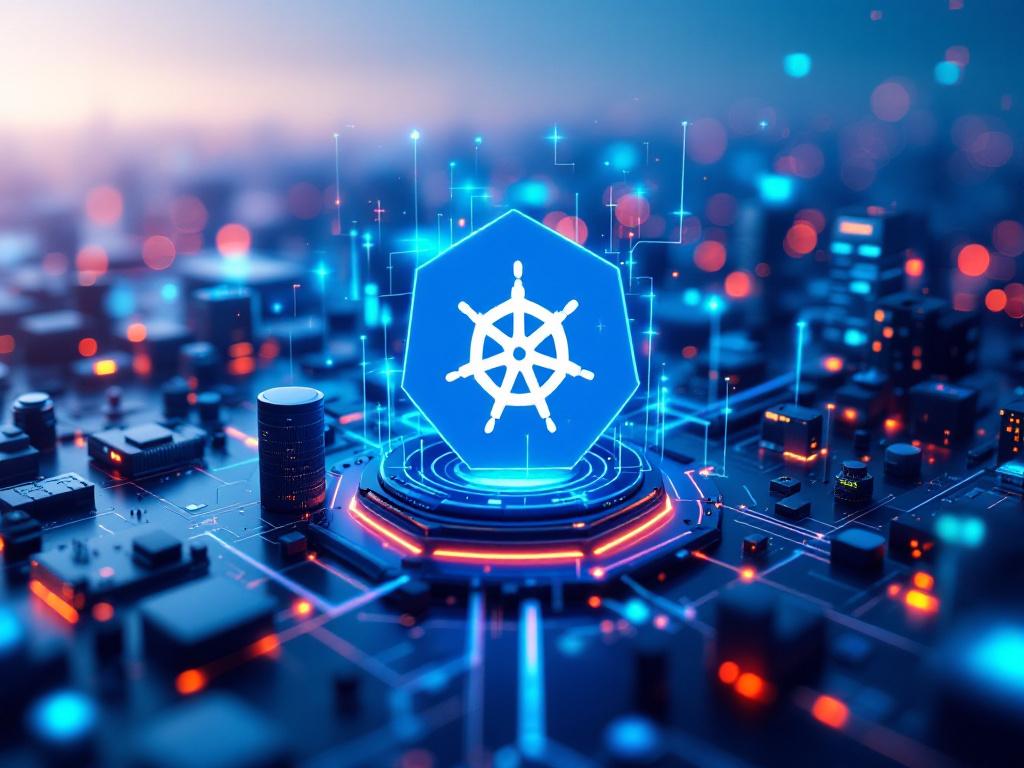
In Silicon Valley, a notable shift is occurring in how companies manage their artificial intelligence (AI) infrastructure, moving from an urgent scramble for Nvidia H100 GPUs to a focus on optimizing existing resources. Kubernetes, long recognized as the operating system of the cloud for containerized microservices, is transforming into a pivotal tool for distributed machine learning, addressing the critical issue of compute utilization. The November Thoughtworks Technology Radar emphasizes that Kubernetes is evolving from merely keeping websites operational to actively managing AI workloads, significantly impacting operational efficiency.
Historically, AI infrastructure has been plagued by inefficiencies, particularly in how traditional container orchestration views GPUs. They have often been treated as singular blocks of compute, analogous to booking an entire hotel for a single guest. This limitation has led companies to over-provision hardware, leaving substantial quantities of costly silicon idle while jobs awaited processing. New advancements in Dynamic Resource Allocation (DRA) and topology-aware scheduling are beginning to alter this paradigm, enabling Kubernetes to function as an active optimizer of AI economics.
The crux of this evolution lies in DRA, which advances Kubernetes beyond basic measurement of CPU cores and memory. As the Thoughtworks report outlines, DRA facilitates a dynamic negotiation between workloads and hardware. Instead of merely requesting a GPU, pods can now ask for specific slices of compute or memory, enabling multiple inference workloads to share a single GPU without the issues that have historically plagued multi-tenancy environments. This granular control is essential for the financial sustainability of deploying Large Language Models (LLMs). For instance, a static inference service needing 12GB of VRAM on an 80GB A100 chip could waste up to 85% of resources. With DRA, Kubernetes can better utilize existing hardware, offering significant financial benefits to enterprises spending extensively on cloud compute.
The challenge of latency in distributed training remains, as model training speed is often limited by the interconnect bandwidth between GPUs. To address this, topology-aware scheduling allows the Kubernetes scheduler to consider the physical layout of server racks, ensuring that pods needing high-bandwidth communication are positioned on the same NUMA (Non-Uniform Memory Access) node or within the same high-speed switch domain. Companies employing this spatial awareness have reported throughput gains of up to 30%, translating into significant reductions in training times for foundational models. This advancement brings Kubernetes closer to the performance benchmarks set by traditional High-Performance Computing (HPC) schedulers like Slurm, known for their efficacy in supercomputing but lacking the flexibility of cloud-native tools.
The Cloud Native Computing Foundation (CNCF) has recognized the maturation of these features and recently announced the introduction of the Certified Kubernetes AI Conformance Program. Launched on November 11, this initiative aims to standardize the definition, deployment, and management of AI workloads within the ecosystem. Similar to certification programs that stabilized the early container market, this new program is designed to provide assurance for vendors and platforms, ensuring that an AI stack built on one cloud remains portable to another.
For industry experts, this signals the end of a chaotic phase in AI infrastructure, where organizations relied on fragile, bespoke scripts and proprietary vendor tools to manage their ML pipelines. The CNCF’s move indicates a readiness to treat AI orchestration as a reliable, standardized utility, thus reducing the risks of vendor lock-in—a significant concern for Chief Information Officers apprehensive about tying their AI strategies to a single cloud provider’s offerings.
Early adopters of these new Kubernetes capabilities are experiencing compelling operational metrics. By leveraging tools like Kueue, a Kubernetes-native job queuing system, teams can prioritize critical batch workloads while efficiently managing resource allocation based on business needs. This elasticity mirrors the behavior of internal markets, directing compute power where the highest return on investment is anticipated. Integration of frameworks like Ray and PyTorch into Kubernetes is also enhancing the developer experience, allowing data scientists to engage with familiar interfaces while Kubernetes manages the complexities of fault tolerance and auto-scaling.
However, the sophistication introduced by DRA and topology-aware scheduling comes with a steep learning curve. The Thoughtworks analysis cautions that configuring these features effectively requires a mature platform engineering team. Organizations lacking deep infrastructure talent may find it challenging to optimize these settings, risking resource waste and scheduling deadlocks. To address this gap, a burgeoning industry of “AI Platform” vendors is emerging, offering user-friendly control planes that encapsulate these Kubernetes capabilities, effectively selling efficiency gains as a service. Yet, for major tech firms and serious AI developers, cultivating this expertise in-house remains a strategic imperative.
As Kubernetes increasingly integrates HPC scheduling intelligence, it is effectively rendering many legacy job schedulers obsolete for commercial AI applications. This convergence is reshaping enterprise IT architectures, as highlighted by CNCF executive director Priyanka Sharma, who expressed the goal of making AI workloads “boring”—predictable, scalable, and mundane. Such transparency in infrastructure allows for accelerated innovation, with the new conformance standards simplifying the complexities of GPU interconnections and NUMA nodes for data scientists.
Looking ahead, Kubernetes’ role is set to expand as model architectures grow increasingly sophisticated. As the industry enters the era of mixture-of-experts (MoE) models, where requests must navigate between various subsets of distributed model parameters, the enhancements in network-aware scheduling and dynamic allocation will be vital for scaling these advanced models. Ultimately, the developments outlined in the Thoughtworks radar and CNCF announcements mark a significant step toward the industrialization of AI, shifting from experimental approaches to disciplined, metrics-driven strategies that ensure that every compute operation translates into concrete business value.
See also Nvidia Shares Dip 2.6% as Meta Considers Google’s AI Chips for Data Centers
 CIQ Expands to Gulf Region, Launching AI-Ready Infrastructure Amid Middle East Digital Transformation
 HP Launches OmniBook 5 AI Laptop at Rs. 83,000 for Enhanced Productivity and Performance
 BofA Reaffirms Buy Ratings for Nvidia, AMD, Broadcom as AI Chip Demand Surges
 Federal Judge Flags AI Use in ICE Reports, Citing Accuracy Concerns with ChatGPT