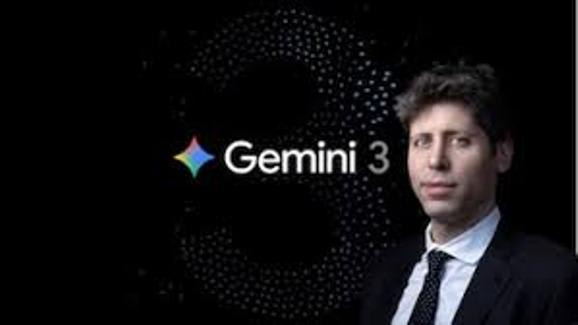
The recent launch of Gemini 3, Google’s most advanced language model, has significantly altered the artificial intelligence landscape, positioning the company as a leader in a sector it has struggled to dominate in recent years. According to The Wall Street Journal, Gemini 3 has outperformed ChatGPT and its competitors in recognized industry benchmarks, solidifying its reputation as the most powerful AI chatbot to date.
This development is not merely technological; it has intensified competitive pressure on rivals like OpenAI. An internal memo reported by CNBC reveals that OpenAI’s CEO, Sam Altman, has cautioned his team about the “complicated environment for a while,” anticipating that Google’s advancements could lead to temporary economic challenges for his company.
Google‘s renewed strength in AI is underscored by its robust financial performance. The company recorded a gross margin of 32%, cash reserves of $112 billion, and free cash flow of $24 billion in the last quarter, according to CNBC. In contrast, OpenAI finds itself grappling with rapid cash burn and the ongoing need to raise funds, a precarious situation given its current lack of profitability.
Analysts suggest that Google’s financial fortitude positions it to weather potential sector slowdowns, while other players could face significant risks amid a possible correction in the AI market. The performance of Gemini 3 in various specialized tests supports these claims; it outperformed competitors in over a dozen assessments measuring logic, technical knowledge, mathematical abilities, and image recognition. Notably, only in a single coding test did Anthropic’s Claude Sonnet 4.5 achieve a higher score.
Tulsee Doshi, senior director of product management for Gemini, emphasized the model’s capability to operate in underrepresented languages on the internet, such as Gujarati, and its exceptional performance in the Vending Benchmark test, which evaluates planning and tool usage over time. “Vending Bench reflects one of the aspects we wanted to transform and enhance with this model, which is the improved use of tools and planning,” Doshi explained.
The launch of Gemini 3 has also driven interest in related products, such as Nano Banana, an image-generating tool contributing to Gemini’s rapid user growth. The Wall Street Journal reports that Gemini’s monthly user base surged to 650 million, up from 450 million in July, though ChatGPT remains the most popular chatbot with 800 million weekly users. Despite this, users and analysts suggest that Gemini 3’s advancements could render it the preferred choice for various tasks.
Google’s strategic restructuring has played a crucial role in its resurgence in AI. CEO Sundar Pichai and senior executives reorganized teams to eliminate silos and centralized model development, while co-founder Sergey Brin has taken a hands-on approach in overseeing AI initiatives. During its annual developers conference in May, Google showcased a new generation of AI products and a revamped search engine featuring AI Mode, which responds in a conversational format, bolstering investor confidence.
The development of Gemini 3 emphasized enhanced analysis and content generation capabilities across multiple formats—text, images, audio, video, and code—while strengthening its reasoning abilities to serve as an effective personal assistant, particularly in programming. Following the launch, results from 20 benchmark tests confirmed that Gemini 3 outperformed both ChatGPT and Anthropic in most categories.
The integration of Gemini 3 into Google’s search engine through AI Mode marked a significant milestone, showcasing the model’s capabilities from day one. Robby Stein, vice president of product for search, noted how AI Mode can simplify complex subjects, such as explaining the lift force of an airplane to a child, enabling interactive simulations. “I was surprised to see that it can really present the information in the best way depending on the question,” Stein remarked.
Google’s advantage extends beyond the quality of its model; it possesses the infrastructure and ecosystem needed to deliver AI to billions of users globally, including those not actively seeking a chatbot. This extensive distribution and integration fortify Google’s position against competitors who lack such a comprehensive user base.
The ongoing shift in the AI landscape is apparent. As Satya Nadella, CEO of Microsoft, expressed ambitions to “make Google dance,” it seems that the music is still playing for Google in Mountain View, with Gemini 3 setting the stage for a fiercely competitive future in artificial intelligence.
For further information, visit Google, OpenAI, and Nvidia.
See also ChatGPT at 3: Transforming Work, Education, and Healthcare for 800M Users Globally
 Getty Images’ Copyright Case Against Stability AI Leaves Key Legal Questions Unresolved
 Boost Employee Engagement: How AI-Driven Benefits Platforms Transform Utilization Rates
 Emirates Partners with OpenAI to Enhance Operations and Customer Experience with AI Integration
 Vertiv Unveils AI-Ready Data Center Solutions for Africa’s 50kW Rack Demands