TORONTO — A recent survey from KPMG in Canada reveals that generative AI adoption among Canadian employees has increased to 51 percent in 2025, up from 46 percent the previous year. Despite this growth, the pace of adoption has decelerated compared to the more rapid advancements seen in 2024. As organizations seek to integrate AI technologies into their daily operations, employees are calling for enhanced training and clearer policies to facilitate this transition.
The findings, published on November 27, indicate that while employees are increasingly using AI in their personal lives, they are now urging employers to catch up with their needs. “Employees were using AI in their personal lives and were often ahead of their companies to begin with, but now, employers are catching up and need to engage their workforce more broadly to drive adoption,” said Megan Jones, a partner in the People and Change practice at KPMG.
According to the survey, 83 percent of employees acknowledge the necessity of improving their AI literacy, expressing a desire for training to effectively leverage generative AI tools. Alarmingly, nearly half of the respondents are apprehensive about job loss due to their inability to keep pace with AI advancements. However, only 48 percent believe that the training provided by their employers has been beneficial.
Key insights from the survey highlight that 73 percent of employees use generative AI tools on a daily basis or several times a week, an increase from 64 percent in 2024. Despite this, challenges persist, with 36 percent indicating they received training but have not implemented AI tools due to feeling overwhelmed. Similarly, 37 percent reported that they had begun using AI tools but stopped, citing similar concerns.
Concerns regarding the accuracy and reliability of generative AI persist, with 58 percent of respondents expressing significant worry about potential hallucinations or inaccuracies in AI responses. Notably, 46 percent stated that these concerns deter them from utilizing generative AI tools in their work.
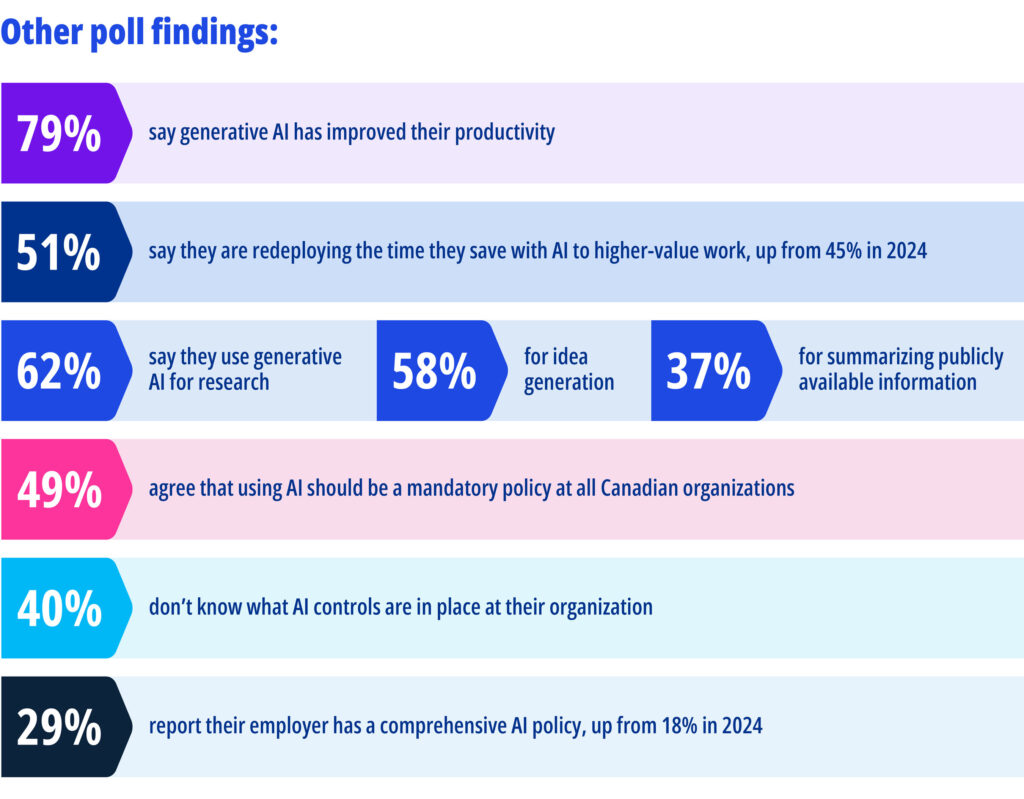
Despite these challenges, nearly eight in ten respondents believe that generative AI tools have enhanced their productivity. More than half of the employees surveyed reported using saved time to focus on higher-value tasks. The majority, at 62 percent, utilize AI tools for research purposes, while 58 percent employ them for idea generation. Around 37 percent use these tools to summarize public information.
“AI success isn’t about being the most tech-savvy; it’s about being the most adaptable,” remarked Davin Gnanapragasam, Chief Technology Officer and Tax Partner at KPMG in Canada. He emphasized that training should empower employees to strategically apply AI in their daily tasks, allowing them to devote more time to value-added work rather than relying on a one-size-fits-all approach.
The findings from KPMG’s generative AI adoption index underscore a critical juncture in the workplace as businesses strive to harness the full potential of AI technologies. As employees become increasingly aware of the necessity to adapt, organizations must prioritize training and support to foster a culture of innovation and collaboration. The ongoing evolution of AI in the workplace presents both opportunities and challenges, demanding a proactive approach from employers to ensure their workforce is equipped to thrive in a technology-driven environment.
See also UK 2025 Budget Unveils Measures to Boost Innovation and AI Investment for Start-ups
 Nigeria Introduces AI Regulation Bill Requiring Licensing for Developers and Users
 Eastnets Embeds AI for Proactive Compliance, Transforming Financial Innovation at Sibos 2025
 Federal Preemption of State AI Laws Could Yield $600 Billion in Economic Gains
 Global Tech Giants OpenAI, Google, and Microsoft Form AI Safety Alliance to Set Standards