






















































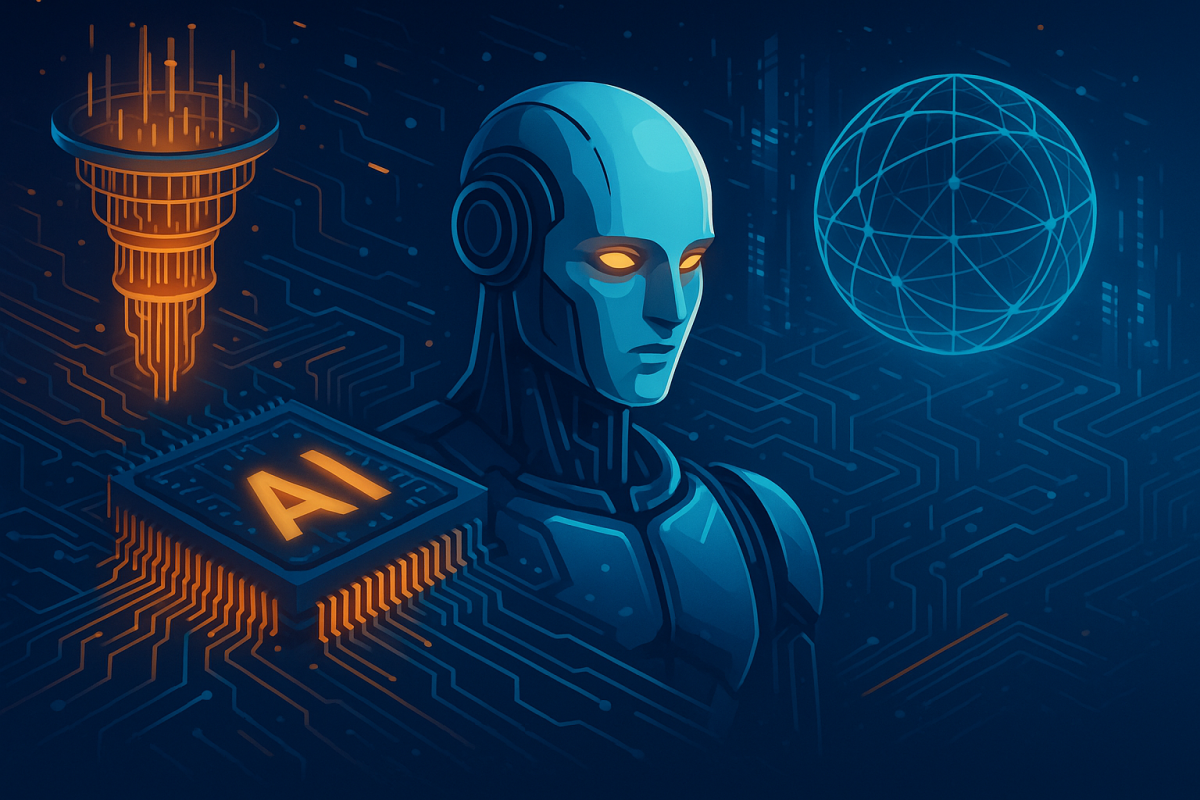
The year 2026 is poised to be a transformative period for technology, marked by a convergence of next-generation computing, hyper-automation, and a pronounced cybersecurity crisis that is set to redefine the global economy. For business leaders, this isn’t just the arrival of the future; it’s the future taking control. Navigating this convergence will be critical for organizational survival and success.
The dawn of agentic AI
One of the most significant developments anticipated for 2026 is the mainstreaming of agentic AI. This evolution extends beyond today’s simple chatbots and generative tools, paving the way for autonomous systems capable of reasoning, planning, and executing complex, multistep tasks with minimal human oversight. For instance, AI agents will not only draft marketing copy but will manage entire campaigns, from budget allocation to performance analysis. In supply chains, they will predict disruptions and autonomously reroute shipments, while in product development, they will design prototypes based on real-time market feedback and generate the necessary software code.
This shift from content creation to action creation reflects a movement from Industry 4.0’s smart factories toward the autonomous factories of Industry 5.0. AI agents will be able to self-diagnose equipment failures, dynamically adjust production lines to avoid bottlenecks, and order replacement parts through blockchain-secured supply chains. However, this level of autonomy introduces the necessity for new governance approaches, requiring clear policy guardrails, full observability into agent actions, and immutable audit trails to ensure accountability.
Web 4.0 foundations
While a fully realized Web 4.0 is not yet upon us, 2026 will see crucial infrastructure being laid for this next-generation web. Defined by the integration of spatial computing, digital twins, and AI at the operating system level, the concept of digital twins will extend far beyond manufacturing to encompass entire cities and critical national infrastructure. AI agents will utilize these real-time virtual models to simulate maintenance cycles, test security patches safely, and predict operational bottlenecks before they manifest in the physical world.
Extended Reality (XR) technologies, like augmented and virtual reality, will serve as the primary interface for personnel interacting with these complex systems. Engineers will have the capability to virtually navigate a machine’s digital twin to diagnose issues prior to physical intervention, enhancing productivity, training effectiveness, and workplace safety. However, for these disparate systems to communicate effectively, interoperability and data standards must be established.
The quantum threat
Although quantum computers capable of breaking current encryption standards are not yet operational, their looming potential casts a significant shadow over cybersecurity. The pressing issue for 2026 is not merely the advent of quantum computing but the widespread panic surrounding its implications. The “harvest now, decrypt later” strategy, where adversaries stockpile encrypted data with the aim of cracking it with future quantum systems, will compel organizations to act.
“Post-quantum cryptography (PQC) will cease to be a theoretical concern and become an immediate compliance and business continuity issue,” states Jayant Jay Dave, Chief Information Security Officer at Check Point Software. As a result, investments in quantum security are expected to exceed five percent of total IT security budgets for major corporations, focusing on achieving cryptographic agility rather than developing quantum computers.
The urgency is palpable: attackers are already accumulating encrypted data, positioning it as a time bomb for future exploitation.
AI–cybersecurity arms race
The rise of agentic AI will also escalate the ongoing conflict between attackers and defenders into an automated arms race. Malicious AI agents may be deployed to execute increasingly sophisticated attacks, including deepfake-powered social engineering that mimics a CEO’s voice for fraudulent activities. In response, security measures are shifting from reactive to predictive approaches, with AI-powered preemptive security becoming standard. Autonomous Security Operations Centers (SOCs) will leverage predictive AI to not only detect breaches in seconds but also to anticipate threats and neutralize them in milliseconds, often before human analysts are even alerted.
Resilience, risk in a hyper-connected era
The landscape of 2026 is underscored by the convergence of AI, quantum risks, and Web 4.0. At the center of this transformation are critical infrastructure resilience and supply chain risk, which emerge as pivotal factors. Critical infrastructure sectors—energy, water, telecommunications, and transportation—are increasingly vulnerable to advanced cyber-physical threats. In 2026, attacks are likely to target operational technology, merging digital breaches with tangible consequences as state-sponsored actors shift focus from data theft to operational disruptions.
To combat these rising threats, critical infrastructure operators are adopting urban digital twins to stress-test systems against cascading failures and simulate crisis scenarios in virtual environments. Additionally, global supply chains are being transformed by agentic AI and regulatory scrutiny, leading to real-time, autonomous risk management. AI agents will continuously monitor external data to anticipate disruptions, facilitating proactive rerouting decisions.
Overall, the convergence of AI, quantum threats, and Web 4.0 mandates that leaders infuse resilience into every operational layer, from the factory floor to the boardroom. Organizations that effectively govern autonomous agents, secure data with post-quantum cryptography, and design systems for continuous resilience will lead in the evolving technological landscape.
See also HUMAIN Launches Qualcomm AI Engineering Center in Riyadh, Boosting 200 MW Data Capacity
 Dell Raises FY26 Revenue Outlook to $111.7B, Driven by $12.3B AI Server Orders
 IREN Partners with Microsoft for $9.7B AI Transformation, Aiming for 140,000 GPUs by 2026
 Nvidia CEO Jensen Huang Predicts Robotics Breakthrough, Boosting AI Crypto Markets
 Big Tech Raises $100 Billion in Debt for AI and Cloud Infrastructure Investments















