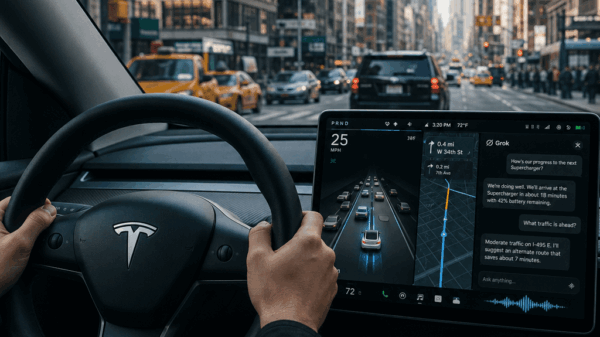
Tesla has recently rolled out its latest version of Full Self-Driving (FSD), labeled v14.2.1. While updates often bring improvements, this version has sparked considerable feedback regarding its new Speed Profiles, suggesting that the adjustments may have gone too far.
The inherent challenge with the iterative nature of FSD updates is the balance between enhancements and setbacks. Users frequently report mixed experiences, with some aspects improving only to see others falter. This latest update has drawn attention primarily for complaints regarding the functionality of its Speed Profiles.
Initial impressions from users highlight a smooth operation on highways, but concerns have arisen about the limitations of the Speed Profiles. One user noted that the “Hurry” setting appears restricted to 10 miles per hour over the limit on highways, and switching from the more aggressive “Mad Max” mode results in a sudden deceleration that some drivers find jarring.
Tesla FSD v14.2.1 first impressions:
✅ Smooth, stress-free highway operation
✅ Speed Profiles are refined — Hurry seems to be limited to 10 MPH over on highways. Switching from Mad Max to Hurry results in an abrupt braking pattern. Nothing of concern but do feel as if Speed…— TESLARATI (@Teslarati) November 29, 2025
The disparity between Speed Profiles has emerged as a significant point of contention. When transitioning from “Hurry” to “Mad Max,” drivers experience a drastic reduction in speed that feels abrupt, potentially compromising comfort and driving experience. Some users express that the speed adjustments do not align well with real-world traffic dynamics.
Feedback suggests that the Speed Profiles appear to be set to predetermined maximum speeds, with “Hurry” capped at 10 MPH over the speed limit. In a 55 MPH zone, for example, the system would only allow a maximum speed of 65 MPH. Meanwhile, the “Standard” setting seems to hover around 4-5 MPH over the limit, which some drivers argue is too constricted for effective navigation in varied traffic situations.
Critics assert that these limiting factors reduce the overall efficacy of FSD. The adaptive nature of driving should ideally correlate with surrounding traffic conditions. For instance, if vehicles are moving at 75 MPH in a 65 MPH zone, FSD should ideally match that pace unless safety dictates otherwise. This is particularly relevant for the “Hurry” profile, which should be more adept at overtaking slower traffic if the situation warrants it. Limiting speed based on strict parameters seems to undercut the system’s potential.
Another user noted the stark differences between neighboring profiles, “Hurry” and “Mad Max.” While “Hurry” restricts itself to a set speed, “Mad Max” adjusts more fluidly to surrounding traffic, which has led some to argue that the latter is too slow. However, others find “Mad Max” suitable, especially in high-speed traffic where maintaining pace is crucial.
The abrupt speed reduction when switching to a slower speed profile is definitely an issue that should be improved upon.
— David Klem (@daklem) November 29, 2025
Many users have echoed concerns about the sudden speed drops encountered when switching profiles. While the reduction is not described as violent, it does create a perceptible shift that impacts the driving experience. This feedback indicates a need for further refinement in how the system manages speed transitions between profiles.
Tesla’s journey with Full Self-Driving technology continues to be a rollercoaster of user experiences and responses. As updates roll out, it remains essential for the company to consider user feedback closely. Balancing functionality with safety will be critical in refining the FSD system, particularly as it moves toward full autonomy.
For users navigating the evolving landscape of autonomous driving, the adjustments in FSD v14.2.1 serve as a reminder of the complexities involved in developing reliable self-driving technology. The discourse surrounding these updates reflects broader concerns about how automation can adapt to the unpredictable nature of human driving behavior and traffic conditions.
See also DeepSeek Achieves Gold at International Maths Olympiad with Self-Verifiable AI Model
 Philips Launches Verida: Transformative AI-Driven Spectral CT Cuts Exam Time by 50%
 Salesforce’s Stock Faces Crucial Test: AI Strategy’s Success at Stake This Week
 OpenAI Celebrates ChatGPT’s 3rd Anniversary as $100B AI Investment Surge Drives Market
 Ooredoo Expands Microsoft 365 Copilot Access, Elevating AI-Driven Productivity Across Workforce