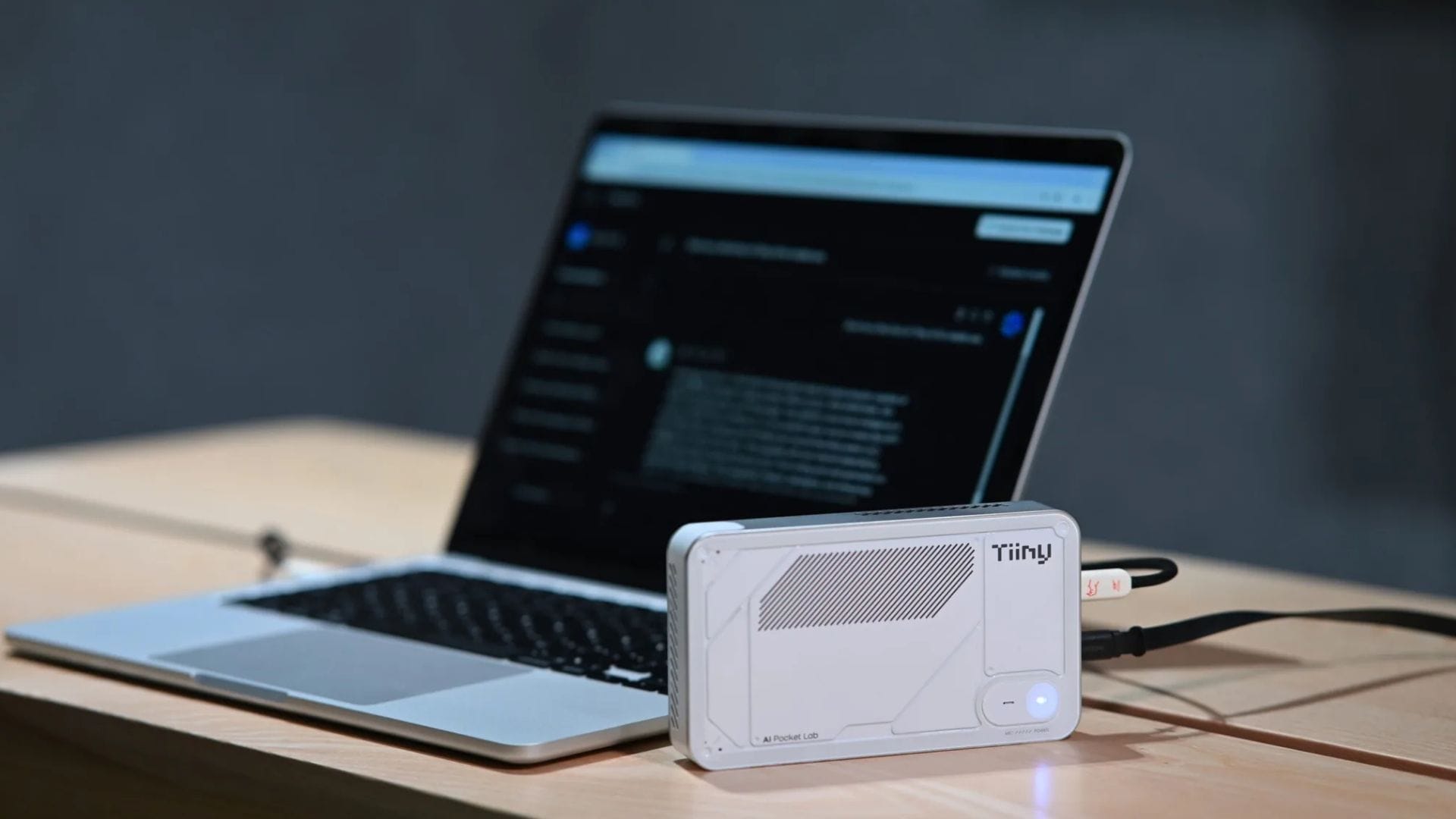
Tiiny AI has unveiled what it claims to be the world’s smallest personal AI supercomputer, a designation confirmed by Guinness World Records. The device, named the Tiiny AI Pocket Lab, is comparable in size to a power bank but is engineered to deliver AI performance typically associated with larger, expensive machines found in data centers or research labs. By condensing this technology into a compact and portable form, Tiiny AI aims to make advanced artificial intelligence more accessible to individual users rather than exclusively to large corporations.
The announcement of the Pocket Lab comes as a response to the high costs of existing compact AI systems. For example, devices like NVIDIA‘s Project Digits and the DGX Spark are priced at around US$3,000 and US$4,000, respectively, which are often prohibitive for hobbyists, students, and smaller teams. Tiiny AI believes there exists a market for a significantly smaller yet potentially more affordable option that retains robust computing power. While the company has yet to disclose pricing information, its messaging indicates a clear focus on broadening access to local AI computing.
In addition to its size, the Pocket Lab is emblematic of a larger transition in AI utilization. The current landscape heavily relies on cloud services, necessitating continuous internet access and raising issues related to cost, latency, and data privacy. Tiiny AI posits that this reliance is among the most significant barriers to wider AI adoption, particularly for users who seek greater control over their data and workflows.
Samar Bhoj, Tiiny AI’s GTM director, articulates the company’s vision by stating, “Intelligence shouldn’t belong to data centres, but to people.” The company asserts that running substantial models locally can diminish dependence on remote servers, reduce the amount of data transmitted off-device, and make AI tools feel more immediate and personal. This concept of personal ownership over AI capabilities is central to the positioning of their new product.
Technical Details
At first glance, the dimensions of the Tiiny AI Pocket Lab may seem incongruous with its ambitious claims. Measuring 14.2 by 8 by 2.53 centimetres and weighing just 300 grams, the device is claimed to be capable of deploying large language models with up to 120 billion parameters. Such models are typically associated with racks of servers or high-end graphics cards, rather than a device that can conveniently fit in a backpack or pocket.
The Pocket Lab is built on a modern ARM v9.2 CPU featuring 12 cores, striking a balance between performance and power efficiency. This modern architecture aims to facilitate the execution of complex AI tasks without excessive energy consumption. Additionally, the system supports various well-known open-source models, including GPT-OSS, Llama, Qwen, DeepSeek, Mistral, and Phi. Such compatibility enhances flexibility for developers and researchers, allowing exploration of different architectures without being confined to a single ecosystem.
A standout feature of the Pocket Lab is its discrete neural processing unit (NPU), which is capable of executing up to 190 trillion operations per second. This specialized hardware is tailored for AI applications, enabling quicker inference than a general-purpose CPU alone. The device also incorporates 80 gigabytes of LPDDR5X memory, a substantial amount for its size, facilitating advanced quantization techniques that enhance the efficiency of running large models on localized hardware.
Tiiny AI contends that this amalgamation of processing capacity and memory empowers users to engage with advanced models without resorting to cloud computing. For developers, this might translate into expedited iteration and testing cycles. Privacy-conscious users could also benefit from minimized risk of sensitive data transmission to external servers, an increasingly significant consideration as AI becomes ingrained in daily tools and workflows.
However, hardware alone does not render the Pocket Lab a miniature supercomputer. Tiiny AI has also crafted proprietary software technologies aimed at improving efficiency and performance. One such innovation is TurboSparse, a neuron-level sparse activation method designed to amplify inference efficiency without compromising model accuracy. By activating only the most pertinent sections of a neural network during computation, TurboSparse seeks to eliminate redundant processing while preserving output quality.
Another critical innovation is PowerInfer, a heterogeneous inference engine that allocates AI workloads between the CPU and NPU. This approach allows each component to excel in its respective tasks, enhancing overall performance while keeping power consumption at a minimum. Tiiny AI emphasizes that this equilibrium is essential for delivering server-level capabilities in a portable device that does not require active cooling or a substantial power supply.
Together, these technologies position the Pocket Lab as suitable for a variety of applications. Researchers may use it to test and refine models locally before large-scale deployment. Robotics developers might integrate it into autonomous systems requiring on-device intelligence without constant internet connectivity. Others could leverage it for advanced reasoning tasks, creative applications, or personal AI assistants that function entirely offline.
While the company presents the Pocket Lab as an exploratory tool rather than a direct substitute for large data center systems, it challenges prevailing assumptions about where powerful AI computing can exist. The notion that a single user can operate a machine capable of running extensive models suggests a significant shift from the cloud-centric paradigm that has dominated recent years. Tiiny AI plans to publicly demonstrate the Pocket Lab at CES 2026, where it is anticipated to garner interest from both industry professionals and enthusiasts alike.
Though details regarding pricing, availability, and precise performance metrics remain undisclosed, the unveiling has already ignited conversations surrounding the future of personal AI hardware. If the device performs as advertised in practical settings, it could herald a move toward more decentralized and user-controlled AI computing, highlighting the increasing interest in making advanced capabilities more accessible to end users.
See also Google Invests $1M in AI Research to Combat Dementia with Tohoku University Partnership
 Top 5 AI Stocks for 2026: AMD, Alphabet, and Broadcom Lead Investment Insights
 Google Unveils Budget Tracker and BATS Framework to Enhance AI Tool Efficiency by 31%
 $400B AI Chip Investment Faces Scrutiny as Lifespan Estimates Shorten to 2-3 Years
 FunkyMEDIA Launches AI-Driven SEO Suite to Enhance Brand Visibility and Performance