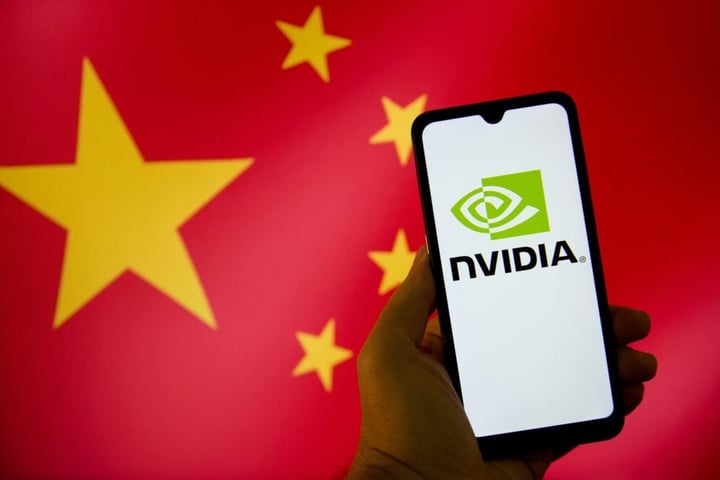
Nvidia Corp. (NASDAQ:NVDA) is contemplating an expansion of its production capacity for H200 artificial intelligence chips following a surge in orders from Chinese clients that has exceeded its current output. The move comes after U.S. President Donald Trump announced on Tuesday that Nvidia would be permitted to export H200 processors to China, contingent on the company paying a 25% tariff on each sale.
Chinese demand for the H200 has prompted Nvidia to lean toward increasing its production capabilities, according to reports by Reuters citing informed sources. Both Alibaba Group Holding Limited (NYSE:BABA) and ByteDance have reportedly reached out to Nvidia this week to place substantial orders. However, it remains uncertain as to when Beijing will approve any H200 imports.
The H200, manufactured by Taiwan Semiconductor Manufacturing Company Ltd. (NYSE:TSM) using its advanced 4nm process, is currently the fastest chip in Nvidia’s Hopper generation. Amid the mounting orders, Chinese officials convened emergency meetings on Wednesday to assess the potential for allowing these shipments.
Despite the promising demand, the Chinese market’s regulatory landscape remains complex. Bank of America Securities analyst Vivek Arya has reiterated Nvidia as his top pick following a recent investor meeting. He noted that Nvidia is a leader in AI computing, holding a significant advantage with current Large Language Models still being trained on Hopper GPUs. Arya anticipates that Nvidia’s upcoming Blackwell architecture is expected to deliver a 10x to 15x performance increase upon its release in early 2026.
Arya emphasized Nvidia’s multi-year demand visibility, projecting at least $500 billion in expected sales for Blackwell, the Vera Rubin platform scheduled for late 2026, and various networking products by 2025–26. He pointed out that partnerships with OpenAI and Anthropic could further enhance Nvidia’s growth prospects, underscoring the company’s extensive platform capabilities that range from central processing units and GPUs to scalable systems and Compute Unified Device Architecture (CUDA) software.
However, uncertainty surrounding Chinese regulations continues to cloud Nvidia’s expansion plans for H200 GPU exports under newly established U.S. rules. The company’s valuation has surged recently, becoming the first to reach the $4.5 trillion mark in October, a significant milestone driven by the robust demand for its GPUs amid the ongoing AI boom.
As Nvidia navigates these complexities, the broader implications for the technology and semiconductor industries are noteworthy. The strong demand for AI chips illustrates a significant shift in market dynamics, where companies are racing to secure the most advanced technologies. With potential regulatory hurdles still looming, how Nvidia adapts to the evolving landscape could set the tone for the industry moving forward.
In summary, as Nvidia contemplates increasing its production of H200 chips in response to burgeoning orders from major Chinese tech firms, its strategic moves will be closely watched. The company’s efforts to balance expanding capacity with regulatory compliance will likely shape its trajectory and influence the competitive landscape of AI technology in the coming years.
See also BlackRock Reveals AI Skills Are Essential in Finance, Rejects AI-Generated Resumes
 Workiva Appoints Barbara Larson CFO, Aims to Strengthen AI Reporting Strategy
 Fermi’s Value Plummets 46% as $150M AI Campus Agreement is Terminated
 Broadcom, Oracle Shares Drop Amid Intensifying AI Competition and High Investor Expectations
 Intellect’s Arun Jain Unveils AI-Driven Banking Revolution at 2025 Global Bank Awards