






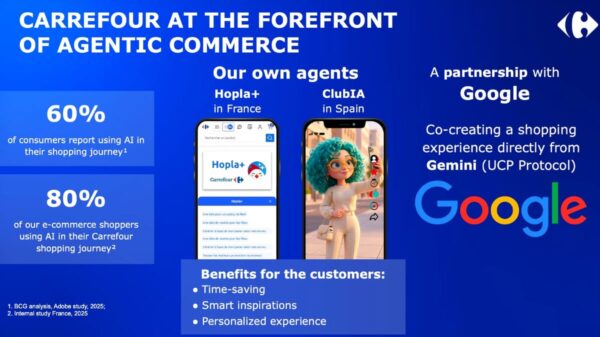










































Major retail chains and tech companies are rolling out new or updated artificial intelligence tools just in time for the holiday shopping season, aiming to enhance the consumer gift-buying experience and capture a larger share of online spending. Despite being in the early stages, AI-powered shopping assistants from Walmart, Amazon, and Google now provide personalized product recommendations, track prices, and facilitate orders through natural conversations with customers. These features build on recent enhancements from platforms like ChatGPT and Google Gemini, with Google also unveiling an AI agent capable of calling local stores to verify product availability.
Salesforce projects that AI will influence $73 billion, or 22%, of global sales from the Tuesday before Thanksgiving through Cyber Monday, up from $60 billion last year. This figure encompasses everything from queries made through ChatGPT to AI-generated gift suggestions on retail websites. However, Brad Jashinsky, a senior retail industry analyst at Gartner, warns that AI’s impact this year will be “relatively limited,” as not all retail sites have adopted effective tools and many shoppers remain hesitant to use them. “The more retailers that launch these tools, the better they get, and the more consumers get comfortable and start to seek them out,” he noted. “But customer behavior takes a long time to change.”
The promise of AI to simplify the search for the ideal gift is most evident in tools designed to yield faster, more detailed results with fewer clicks. OpenAI has upgraded ChatGPT to include a shopping research feature that offers personalized buyers’ guides based on product pages, reviews, prices, and previous customer interactions. Amazon’s Rufus remembers user-provided information and utilizes browsing and purchase history to tailor recommendations, while Google has enhanced its AI Mode tool to respond to detailed questions in natural language, providing side-by-side comparisons from 50 billion product listings.
“This is an expansionary moment, I think, for all of technology and for commerce,” said Lilian Rincon, vice president of product, consumer shopping at Google. Each retailer is now equipped with AI tools designed to assist customers in more personalized ways. For example, Walmart’s AI assistant, Sparky, offers occasion-based recommendations, while an AI-powered gift finder in Target’s app responds to inquiries about the recipient.
Although tools for price tracking have existed for years, shoppers now have more advanced options. Amazon has introduced a 90-day pricing history tracker and alerts for items that drop within specified budgets. Google has released a more refined price tracker that allows users to specify details such as size and color, while Microsoft’s Copilot has launched similar capabilities.
Amazon, OpenAI, and Google are in a competitive race to enable seamless AI-powered purchasing within the same platforms. OpenAI has launched an instant checkout feature that allows users to buy products suggested by ChatGPT from Etsy sellers and some brands using Shopify. A partnership with Walmart will enable ChatGPT users to shop for nearly everything on Walmart’s site, though currently, purchases are limited to one item at a time. A separate collaboration with Target allows shoppers to build carts in ChatGPT before being redirected to the Target app for payment.
In a bid to streamline the purchasing process, Amazon enables Rufus to automatically buy items for customers who opt for “auto buy” with price alerts, while also allowing Rufus searches to guide users to outside retailers if Amazon does not stock an item. Google’s AI Mode features a “buy for me” option that facilitates purchases through Google Pay when prices drop and includes an automated calling feature to inquire about product availability at local stores.
As the holiday shopping season approaches, the integration of AI technologies aims to transform the retail landscape, enhancing consumer experiences while potentially reshaping spending patterns. As these tools evolve and more retailers adopt them, the future of shopping may see a significant shift, driven by consumer demand for convenience and personalization.
See also Topps Tiles Reports Record £295.8M Sales with 28% Trade Growth, Faces Market Challenges
 AI-Driven Shopping Surges to $11.8B on Black Friday; ETFs Like IYW and AIQ Set to Gain
 Dechert Advises Cognita Imaging on Acquisition by Mosaic Clinical Technologies to Enhance Radiology AI
 Geotab Reveals 2026 Predictions: AI and Quality Data Key to Business Survival
 2025 Sees Major Shift to Embedded Agentic AI, Driving Industry Value and Governance