





















































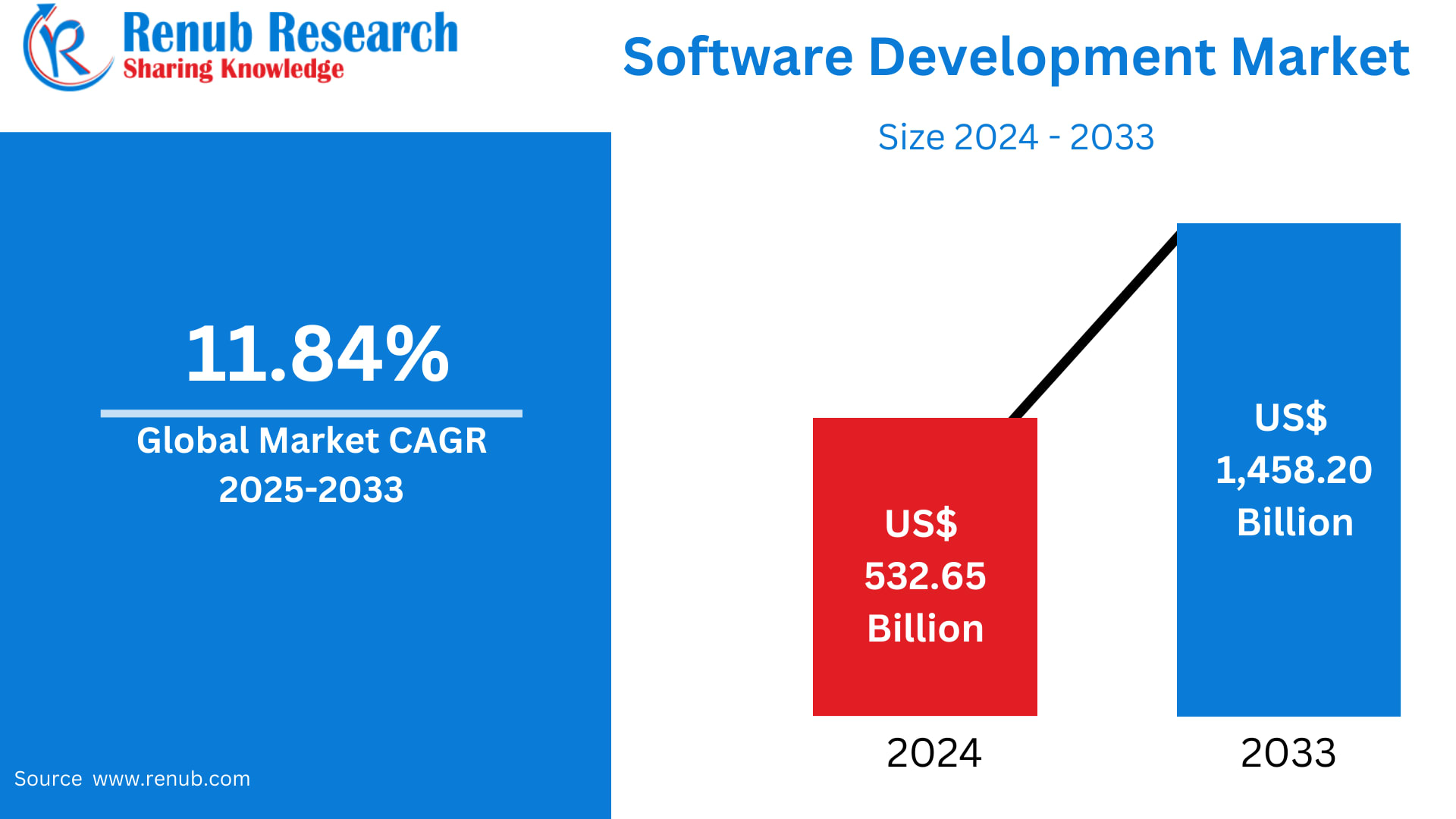
The global software development market is on track to see substantial growth, projected to increase from US$ 532.65 billion in 2024 to US$ 1,458.20 billion by 2033, according to Renub Research. This represents a compound annual growth rate (CAGR) of 11.84% from 2025 to 2033. This expansion underscores the software industry’s vital role as organizations, governments, and individuals increasingly rely on technology for operational efficiency, innovation, and scalability.
The surge in the software development sector reflects the broader trend of digital transformation across various industries, marking software as a core strategic asset rather than merely a support function. The industry’s diverse landscape encompasses everything from enterprise applications to AI-driven analytics and cloud-native solutions, all essential for maintaining competitiveness in today’s data-driven economy.
The software development landscape is characterized by a wide range of services, including mobile and web application development, artificial intelligence (AI) platforms, and Internet of Things (IoT) solutions. As consumer and enterprise demands evolve, organizations are embracing modern development practices such as agile methodologies, DevOps frameworks, and continuous integration/continuous deployment (CI/CD) pipelines. These approaches enhance product delivery speed while ensuring quality and security. The prominence of cloud platforms like Amazon Web Services, Microsoft Azure, and Google Cloud has contributed to shorter development cycles by providing scalable infrastructure and pre-built tools.
The rise of low-code and no-code platforms is also democratizing software development, enabling non-technical users to create functional applications. This trend, combined with the growth of open-source ecosystems and global developer communities, plays a crucial role in fostering innovation and driving down development costs. However, the industry’s growth is heavily concentrated in regions such as North America, Europe, and Asia-Pacific. North America leads in innovation and investment, while Asia-Pacific benefits from a vast talent pool and cost-effective services.
Digital transformation is the primary growth driver for the software development market. Industries including manufacturing, retail, banking, financial services and insurance (BFSI), healthcare, and logistics are significantly investing in digital solutions to streamline operations and enhance customer engagement. Custom software applications facilitate automation, real-time analytics, and omnichannel user experiences. The increasing adoption of agile and DevOps practices enables organizations to respond rapidly to market changes, fueling demand for reliable and scalable software solutions.
The widespread adoption of cloud computing and Software-as-a-Service (SaaS) models has fundamentally reshaped the software development sector. These cloud platforms provide on-demand access to computing resources and development tools, eliminating the need for substantial upfront investments in infrastructure. Organizations are increasingly turning to cloud-native applications for their flexibility and cost efficiency, while SaaS solutions simplify the deployment of complex software capabilities.
Moreover, the integration of AI and automation is reshaping both the development process and the functionality of applications. AI-driven development tools assist developers in writing cleaner code, automating testing, and optimizing performance, significantly reducing time-to-market. Businesses are seeking intelligent software that can adapt to user behavior and deliver actionable insights, thereby accelerating innovation across the software development landscape.
Nonetheless, the market faces challenges, notably a persistent talent shortage and skill gaps. The demand for expertise in areas such as AI, cybersecurity, and cloud architecture is outpacing supply, resulting in higher labor costs and extended project timelines. Many organizations struggle to keep up with the rapid pace of technological change, making the availability of qualified developers a critical constraint on market scalability.
As software systems grow more complex, managing development lifecycles becomes increasingly challenging. Developers must incorporate security and compliance measures into their projects to mitigate cybersecurity risks and prevent data breaches. Balancing the demands of speed, innovation, and security remains a significant hurdle for software firms worldwide.
In terms of regional markets, the United States stands out as a global leader in software development, fueled by its advanced technology ecosystem and significant R&D investments. Innovation hubs like Silicon Valley and Seattle are at the forefront of advancements in AI and cloud computing. Meanwhile, Germany plays a crucial role in Europe’s software landscape, driven by demand for automation and strict regulatory compliance under the General Data Protection Regulation (GDPR).
India is rapidly emerging as a key player, bolstered by a large pool of IT talent and competitive service offerings, particularly in sectors like BFSI and healthcare. The country’s government initiatives, such as Digital India and Startup India, support its growing market presence. In the Middle East, the UAE is experiencing rapid growth in software development, spurred by national digital transformation strategies.
As the software development market approaches a projected value of US$ 1.45 trillion by 2033, the industry’s significance is set to increase. Amid challenges like talent shortages and rising cybersecurity risks, ongoing technological investments and the integration of AI are likely to sustain long-term growth. This evolution signifies that software development will continue to serve as a cornerstone of global economic and technological advancement.
See also xAI’s Grok AI Faces Scrutiny for Generating Explicit Images of Minors and Women
 AI Adoption Accelerates in 2026: Agentic Systems Drive Efficiency and ROI for Enterprises
 Agentic AI Revolutionizes Business: 42% of CIOs Adopt New Strategies by 2025
 Rideflux Secures $13.9M Pre-IPO Funding to Propel Autonomous Truck Commercialization