


















































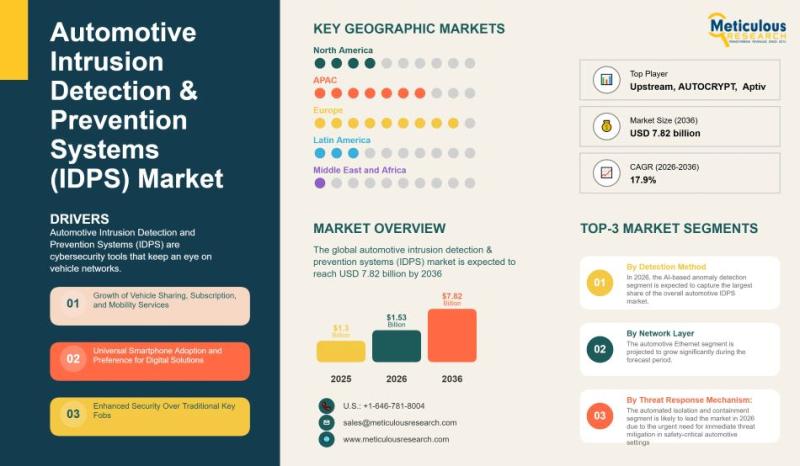
The global automotive intrusion detection and prevention systems (IDPS) market is set to surge from USD 1.53 billion in 2026 to approximately USD 7.82 billion by 2036, reflecting a robust compound annual growth rate (CAGR) of 17.9% during the forecast period. These systems are specialized cybersecurity solutions designed to monitor vehicle networks, detect malicious activities, and respond in real time to mitigate cyber threats. Aimed at protecting connected, electric, and autonomous vehicles, automotive IDPS safeguard against unauthorized access, malware injections, and command injection attacks, while ensuring the operational integrity of safety-critical systems.
AI-based anomaly detection is anticipated to dominate the market share by 2026. Utilizing machine learning models trained on normal network behavior, these systems can identify deviations that indicate potential attacks. AI-driven detection methods can uncover unknown zero-day attacks and adapt to vehicle-specific operational patterns. Techniques such as supervised and unsupervised learning, recurrent neural networks, and ensemble modeling are commonly employed. Context-aware models enhance reliability by differentiating behavior across diverse driving environments, a critical feature for autonomous vehicles where operational complexity surpasses traditional detection capabilities.
Automotive Ethernet is expected to experience significant growth, attributed to its high bandwidth that facilitates detailed traffic inspection. This technology allows for deep packet inspection and application-layer analysis, enabling the identification of sophisticated attacks that lower-bandwidth protocols might miss. As centralized computing platforms in modern vehicles increasingly rely on Ethernet backbones, effective monitoring of this network layer becomes vital for comprehensive visibility. Meanwhile, Controller Area Network (CAN) and CAN-FD networks continue to play a key role in real-time control applications.
Automated isolation and containment mechanisms are projected to be the market’s leading threat response strategy. Upon detecting a threat, an IDPS can autonomously isolate compromised electronic control units (ECUs), block harmful message flows, and alert drivers of safety-critical risks. Such automated responses are critical in automotive contexts due to the rapid progression of cyber threats, where human intervention may not be timely enough.
The deployment of distributed IDPS with centralized management is anticipated to capture the largest market share. This architecture allows local sensors to monitor network segments while transmitting security data to a central management platform. Benefits include fast local threat detection, comprehensive coverage, and resilience against isolated failures. Centralized management facilitates coordinated responses across vehicle domains and enables intelligence sharing across fleets. Sensors are commonly embedded in gateway ECUs and critical system components, while central management may reside in gateway or telematics platforms with cloud connectivity for fleet-level analysis.
Regionally, Europe is poised to lead the market, driven by regulatory mandates for security monitoring and a strong cybersecurity expertise in the automotive sector. Premium vehicles in the region frequently implement detailed security architectures, bolstered by early regulatory compliance. The Asia-Pacific region is expected to witness the highest growth due to the increase in connected and electric vehicle production, coupled with government regulations emphasizing threat detection. China’s leadership in this growth is propelled by stringent cybersecurity requirements for intelligent vehicles and the substantial production of connected electric vehicles.
Market dynamics indicate key drivers of growth, including regulatory mandates and escalating cyber threats. Global regulations now necessitate ongoing monitoring and incident response capabilities in vehicles, recognizing that preventive measures alone are insufficient against sophisticated attackers. Increasing cyber threats—ranging from remote network injections to telematics exploitation—underscore the necessity for active detection and rapid response. As vehicles have long lifecycles, evolving security measures become paramount.
The automotive IDPS market is shifting toward integrated, AI-driven platforms that enhance visibility across entire fleets. Modern systems utilize distributed sensors and deep learning models to detect subtle attack patterns while minimizing false positives. Edge AI processing enables immediate onboard threat responses without reliance on cloud infrastructure. Moreover, integration with Security Operations Centers facilitates a coordinated defense across fleets, transforming vehicle cybersecurity from isolated defenses into a collective protection network.
In conclusion, automotive intrusion detection and prevention systems are becoming essential in the cybersecurity framework for modern vehicles. The combination of AI-powered detection, automated responses, and network-wide monitoring addresses increasingly sophisticated threats targeting connected and autonomous vehicles. Regulatory mandates, technological advancements, and the expansion of these vehicle markets are driving strong adoption in an era where cybersecurity is more critical than ever.
See also IBM and Palo Alto Networks Launch Unified AI Security to Cut Costs by 19.4%
 Free AI Tools Compromise Data Security: 95% of Businesses Lack NHI Management Strategies
 AI Cybersecurity Solutions Reduce Threat Detection Time by 95% for Modern Businesses
 Incident Response Teams Enhance Defense Against Evolving AI-Powered Cyber Threats
 Chrome Introduces Option to Disable On-Device AI Security Models for Enhanced Privacy






