































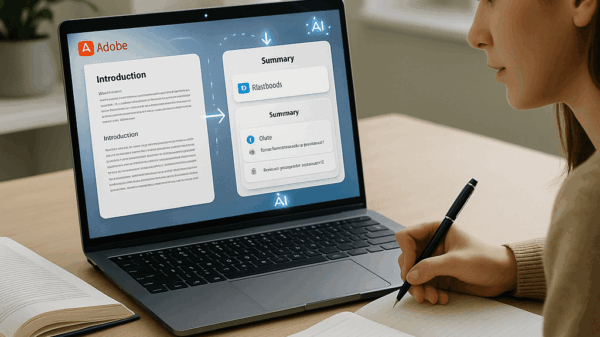


















Adobe has launched a new initiative targeting the student market with its introduction of Acrobat Spaces, a free AI-powered tool designed to convert complex PDFs and documents into more manageable study materials. This release marks a significant step in Adobe’s broader strategy to integrate AI into its product offerings while aiming to capture the interest of future creative professionals before they transition into the workforce.
With Acrobat Spaces, Adobe allows students to upload various documents, such as lecture notes or textbook chapters, to generate study aids like flashcards, summaries, and quizzes without incurring costs associated with premium subscriptions. This strategic move not only enhances product development but also serves as a method for user acquisition, positioning Adobe to engage students early in their academic careers.
The timing of this launch coincides with an explosion of AI-driven educational tools, which have gained traction over the past year. Platforms like Quizlet and Studocu, along with OpenAI’s ChatGPT, have become staples in study environments. Adobe’s entry into this competitive field leverages its established expertise in handling documents, as Acrobat processes billions of PDFs every year, while simultaneously incorporating generative AI capabilities tailored to student workflow.
What sets Acrobat Spaces apart from other AI tutoring solutions like ChatGPT is its specialized focus on document workflows. The platform is engineered to analyze document structures, extract key concepts, and generate outputs specifically designed for studying, rather than offering general chat responses. This targeted approach not only enhances user experience for students but also represents a potential data goldmine for Adobe, as insights gained from student interactions could inform future AI features across its existing Creative Cloud and Document Cloud offerings.
The education sector has increasingly become a battleground for various AI companies. Competitors like Google are embedding AI into their educational products, including Classroom and Workspace, while also integrating Copilot into Teams for Education. Meanwhile, numerous startups are pursuing venture capital to fund their AI tutoring solutions. Adobe’s established brand recognition and its existing relationships with educational institutions provide it with a strategic advantage. Many universities already license Creative Cloud, making Acrobat Spaces an attractive upsell or retention tool for these institutions.
As Adobe continues to push forward in the rapidly evolving educational technology landscape, its commitment to integrating AI into its services could redefine how students engage with digital learning materials. By unveiling Acrobat Spaces, Adobe not only enhances its product portfolio but also positions itself as a key player in the growing market for AI-powered educational tools. As the tech giant seeks to cultivate the next generation of users, its foray into the student space may have implications for both its future growth and the educational technology landscape at large.
See also Andrew Ng Advocates for Coding Skills Amid AI Evolution in Tech
 AI’s Growing Influence in Higher Education: Balancing Innovation and Critical Thinking
 AI in English Language Education: 6 Principles for Ethical Use and Human-Centered Solutions
 Ghana’s Ministry of Education Launches AI Curriculum, Training 68,000 Teachers by 2025
 57% of Special Educators Use AI for IEPs, Raising Legal and Ethical Concerns