








































Charlotte, NC (Tuesday, March 31, 2026) — Discovery Education has launched the Discovery Education Connected Ecosystem, a comprehensive K-12 framework that integrates artificial intelligence (AI), instructional resources, adaptive learning, and professional development into everyday teaching practices. Drawing from over 20 years of educational experience and currently utilized by 45% of U.S. K-12 schools, this Ecosystem aims to enhance instructional effectiveness and improve student outcomes.
A recent report by the Consortium for School Networking revealed that while over half of U.S. school districts are implementing AI technologies, 72% use these tools sparingly, leveraging them only 10% of the time or less. In response to the rapid expansion of AI tools, Discovery Education seeks to unify these capabilities into a coherent framework that centers around effective instruction.
The Discovery Education Connected Ecosystem is designed to ease the transition to AI in K-12 education by combining vetted, standards-aligned content, adaptive learning pathways, AI-driven instructional tools, and ongoing professional learning. This integrated approach helps school districts move beyond ad hoc technology solutions, fostering consistent and widespread use while enhancing educator confidence and fluency over time. It also addresses the larger context of educational change, including the evolving roles of educators, the needs of families seeking responsible technology use, and the imperative for students to acquire skills necessary for an AI-centric future.
“AI is not the answer. Great teaching is,” stated Brian Shaw, Chief Executive Officer at Discovery Education. “The Discovery Education Connected Ecosystem puts AI in service of instruction, directly in the flow of teaching, grounded in learning science, and built to move every student forward.” His remarks underscore the commitment to supporting educators during this significant technological transition.
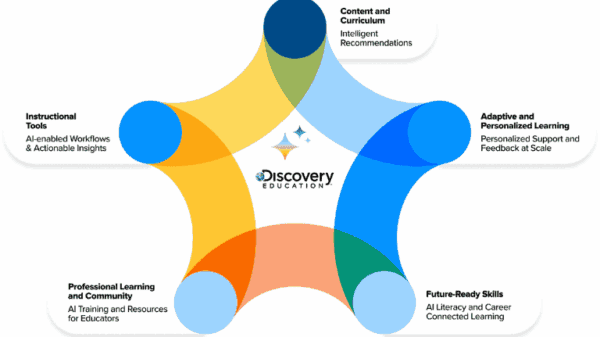
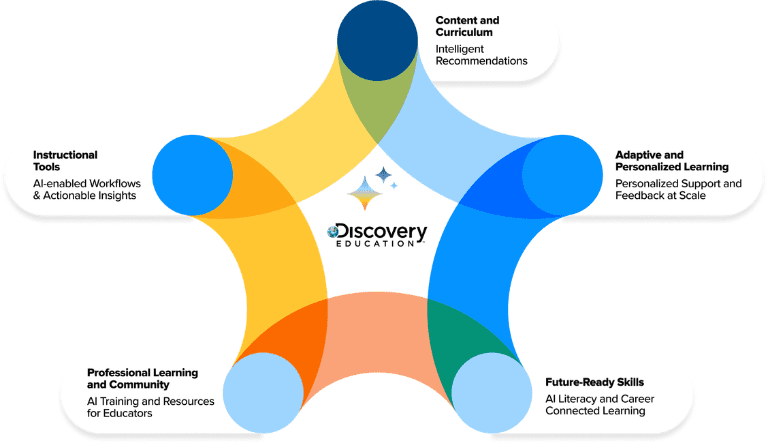
The Ecosystem is underpinned by five foundational pillars, each incorporating AI and educational science to ensure that every learner receives the appropriate resources at the right time. The first pillar focuses on Trusted K-12 Content and Curriculum, featuring a curated selection of resources reviewed by curriculum experts and aligned with educational standards. In a collaborative effort with Otus, educators now have access to a conversational AI assistant that offers personalized content recommendations tailored to student assessment data and district objectives.
The second pillar, Adaptive and Personalized Learning, emphasizes the importance of personalized education through AI. The adaptive learning capabilities of DreamBox Math are designed to align learning paths with critical grade-level standards, enabling more targeted instruction at both the classroom and district levels.
Meanwhile, the third pillar, AI-Enhanced Instructional Tools, focuses on integrating AI into educators’ workflows. This includes the recently updated AI TeacherTools | Assess feature in Discovery Education Experience, which allows educators to create customized assessments efficiently. Upcoming enhancements will introduce an AI classroom assistant to DreamBox Math, providing real-time insights into student learning and supporting instructional decision-making.
The fourth pillar, dedicated to Future-Ready Skills, offers free resources that help students develop critical thinking, problem-solving abilities, and AI fluency. Discovery Education has enhanced its Digital Citizenship Initiative, which, in collaboration with Verizon and Norton, aims to help students and families responsibly navigate AI technologies. Since its inception in 2025, the initiative has reached over 685,000 students.
The fifth pillar, Professional Learning and Community, emphasizes comprehensive support for educators. Through partnerships, including a new collaboration with IBM SkillsBuild, educators can access workforce-aligned credentialing courses in AI, cybersecurity, and digital literacy. The goal is to equip 100,000 educators with practical training that complements existing professional development programs.
“Educators play a critical role in helping students move from learning about AI to applying it responsibly and with confidence,” noted Lydia Logan, Vice President of Global Education and Workforce Development at IBM. The collaboration between IBM and Discovery Education aims to simplify access to trusted training resources for teachers.
Discovery Education’s commitment to secure and compliant use of AI technologies is evident in its adherence to privacy regulations such as COPPA and FERPA. The company’s solutions are designed to provide age-appropriate resources that have been thoroughly vetted to ensure quality and safety in educational environments. “Trust in edtech isn’t given; it’s earned,” stated Travis Barrs, Chief Strategy and Transformation Officer at Discovery Education. He emphasized the importance of protecting student data and ensuring that every AI application in their ecosystem is scrutinized before implementation.
With the Discovery Education Connected Ecosystem, the company seeks to redefine the educational landscape, making it easier for districts to adopt AI technologies with confidence and ensuring that every student is equipped with the skills necessary to thrive in an increasingly digital world.
See also Andrew Ng Advocates for Coding Skills Amid AI Evolution in Tech
 AI’s Growing Influence in Higher Education: Balancing Innovation and Critical Thinking
 AI in English Language Education: 6 Principles for Ethical Use and Human-Centered Solutions
 Ghana’s Ministry of Education Launches AI Curriculum, Training 68,000 Teachers by 2025
 57% of Special Educators Use AI for IEPs, Raising Legal and Ethical Concerns