














































Million Tech, founded in 1987, has transitioned from its roots in barcode technology to focus on smart education enhanced by artificial intelligence (AI). With the launch of its Library GO AI platform, the company aims to stimulate children’s imagination and increase their reading interest through innovative AI solutions. This transformation has not only improved the reading experience for students but has also significantly enhanced the operational efficiency of libraries, reducing the time required for organizing books from three weeks to as little as one hour.
Over its 38 years of operation, Million Tech has provided barcode and point-of-sale (POS) systems to various sectors, including retail, healthcare, and government institutions such as the Legislative Council Library, which houses a collection of 50,000 volumes. Nelson Tse, the founder and CEO of Million Tech, emphasizes that the company is dedicated to solving practical challenges in education, stating, “We have witnessed the power of AI to truly help teachers reduce their workload and increase students’ reading interest, dedicated to making knowledge a priority in this distracting era.”
Central to Million Tech’s smart library system is its use of RFID (radio-frequency identification) technology, which replaces traditional barcode systems. This upgraded system allows libraries to conduct inventory checks of up to 10,000 books in under half a day, freeing educators from tedious administrative tasks. The new system also supports the borrowing of multiple books simultaneously, tripling the speed of library services, thereby facilitating greater access to knowledge for students during brief breaks between classes. The flexible deployment options, such as setting up book lockers outside libraries, ensure that borrowing is not restricted by physical space.
Reports indicate that over 100 primary and secondary schools in Hong Kong have already implemented this system, leading to a marked reduction in teachers’ administrative burdens and an increase in the number of books borrowed by students. Feedback from educators highlights improved reading habits among students, with one teacher noting, “The system revitalizes the library.” Additionally, the system’s data analysis capabilities allow it to track student borrowing preferences, providing personalized book recommendations to enhance resource allocation.
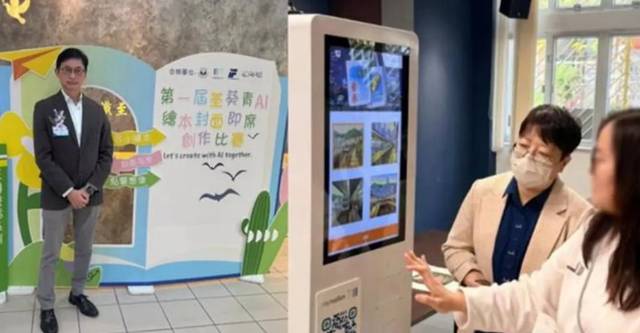
Million Tech has also unveiled the Library GO AI platform, which is recognized as Hong Kong’s first AI-powered library management system built on the KOHA framework. Tse notes that Library GO integrates traditional library functions with advanced AI features, transforming libraries into interactive environments. Students can not only track their borrowing activity but can also upload reading reports to the platform. The AI generates unique images based on these reports, which can be printed on cards or even everyday items like reusable bags, thereby enhancing students’ engagement and creativity.
The principal of CNEC Lui Ming Choi Primary School, Leung Hon Kei, remarked on how the library has evolved into a central space for promoting reading and creativity, stating, “The smart library system makes borrowing books more convenient for students. As a consequence, they have increased their interest in reading.” These sentiments were echoed during the recent AI Picture Book Cover Improvisation Competition held in collaboration with the school, where students showcased their creativity by using the Library GO platform to generate AI-inspired book cover designs based on their reading reflections.
Through initiatives like these, the school aims to leverage technology to foster children’s creativity and reading habits. “With the help of AI tools, children can transform their creativity into anything they like,” Leung stated, emphasizing the role of reading in children’s development. The competition encouraged innovative adaptations of classic stories, enabling discussions on themes such as cooperation versus competition.
Looking to the future, Million Tech plans to expand its presence in the smart education sector by exploring new developments in e-book management, AI fitness tracking, and self-learning platforms. Tse stated the company aims to continue addressing the practical challenges faced by educators through ongoing dialogue and collaboration. Moreover, there are plans to export these smart education solutions to nearby regions, beginning with Macau and eventually targeting markets in Southeast Asia and countries involved in the Belt and Road Initiative.
As Million Tech navigates this expansion, it remains focused on utilizing technology not just as a tool for efficiency but as a means to enhance the educational landscape, ensuring that children are equipped with the skills and knowledge necessary for the future.
See also Industry Leaders Predict AI’s Role in K-12 Education by 2026: Key Insights Revealed
 AI-Enhanced Framework Boosts STEM Language Skills, Study Shows 30% Improvement
 Zenith School of AI Launches ₹100Cr B.Tech and Mini-MBA for Future Tech Leaders
 India’s AI Workforce Strategy Produces 416K Specialists, Offers Model for Emerging Nations
 UN Urges ‘People-First’ AI Approach as 44 Million Teachers Needed by 2030