












































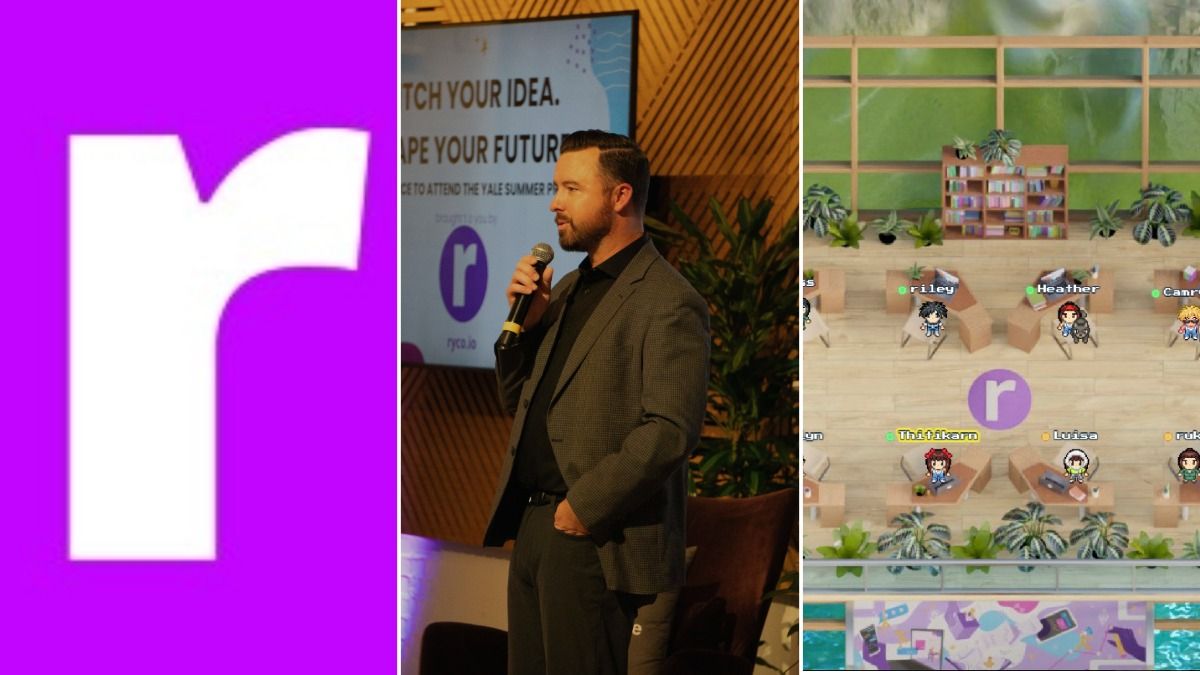
Riley Walker, founder and CEO of ryco, is redefining education technology from his base in Tampa, Florida. The company is focused on creating tailored curriculum and interactive learning tools designed to meet the unique needs of schools and businesses. This mission is driven by Walker’s early experiences growing up in a small Maine town, where he witnessed the challenges faced by his artistic sister in a rigid educational system.
Walker’s foray into education technology began unexpectedly while he was waiting tables in college. He crossed paths with a theoretical particle physicist who owned an educational publishing company and offered him a job on the condition that Walker first become a writer. Over the next four years, he authored textbooks in advanced mathematics and software, coordinating with professors from prestigious institutions like Carnegie Mellon and the University of Pittsburgh.
By the age of 22, Walker was leading teams to develop early gamified learning programs for schools and performing arts centers. Although digital art and interactive learning were then emerging concepts, he recognized their potential to transform education.
After departing from the publishing realm, Walker established a marketing firm to assist small educational publishers in directly marketing their products to schools. While successful, he aspired to create something more impactful. During the COVID-19 pandemic, former colleagues approached him for assistance in transitioning to remote learning. Initially, Walker managed all aspects of content creation himself; however, as demand increased, he recruited a skilled team. This evolution led to the formation of ryco, which now boasts a staff of nine in Tampa and a remote team based in South Africa.
Ryco offers a unique approach to education, modeling its virtual campus after retro video games. “Imagine Mario, but for education,” Walker describes, emphasizing the company’s innovative spirit.
Walker is committed to replacing the traditional textbook model with adaptive content that caters to individual student needs. He criticizes major publishers for locking school districts into lengthy licensing agreements for outdated materials, forcing teachers to create their own lesson plans on their own time. Ryco aims to build customized curricula that reflect each school’s specific objectives, whether they focus on special education, advanced STEM instruction, or vocational training. Utilizing artificial intelligence, the company equips educators with tools to generate lessons, videos, and gamified modules on demand.
Each client at ryco collaborates with a project manager who has teaching experience, facilitating a dialogue between educators that informs the content development process. “Teachers talk to teachers,” Walker asserts, underscoring the collaborative nature of their operations. The company is capable of creating anything from new Advanced Placement courses to comprehensive virtual reality simulations.
Initially, ryco partnered with significant publishers, including National Geographic Learning, to help develop branded products, which provided the revenue needed to grow without outside investment. Currently, the company serves a range of schools across the United States, from New York to Los Angeles, while also offering a platform that allows schools to submit project requests and retain full ownership of the materials produced by ryco. “Everything we build for them is theirs,” Walker insists, allowing institutions the flexibility to monetize or uniquely tailor their content.
Recently, ryco has ventured into corporate training, applying its interactive methodology to employee onboarding and professional development. Walker notes that corporate training has a shorter sales cycle than educational projects but applies similar principles of relevance in learning. In its first week of entering this sector, ryco secured five corporate training projects.
Walker operates from Embarc Collective, a hub for local tech entrepreneurs, where he also leads a Founders Forum. He believes that Tampa’s vibrant energy and collaborative environment make it an advantageous location for technology startups. The core philosophy that propelled his journey from a small town in Maine remains unchanged: education should not be one size fits all. “We want every learner to discover their own path,” he emphasizes.
Ryco stands at the forefront of a $100 billion education publishing industry, challenging traditional models with its teacher-driven design and AI-powered customization. The company’s efforts highlight a pivotal shift in education, demonstrating that even as technology advances rapidly, the human element remains essential in shaping effective learning experiences.
See also University of Toronto Hosts Anthropic AI Hackathon Showcasing Innovative ABA Tools
 Educators Embrace AI: 3 Essential Strategies for Classroom Integration
 AI Video Enhancement Tools Elevate Online Education Quality by 40%—Here’s How
 Amazon Awards $10M to 63 Global Researchers in Spring 2025 AI Research Initiative
 Hawai‘i Schools Implement AI Guidelines to Enhance Learning and Safeguard Student Data