




















































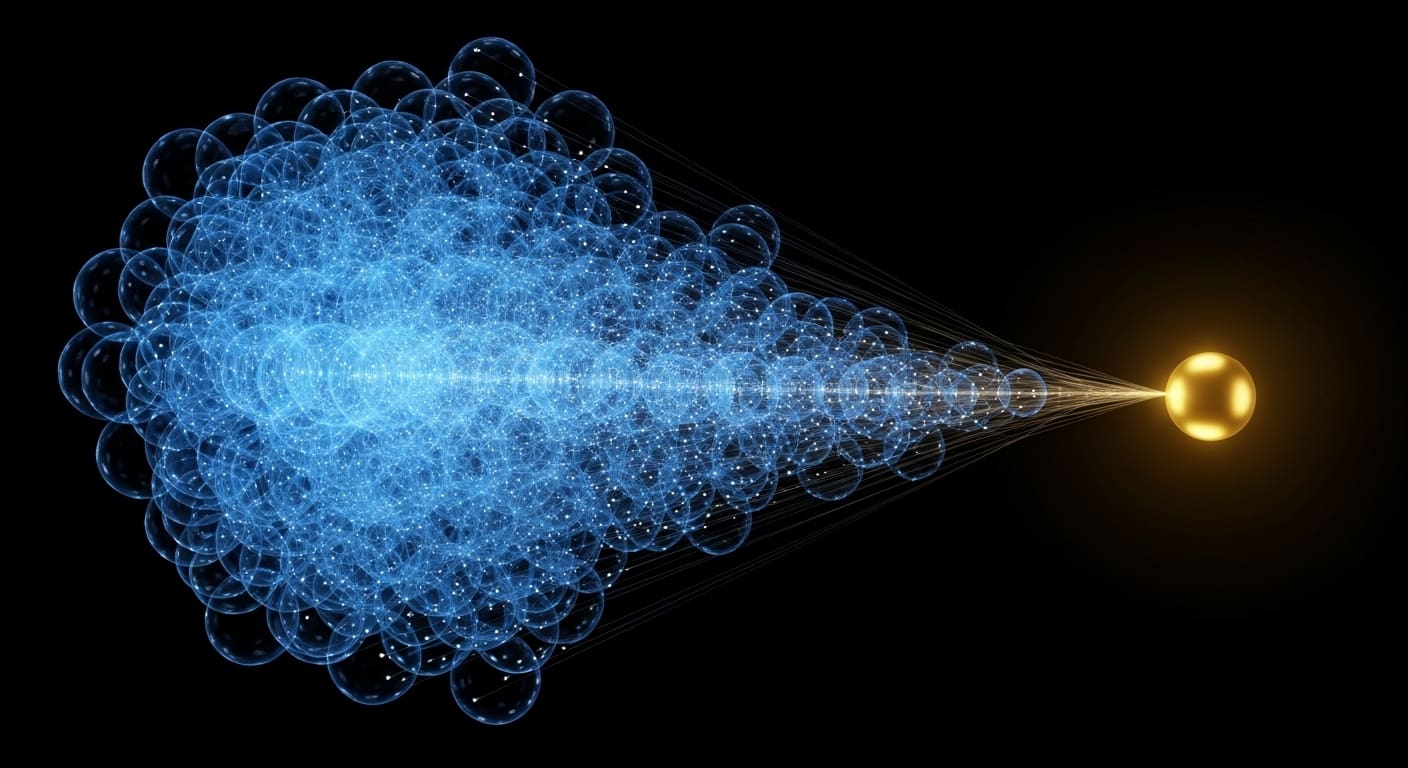
A team of researchers at Delft University of Technology has developed a novel generative approach that reconstructs complete charge stability diagrams (CSDs) from limited measurements, a significant advancement in the quest to scale quantum processors based on confined spins. Led by Vinicius Hernandes, the researchers employed conditional diffusion models to achieve this reconstruction, enabling the preservation of essential physical features using as little as 4% of the data typically required. This technique addresses a critical bottleneck in emerging quantum architectures where direct charge sensing is not feasible.
Charge stability diagrams are essential maps that define the occupation of quantum dots, crucial for understanding the electrostatic environment within these structures and for precisely controlling the number of electrons confined within them. Traditionally, obtaining complete CSDs involves sweeping the voltages applied to gate electrodes and measuring the resulting changes in current, a process that can take hours or even days per device. This lengthy procedure has hindered rapid automated tuning and statistical characterization, particularly in architectures reliant on remote sensing.
The innovative conditional diffusion model devised by the Delft team successfully overcomes these limitations, allowing for accurate CSD reconstruction despite significantly reduced measurement efforts. By preserving critical physical features while operating with minimal data, the model provides a solution in circumstances where direct charge sensing, typically conducted using sensitive electrometers, becomes impractical due to proximity challenges or architectural constraints.
Standard interpolation methods have historically struggled to capture the complex relationships inherent in CSDs, often resulting in inaccurate reconstructions. The conditional diffusion model not only outperforms traditional techniques but also maintains crucial charge transition lines—boundaries that define stable quantum dot states. These transition lines are vital for controlling the spin state of confined electrons, underscoring the model’s importance in optimizing device performance and scaling quantum systems. The process of tuning gate voltages to achieve desired charge configurations while minimizing unwanted interactions between quantum dots is now more accessible.
To train the conditional diffusion model, the researchers utilized approximately 9,000 examples of quantum dot data. This generative model learns to produce data conditioned on given inputs, making it adept at generating a complete CSD from limited measurements. Critically, the model was able to predict charge transition lines accurately, even with severely restricted input data. In contrast, traditional interpolation techniques struggle to fill considerable gaps in CSD data, emphasizing the generative approach’s advantages in complex reconstructions.
Evaluations conducted using both uniform grid sampling and line-cut sweeps demonstrated the model’s robustness across various measurement strategies. Uniform grid sampling entails measuring the CSD at a regular gate voltage grid, while line-cut sweeps focus on specific lines in gate voltage space. The ability to control quantum dots effectively—the foundational elements for larger and more stable quantum computers—is paramount for advancing the field. The Delft team’s model eases one of the key bottlenecks in mapping a quantum dot’s operational field through CSDs, a process essential for understanding device behavior and optimizing performance.
However, it is important to note that the current solution relies on some degree of similarity between the training data and the characteristics of new devices. While reducing the data needed to characterize these devices by up to 96% marks a substantial advancement for scaling quantum processing, achieving perfect generalization remains a challenge. The 4% data requirement assumes ideal, noise-free initial measurements, and the model’s efficacy in real-world scenarios, plagued by experimental noise from sources like thermal fluctuations or electromagnetic interference, still requires thorough evaluation.
This breakthrough in generative modeling alleviates a critical practical hurdle in quantum device characterization, making it possible to reconstruct complete charge stability diagrams with minimal data. The implications of this advancement are significant, as it accelerates the pace of research and development within the quantum computing sector. The ability to rapidly and accurately characterize quantum dots is essential for constructing larger, more complex quantum processors, which necessitate the characterization of numerous quantum dots, thereby highlighting the importance of efficient techniques.
Moreover, the development of robust generative models such as this one could pave the way for automating quantum device characterization. Automated screening would enable researchers to efficiently assess a multitude of devices, identifying those with optimal performance characteristics, which could significantly speed up the advancement of quantum technology. Future research is likely to focus on enhancing the model’s ability to generalize across variations in real-world quantum dots and applying this framework to other types of quantum devices.
In summary, the research from Delft University of Technology illustrates that complete charge stability diagrams, crucial for understanding electron behavior in quantum dots, can now be reconstructed from as little as 4% of the data previously needed. This progress holds promise for overcoming the slow characterization processes that have hindered quantum computing development, marking a substantial leap forward in the field.
See also Sam Altman Praises ChatGPT for Improved Em Dash Handling
 AI Country Song Fails to Top Billboard Chart Amid Viral Buzz
 GPT-5.1 and Claude 4.5 Sonnet Personality Showdown: A Comprehensive Test
 Rethink Your Presentations with OnlyOffice: A Free PowerPoint Alternative
 OpenAI Enhances ChatGPT with Em-Dash Personalization Feature