
















































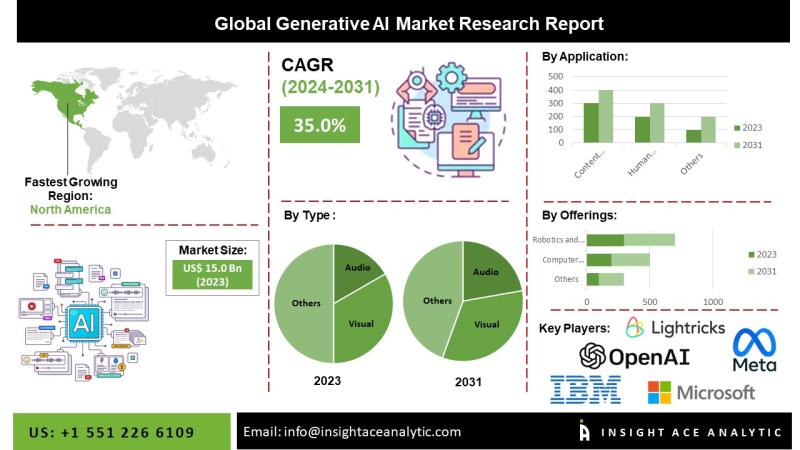
The global generative AI market is set for remarkable growth, with a projected value of USD 20.10 billion in 2024, soaring to USD 415.45 billion by 2031. This represents a compound annual growth rate (CAGR) of 35.5% from 2025 to 2034, according to a recent analysis report. This surge is largely driven by advancements in high-definition image generation, text-to-video synthesis, and the increasing demand for operational efficiency across various sectors.
As companies prioritize innovation and process optimization, the integration of generative AI technologies is expected to escalate. The COVID-19 pandemic has acted as a catalyst, accelerating the adoption of machine learning (ML) and artificial intelligence (AI) tools to navigate emerging business challenges. Leading players in the industry are investing heavily in developing advanced capabilities, such as text-to-image generation and automated video production, to remain competitive in this rapidly evolving landscape.
Generative AI finds applications in diverse use cases, including high-resolution image synthesis, facial age prediction, and medical imaging. Its growing adoption in sectors like spam detection, data preprocessing, and image compression further propels market growth. To maintain a competitive edge, companies are focused on continuous investment in research and development, along with recruiting specialized talent.
Prominent players in the generative AI market include Microsoft, AWS, Google, Adobe, and IBM, each contributing significantly to the market’s evolution. Other noteworthy companies include OpenAI, Meta, and Insilico Medicine, among others. These organizations are not only pushing the boundaries of technology but also engaging in ethical considerations surrounding AI governance to mitigate algorithmic bias.
The market’s dynamics reveal a duality of drivers and challenges. On one hand, the development and implementation of AI governance frameworks and ethical standards facilitate responsible AI adoption, promoting operational efficiency through automation. On the other hand, challenges such as high initial capital requirements, data privacy concerns, and a scarcity of skilled professionals threaten broader market adoption. The need to manage vast datasets, often at exabyte or petabyte scales, exacerbates risks related to data breaches and information loss.
Regionally, North America is expected to maintain its leadership in the generative AI market, bolstered by rising incidents of financial fraud and expanding AI integration within healthcare. The Asia-Pacific region, however, is projected to experience rapid growth, driven by supportive government initiatives in countries such as China, India, and South Korea. The strategic adoption of generative AI by enterprises in this region is further reinforcing market expansion.
Recent developments in the sector highlight the pace of innovation. In September 2022, Meta unveiled Make-A-Video, an advanced AI tool that converts text prompts into high-quality video segments. Similarly, harli AI introduced Anacaeus in November 2022, a generative platform that helps organizations generate insights and presentations from extensive content. These advancements exemplify the accelerating integration of generative AI across various industries.
The segmentation of the generative AI market illustrates its breadth and depth across multiple dimensions. By offerings, it is divided into software and services, while applications span from natural language processing and computer vision to finance and legal sectors. Industries such as media and entertainment, healthcare, and retail are increasingly leveraging generative AI to enhance customer engagement and streamline operations.
As the generative AI market continues to evolve, its long-term viability will hinge on balancing innovation with ethical considerations. The growing emphasis on responsible AI practices, coupled with ongoing advancements in technology, will likely define the next phase of this dynamic industry. Stakeholders are poised to capitalize on emerging opportunities while navigating the complexities of a rapidly changing technological landscape.
See also Generative AI Expands Creative Horizons, Unlocking the Era of the “Super Subconscious”
 Agents Surge in 2025: OpenAI and Anthropic Lead AI’s Evolution with New Protocols
 Research Evaluates AI Definition Accuracy Using Cosine Similarity Metrics Across GPT Models
 Yann LeCun Slams LLMs as ‘Dead End’ for Superintelligence, Advocates for World Models
 AI Model Framework Enhances Hypertension Education with Multi-Layer Retrieval System






