















































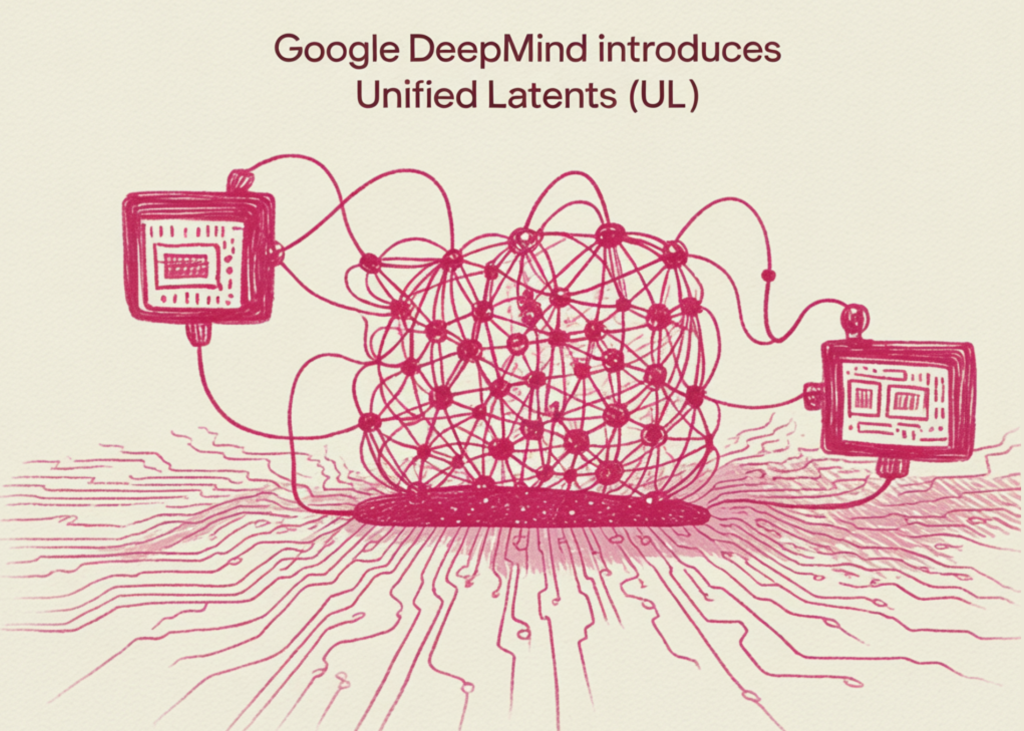
Google DeepMind has unveiled a novel framework known as Unified Latents (UL), aimed at addressing key challenges in the realm of generative AI. The introduction of UL is particularly timely, as generative AI increasingly depends on Latent Diffusion Models (LDMs) for high-resolution content synthesis. By compressing data into a lower-dimensional latent space, LDMs can manage computational costs effectively. However, they face a critical trade-off: while lower information density allows for easier learning of latents, it compromises the quality of reconstruction. Conversely, higher density enhances reconstruction fidelity but requires more modeling capacity.
The UL framework seeks to systematically navigate this trade-off by jointly regularizing latent representations through a diffusion prior and decoding them with a diffusion model. This dual approach allows for a more efficient synthesis process, promising improvements in both the quality of generated outputs and the computational resources required.
At its core, the UL framework incorporates three pivotal components. Firstly, it employs a Fixed Gaussian Noise Encoding, where a deterministic encoder predicts a single latent, which is subsequently forward-noised to a specific log signal-to-noise ratio. This method diverges from traditional Variational Autoencoders (VAEs), which typically learn an encoder distribution. Secondly, the framework features Prior-Alignment, aligning the prior diffusion model with the latent’s minimum noise level, thereby simplifying the evaluation of the evidence lower bound (ELBO) to a weighted Mean Squared Error (MSE). Lastly, it includes a Reweighted Decoder ELBO, which utilizes a sigmoid-weighted loss to balance the latent bitrate while prioritizing various noise levels in the decoding process.
The implementation of UL follows a two-stage training process designed to optimize both the learning of latents and the quality of the generated outputs. In the first stage, the encoder, diffusion prior, and diffusion decoder are trained together, aiming to achieve a tightly controlled upper bound on the latent bitrate. This joint training ensures that the encoder’s output noise is directly tied to the prior’s minimum noise level. In the second stage, the research team identified that a prior trained solely on ELBO loss does not yield optimal samples, as it places equal weight on low-frequency and high-frequency content. Thus, the encoder and decoder are frozen, and a new larger ‘base model’ is trained on the latents, allowing for improved performance based on a sigmoid weighting approach.
Results from the UL framework indicate significant advancements in training efficiency and output quality. For example, in testing on the ImageNet-512 dataset, UL achieved an impressive Fréchet Inception Distance (FID) of 1.4, outperforming previous models trained on Stable Diffusion latents under similar computational budgets. In video generation tasks utilizing the Kinetics-600 dataset, UL set a new State-of-the-Art (SOTA) with a Fréchet Video Distance (FVD) of 1.3, while a smaller UL model recorded a 1.7 FVD.
The innovations introduced by UL highlight an integrated diffusion framework that effectively optimizes latent representation through simultaneous encoding, regularization, and modeling. By leveraging a deterministic encoder that incorporates a fixed amount of Gaussian noise, UL provides a clear and interpretable upper bound on the latent bitrate. The two-stage training strategy enhances the model’s ability to maximize sample quality, making it a noteworthy contribution to the field of generative AI.
As the generative AI landscape continues to evolve, the implications of UL are substantial. It not only sets new benchmarks in training and generation quality but also paves the way for more efficient models capable of producing high-fidelity outputs with reduced computational resources. The ongoing advancements from Google DeepMind signify a promising future for AI-driven content creation.
See also Sam Altman Praises ChatGPT for Improved Em Dash Handling
 AI Country Song Fails to Top Billboard Chart Amid Viral Buzz
 GPT-5.1 and Claude 4.5 Sonnet Personality Showdown: A Comprehensive Test
 Rethink Your Presentations with OnlyOffice: A Free PowerPoint Alternative
 OpenAI Enhances ChatGPT with Em-Dash Personalization Feature