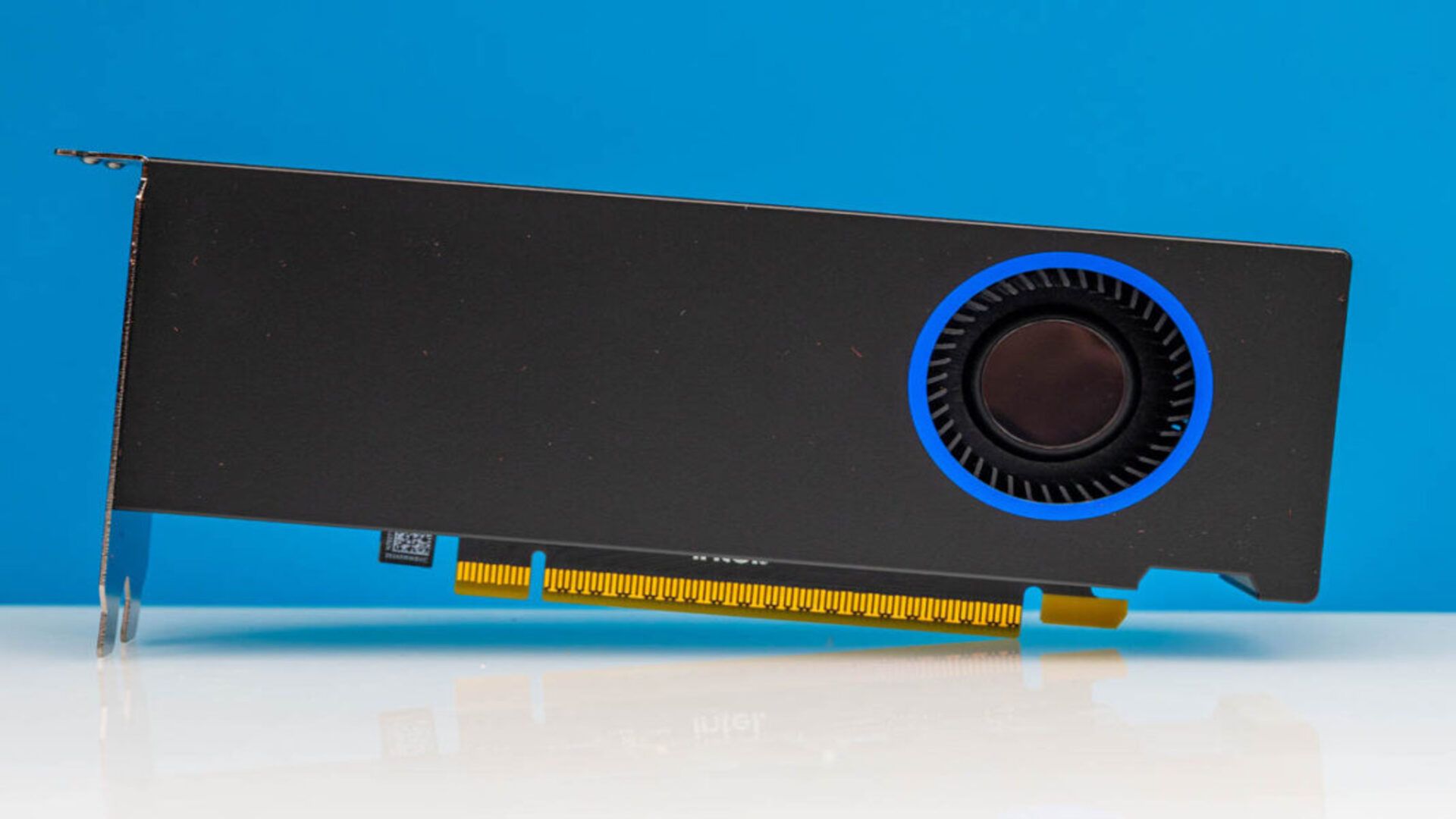
The professional GPU market is evolving, with Intel’s B50 emerging as a notable player alongside Nvidia’s Blackwell generation and AMD’s updated Radeon PRO lineup. Released in 2025, the B50 offers budget-conscious professionals a surprisingly capable option, despite not matching the performance of high-end Blackwell cards. Nonetheless, it provides sufficient power to remain relevant in specific professional workflows.
Priced at approximately $300, the Intel B50 is particularly appealing to mini PC brands, offering a lower cost and modest power requirements. In synthetic benchmarks, it shows first-token generation times in MLPerf comparable to a 4000 Blackwell, indicating that it can run single-query AI tasks efficiently. Its sustained throughput aligns it with the 2000 Blackwell and Radeon W7600, establishing a usable baseline for lighter machine learning workloads.
Although the B50 lags behind higher-end GPUs in Blender’s cycles render benchmark, it remains functional enough to handle entry-level 3D work. For real-time engines such as Unreal and Unigine, the B50 produces playable frame rates suitable for basic visualization and preview tasks, although mid-tier Ada and Blackwell GPUs perform better. In media editing applications, the card accelerates 2D workflows in After Effects and manages standard DaVinci Resolve timelines without major issues.
As GPU-intensive 3D effects reveal significant performance gaps compared to more powerful cards, the B50 still enables creative work to proceed in compact setups. Its performance in Topaz Video AI is moderate, yet stability remains consistent across tasks. While CPU usage can influence results in AI-assisted and GPU-heavy effects, the B50’s efficiency allows for experimentation in machine learning and video inference at a low cost.
Despite AMD’s RDNA3 cards delivering higher throughput for a similar price, Intel’s B50 presents a viable alternative for creators seeking functionality without a substantial financial commitment. Users requiring modest acceleration can achieve practical results without resorting to multi-thousand-dollar hardware.
Intel’s B50 occupies a unique niche in the professional GPU landscape. While it cannot rival Blackwell or high-end AMD GPUs in terms of raw performance, offline rendering, or sustained AI workloads, its $300 price point and low power draw make it suitable for entry-level content creation and compact PC builds. For budget-constrained or space-limited users, the B50 represents a surprisingly competent solution capable of efficiently managing lighter professional workloads.
See also AI Study Reveals Image Generation Converges to 12 Styles After 100 Cycles
 China Files 700 Generative AI Models as HarmonyOS Devices Exceed 1.19 Billion Units
 Study Uncovers 73 Risks of Large Language Models, Urges Urgent Ethical Governance
 Roblox Launches 4D Generative AI Tools, Revolutionizing Metaverse Creation with Open-Source Cube Model
 Generative AI Japan Awards 2025: COLOPL’s ‘Tsukuyomi’ Wins Grand Prix Among 8 Honorees