
















































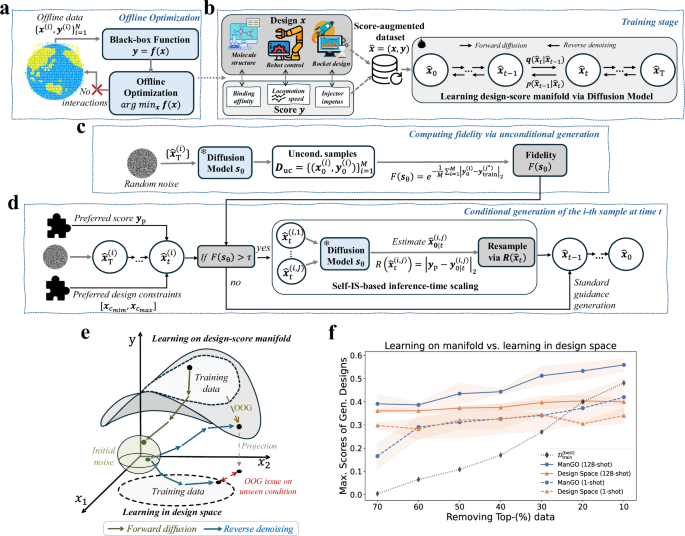
A new offline optimization framework called ManGO is making waves in the field of design and engineering, significantly enhancing the capabilities of design-score manifold learning. By employing diffusion models, ManGO sets itself apart from traditional optimization methods, enabling the generation of high-quality designs based on inferred scores without requiring real-time data evaluations. Key to this innovation is ManGO’s ability to establish a bidirectional relationship between design configurations and their corresponding performance scores, facilitating a more robust understanding of design landscapes.
Offline optimization, a technique for identifying optimal designs within a specified design space without needing online evaluations, can be categorized into two primary types: Single-Objective Optimization (SOO) and Multi-Objective Optimization (MOO). The former focuses on identifying the best design based on a single score, while the latter seeks to balance trade-offs among multiple conflicting objectives. ManGO enhances these processes by leveraging a learned design-score manifold, allowing the system to not only predict scores for given designs but also generate designs based on desired scores.
Diffusion models underpin ManGO’s capabilities, effectively transforming random noise into realistic data through a sophisticated iterative process. These models excel in capturing complex geometrical relationships within the design space, overcoming limitations faced by conventional methods, which often struggle with nonlinear scenarios. The inherent stability and fidelity of diffusion models further bolster ManGO’s performance, making it an ideal choice for offline optimization tasks.
In a series of experiments, ManGO demonstrated its superiority over existing baseline methods in both offline SOO and MOO tasks via extensive testing on Design-Bench and Off-MOO-Bench datasets. The findings revealed that ManGO consistently outperformed 22 other established frameworks, showcasing its efficacy in various domains, including materials science, robotics, and bioengineering. With a mean rank of 2.2 out of 24 in single-objective tasks and an impressive first-place ranking on four specific challenges, its performance speaks to the potential of learning the design-score manifold.
Beyond performance metrics, ManGO’s visualization capabilities reveal significant insights into its operational strengths. In controlled experiments, it effectively reconstructs the design-score manifold, maintaining fidelity even with reduced data quality. For instance, in a task focused on optimizing superconducting materials, ManGO achieved a level of performance gain exceeding 0.1 over traditional design-space approaches, a margin that widened to nearly 0.2 under specific data conditions. These results confirm not only the framework’s robustness but also its ability to extrapolate beyond training datasets.
As the field of offline optimization evolves, the implications of ManGO’s approach are far-reaching. Its capacity to handle complex design scenarios, coupled with its bidirectional mapping capabilities, positions it as a pivotal tool for engineers and researchers aiming for improved design efficiency and effectiveness. The ability to generate tailored designs conditioned on specific performance scores opens new avenues in design methodology, particularly in environments where real-time evaluation is not feasible.
With ongoing advancements in AI-driven optimization frameworks, ManGO represents a significant step forward, promising to reshape how engineers and scientists approach complex design challenges. As its capabilities expand, the potential for further innovation within this domain appears limitless, heralding a new era for offline optimization methodologies.
See also Indonesia Bans Elon Musk’s Grok Over Non-Consensual Sexual Deepfakes
 Grid Dynamics Gains 8.2% After Multi-Year AWS Generative AI Partnership Announcement
 Grok AI Model Continues to Generate Sexualized Content Despite Recent Restrictions
 AI Chatbot News Experiment Reveals 18% Fabricated Sources and 47% Accuracy Rate
 Generative AI Risks: 60% of Enterprises Fail to Measure Security Vulnerabilities