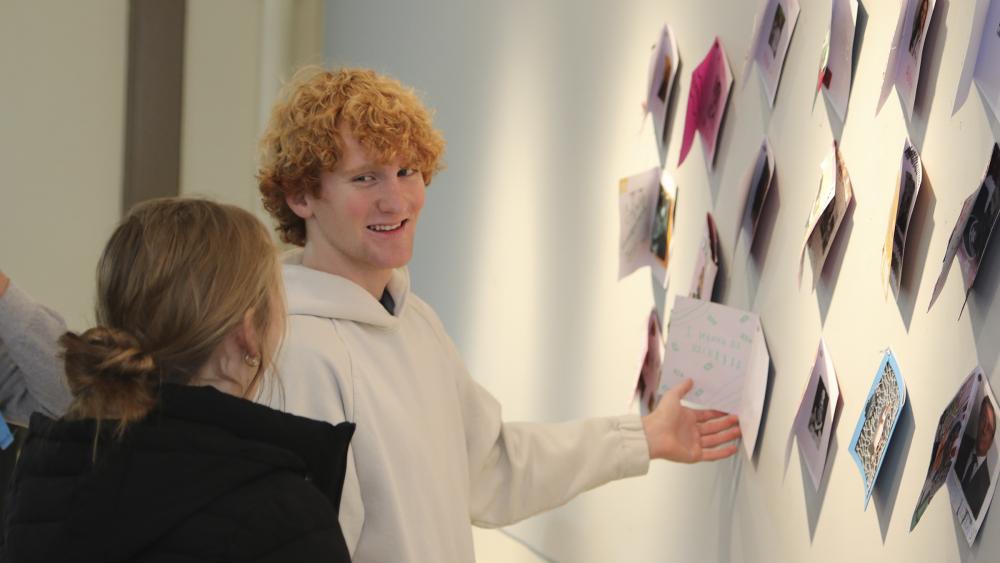
SHARON, Pa. — Students in the English 15: Rhetoric and Composition class at Penn State Shenango have taken an imaginative approach to envision their futures through a new art display titled “A Future You,” showcased in the Lecture Hall Art Gallery. This initiative prompts students to explore personal aspirations by utilizing creative processes that incorporate both traditional art forms and modern technology.
“What do you want to be when you grow up?” This common question resonates particularly with first-year college students embarking on their academic journeys. Elaine Andrews, assistant director of academic affairs and associate teaching professor of English at Penn State Shenango, emphasized the importance of self-exploration during this formative time. “As a former General Education Scholar at Penn State, I worked on other projects involving integrative thinking, a learning objective which involves exploring topics from multi-disciplinary angles,” she said.
To facilitate this exploration, Andrews invited students from all sections of the Rhetoric and Composition class to create self-portrait collages. The creative process began with students cutting and pasting newspaper or magazine clippings, stickers, and colored paper to craft a physical representation of their aspirations. Following this, they utilized Microsoft Copilot to generate AI-created images that depicted them in future occupations or activities. This blend of tactile and digital art aimed to enhance self-reflection and creative expression.
As students incorporated AI-generated images into their collages, they were also tasked with writing reflection essays on their experiences. “Returning to basic arts and crafts skills in an English class brought joy to many of the students,” Andrews observed. “There is something so therapeutic and accessible about collage. There’s not that anxiety about needing to be ‘good’ at it.”
However, the integration of AI was not without its challenges. Andrews noted that many students expressed ambivalence towards the technology. “I underestimated students’ ambivalence about AI. Some didn’t think the AI image looked like them at all,” she remarked. “Many wrote about how they preferred the collage as the more accurate form of self-expression.” This feedback highlights the ongoing dialogue about the role of AI in creative fields, where authentic representation remains a priority for many.
The project was funded by campus leadership, ensuring that students did not incur any costs for their participation. The “A Future You” display will remain open to the public through the end of the fall semester, providing a platform for students to showcase their artistic expressions and reflections.
The initiative serves not only as a creative outlet but also as a reminder of the evolving nature of self-identity in a technologically advanced society. As students navigate their futures, the juxtaposition of personal expression and AI involvement raises important questions about authenticity and the role of emerging technologies in shaping individual narratives.
Looking ahead, such projects at educational institutions may foster deeper engagement with technology while encouraging students to maintain a sense of individuality. By bridging the gap between traditional art and modern tools, educators can create enriching experiences that resonate with the aspirations of today’s youth.
See also Pollo AI Launches Video Generator, Transforming Images and Text into Dynamic Clips
 Pixazo Launches Kling O1 API, a Unified Multi-Modal Engine for Advanced Visual Creation
 Apple Launches STARFlow-V: Open-Source Text-to-Video Model Surpasses Diffusion Techniques
 Nvidia and Mistral AI Partner to Optimize Open Source LLMs with Mistral 3 Integration
 UMass Dartmouth Unveils LLM-Driven Framework Achieving 97.5% Accuracy in Robot Code Generation