

















































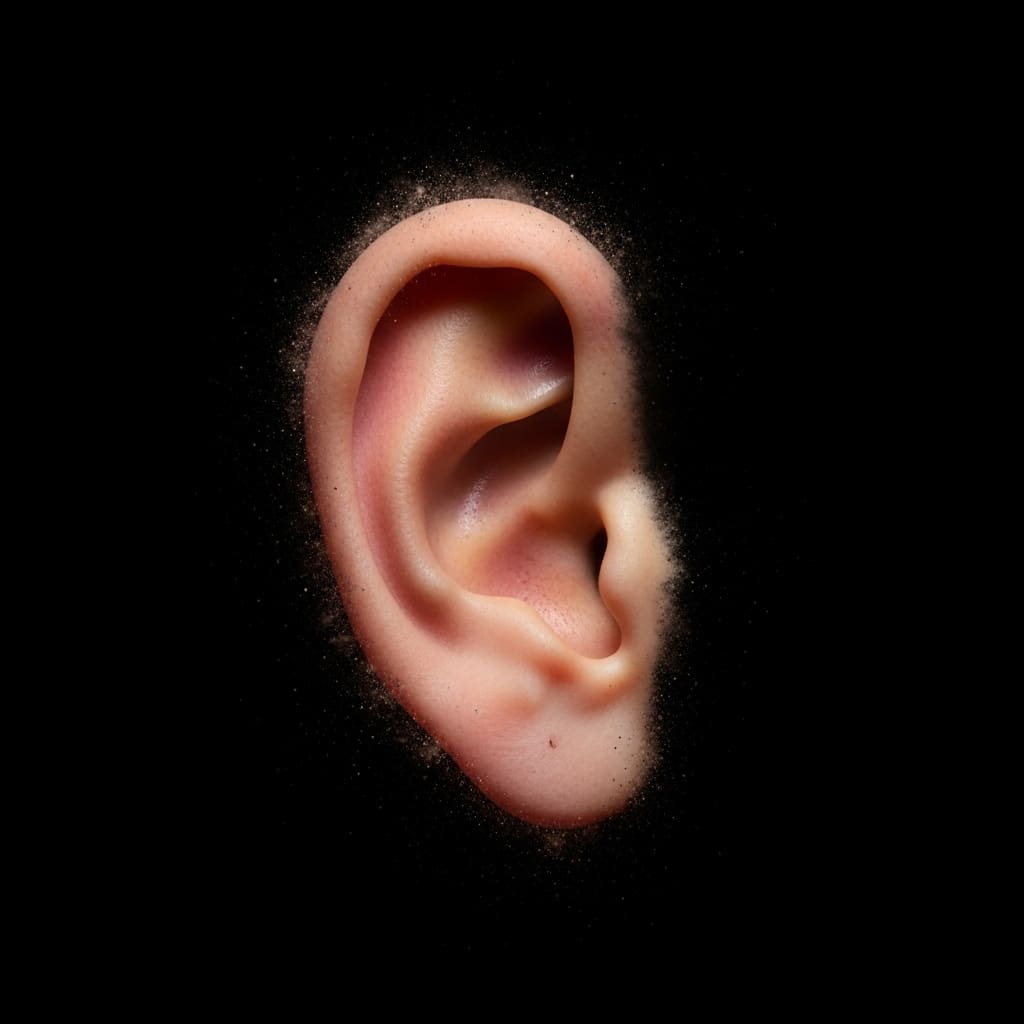
Researchers at the University of Notre Dame have developed a groundbreaking technique to enhance the reliability of ear-based biometric recognition systems, which are often compromised by occlusions from accessories such as earrings and earphones. The collaborative team, consisting of Deeksha Arun, Kevin W. Bowyer, and Patrick Flynn from the Department of Computer Science and Engineering, introduced a novel diffusion-based inpainting method that reconstructs obscured ear regions with remarkable anatomical accuracy. This advancement is particularly significant for security and surveillance applications, as it allows for improved biometric identification even when ears are partially covered.
The researchers’ approach consists of two main stages: accessory mask generation and masked restoration, or inpainting. Initially, they employ a fine-tuned YOLOv10 model to identify and label the bounding boxes of common ear accessories in images. This supervised detector generates candidate accessory boxes at inference time. To bolster robustness against unseen accessory types, they also integrate Grounding DINO, a zero-shot detector that uses curated text prompts to enhance accessory localization.
Automated mask generation is a critical component of this workflow, enabling the inpainting process to focus specifically on the occluded areas of the ear. By combining YOLOv10, Grounding DINO, and SAM 2, the researchers have created a fully automated pipeline capable of achieving precise accessory segmentation even under varied lighting conditions and accessory styles. Following the mask generation, high-quality pixel masks are refined through morphological operations before guiding the inpainting process, which reconstructs an accessory-free ear image suitable for downstream recognition tasks.
In their experiments, the team aligned and cropped ear images to ensure consistent input for both the original and reconstructed images. They rigorously compared the recognition performance with and without the diffusion-based pre-processing, utilizing various model architectures. The results indicated a marked improvement in biometric utility, as the diffusion models’ iterative denoising process enabled the generation of sharp and structure-consistent reconstructions. This minimizes identity drift and avoids artifacts that could undermine biometric accuracy, marking a significant step forward in ear biometric recognition.
The study reveals that the application of this innovative inpainting technique significantly enhances verification accuracy in biometric systems. Tests conducted across multiple benchmark datasets, including the EarVN1.0 dataset, demonstrated that the method is particularly effective under challenging conditions, such as when occlusions obscure vital ear features. Although the authors noted that performance can occasionally decline on cleaner datasets, suggesting a complex trade-off between artifact removal and the preservation of subtle identity cues, the overall benefits of the approach are clear.
The researchers’ key contributions include the establishment of the first ear accessory-aware diffusion-based inpainting pipeline and a comprehensive evaluation demonstrating improved verification performance across multiple benchmarks. Future research is expected to focus on integrating explicit identity-preserving constraints, such as feature-level consistency, to maintain fine-grained morphological details. Additionally, the team aims to extend the model to handle more complex occlusions, such as hair or shadows, thereby exploring tighter integration between restoration and recognition modules.
This pioneering work paves the way for more reliable ear-based biometric systems, which could have far-reaching implications for security and identification technologies. As the demand for robust biometric recognition solutions continues to grow, the advancements made in this study represent a significant leap forward, addressing a critical challenge in the field and setting the stage for future developments.
👉 More information
🗞Diffusion for De-Occlusion: Accessory-Aware Diffusion Inpainting for Robust Ear Biometric Recognition
🧠 ArXiv: https://arxiv.org/abs/2601.19795
 NVIDIA Launches FastGen, Accelerating Diffusion Models with 100x Speed Improvements
 Tech Giants Introduce Filters to Combat Surge of Low-Quality AI Content
 Google Launches Nano Banana AI for Instant Image Generation Directly in Chrome
 YouTube Announces Major Policy Shift to Combat AI-Generated Content Flooding Platform
 Google DeepMind Launches Project Genie, Enabling Dynamic AI-Generated Worlds for Users