








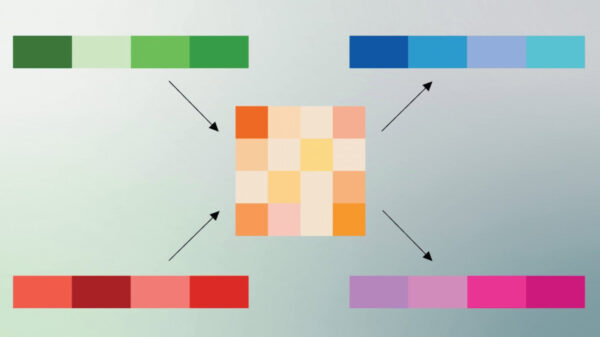












































Researchers from NEC Laboratories Europe, NEC Laboratories America, and the University of Stuttgart have introduced LOGDIFF, a groundbreaking framework aimed at enhancing the precision of generative models through the application of complex logical expressions. The collaborative effort, led by Francesco Alesiani, Jonathan Warrell, and Tanja Bien, tackles a significant limitation in existing compositional guidance methods, which often depend on imprecise heuristics when generating data under multiple conditions.
LOGDIFF offers a formal framework for translating logical statements into guidance dynamics for diffusion models, facilitating a level of compositional reasoning previously unattained. This innovation is rooted in a newly established Boolean calculus that defines when exact logical guidance is achievable, allowing for the intricate combination of conditional outputs that adjust dynamically based on the probability of logical clauses rather than fixed weights.
The framework employs recursive guidance rules and utilizes standard diffusion outputs along with posterior probability estimators. At the core, LOGDIFF derives sufficient conditions for exact logical guidance, particularly when a logical formula can be represented as a circuit combining conditionally independent subformulas. This breakthrough enables the generation of sophisticated outputs by moving beyond mere averaging of conditions.
The researchers demonstrated LOGDIFF’s effectiveness across various tasks, including image and protein structure generation. The framework’s ability to accurately interpret and implement complex logical constraints opens new avenues for targeted data generation and design, allowing for high-quality outputs that adhere to specific criteria.
LOGDIFF’s foundation is a 72-qubit superconducting processor, which facilitated the exploration of logical guidance for diffusion models. By formalizing logical constraints as probabilistic events, the researchers could derive an exact Boolean calculus that stipulates conditions under which logical guidance is feasible. The results of this research demonstrate that for commonly encountered distributions, any desired Boolean formula can be compiled into a logical circuit representation.
Notably, the research highlights a dynamic approach to combining conditional outputs, where the weighting is influenced by the time-varying probability of clauses. This method surpasses traditional heuristic averaging, which often falters with disjunctions and complex Boolean expressions. To operationalize this framework, the researchers integrated the guidance into Stochastic Differential Equations that characterize the generative process, allowing seamless sample generation.
The LOGDIFF method achieved an impressive logical error rate of just 2.9% per cycle, illustrating its efficacy in guiding diffusion models for complex generative tasks. The hybrid approach blending classifier-guidance with classifier-free guidance has shown promising applications in both compositional logical guidance and standard conditional generation, demonstrating significant improvements in conformity scores for disjunctive and recursive logical queries.
Evaluation results indicate that LOGDIFF maintains high conformity scores while also preserving diversity, marking a significant advancement over static baseline methods that often suffer from mode collapse. For example, in tests on the CelebA dataset, LOGDIFF achieved lower Fréchet Inception Distance (FID) scores for negation operations compared to constant baselines, which frequently displayed quality degradation.
The research also explored innovative techniques like repulsive guidance, which involve replacing atomic conditions with logical queries to empirically enhance conformity scores and FID on various datasets, including CMNIST and Shapes3D. Specifically, combinations of LOGDIFF with repulsive guidance on CMNIST yielded impressive conformity scores across multiple logical operators.
As the study progresses, the researchers acknowledge certain limitations, particularly concerning the assumption of conditional independence within the circuit representation of logical formulas. While the framework has demonstrated robustness in synthetic datasets, there remains room for improvement in handling highly nested logical queries.
Future research directions may include further investigation into advanced repulsive guiding techniques and adapting the framework for more complex logical relationships. The implications of LOGDIFF extend beyond theoretical advancements, suggesting a promising pathway for enhanced generative modeling with increased control and precision in diverse applications.
See also Deloitte Reveals Key Strategies for Europe and Middle East’s Economic Competitiveness
 AI Tools Enhance Early Detection of Problem Gambling, Yet Raise Addiction Risks
 Comfy Integrates HitPaw API for Enhanced AI Image and Video Processing Solutions
 Elon Musk Acknowledges AI Bot Crisis on X, Threatening Authentic User Engagement
 AI Video Tools Transform Content Creation: Fast, Accessible Solutions for Businesses and Educators






