






















































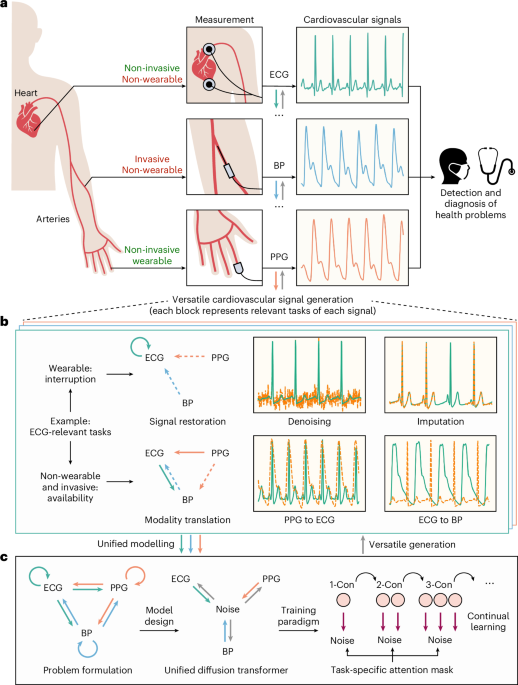
The World Health Organization (WHO) has identified cardiovascular diseases (CVDs) as a leading global health concern, underscoring the urgency for effective monitoring and management strategies. In 2021, WHO reported that CVDs remain a significant cause of morbidity and mortality worldwide. The effective assessment of cardiovascular health is increasingly reliant on advanced technologies, particularly in non-invasive monitoring methods such as photoplethysmography (PPG) and electrocardiography (ECG).
Research by Alian and Shelley (2014) highlights the effectiveness of PPG in monitoring blood volume changes, providing critical data about heart rate and other cardiovascular metrics. This technique has gained traction in wearable technologies, enabling continuous health monitoring in everyday settings. Mirvis and Goldberger (2001) further emphasize the role of electrocardiography in diagnosing heart conditions, showcasing its importance in clinical environments.
As technology advances, the integration of PPG and ECG has become a focal point for researchers. This convergence is particularly relevant in the context of developing cuffless blood pressure estimation algorithms, as noted by Kachuee et al. (2016). Their work has propelled innovations in continuous health-care monitoring systems, leveraging the strengths of both PPG and ECG signal processing.
Current research is also focused on enhancing data quality and signal processing techniques to improve the accuracy of cardiovascular assessments. A study by Elgendi et al. (2024) provides recommendations for evaluating PPG-based algorithms aimed at blood pressure assessment, while Tamura et al. (2014) review the evolution of wearable photoplethysmographic sensors, noting significant technological advancements.
Recent studies have also highlighted the challenges of noise and interference in ECG and PPG signals. Chiang et al. (2019) explored noise reduction techniques using fully convolutional denoising autoencoders, showing promising results for clearer signal interpretation. The application of deep learning methods for signal denoising has gained traction, as evidenced by Ahmed et al. (2023), who proposed a hybrid approach combining deep learning and wavelet transforms to enhance PPG signal quality.
The growing body of evidence supports the development of algorithms to reconstruct ECG signals from PPG data. Ezzat et al. (2024) introduced a hybrid attention-based deep learning network to facilitate ECG signal reconstruction, potentially expanding the utility of PPG in clinical applications. This research underscores an ongoing trend toward leveraging machine learning techniques to enhance cardiovascular monitoring capabilities.
Market Implications and Future Directions
The integration of PPG and ECG technologies signifies a transformative shift in cardiovascular health management. As wearable devices become more sophisticated, companies are increasingly investing in research and development to enhance the functionality of these technologies. For instance, the implementation of PPG and ECG in consumer health devices offers potential for early detection of heart-related issues, making proactive health management more accessible.
Regulatory bodies and health organizations are also taking notice. The American College of Cardiology and other professional bodies advocate for the adoption of standardized protocols to ensure the accuracy and reliability of devices that utilize these technologies. Such initiatives are crucial for fostering trust between consumers and health technologies.
In summary, the convergence of PPG and ECG technologies represents a significant opportunity for improving cardiovascular health monitoring. With ongoing advancements in signal processing and machine learning, the potential for these technologies to enhance patient outcomes is substantial. As the healthcare landscape continues to evolve, the emphasis on non-invasive monitoring will likely grow, paving the way for innovative solutions that prioritize preventative care and early intervention.
See also Top 10 Fastest-Growing AI Startups: Key Insights on Funding and Market Impact
 Q. Lu Reveals Multimodal Gesture Recognition Method to Enhance User Interaction Accuracy
 ChatPlayground AI Launches Unlimited Plan for $79, Compares 25+ Leading AI Models
 Andrew Ng Warns AI is Years Away from General Intelligence, Citing Training Constraints
 Quantum U-Net Achieves 76% Improvement in Synthetic Earth Observation Data Quality