























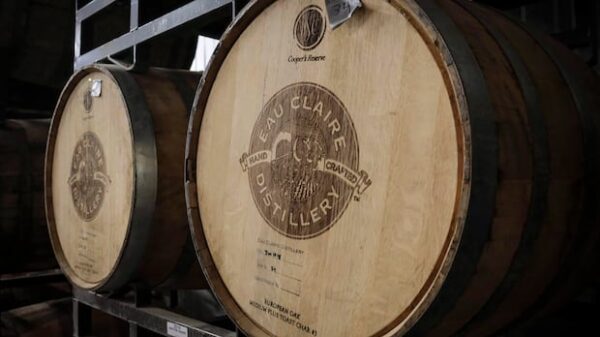


























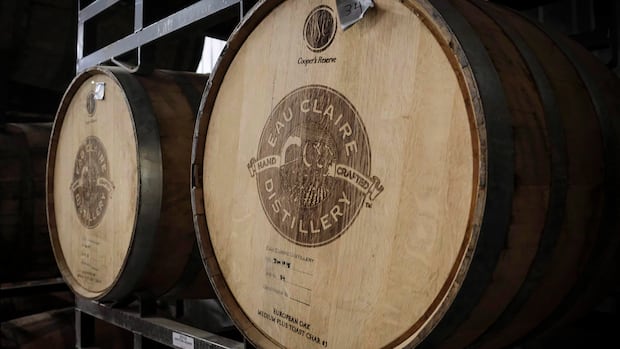
The Alberta provincial government has introduced the Alberta Whisky Act, a legislative measure aimed at defining and protecting the label “Alberta whisky.” Tabled on Tuesday, the act outlines specific criteria that must be met for whisky to be marketed as such, setting a framework that distinguishes Alberta’s offerings from other Canadian whiskies. Premier Danielle Smith stated, “We think there’s an obvious solution to this challenge. Define what Alberta whisky is and protect it in legislation.”
To earn the “Alberta whisky” designation, producers must adhere to a series of stringent regulations. These include requirements that the whisky must be mashed, fermented, aged, proofed, and bottled entirely within Alberta. Importantly, the water used during production must be sourced 100 percent from Alberta, and at least two-thirds of the grains must be grown within the province. Additives post-distillation are limited to Alberta water and plain caramel color, with any blended alcohol products restricted to no more than 9.09 percent of total alcohol content and aged for at least two years. Furthermore, the whisky must be aged for a minimum of three years in small wood barrels and have an alcohol by volume of at least 40 percent.
The province has emphasized that participation in this designation is voluntary, allowing distillers to produce other whisky products that do not meet the legal definition. Service Alberta Minister Dale Nally expressed his enthusiasm for the initiative, describing it as “a real passion project.” He believes that Alberta is on the verge of gaining recognition for its whisky, asserting, “I have known for some time what the world is about to find out, and that’s that we have some of the best whisky in the world.”
In a notable first, the Alberta Whisky Act represents the initial use of AI technology in drafting provincial legislation. Nally detailed that AI was employed to analyze data and provide foundational building blocks for the legislative process. He assured that human oversight remained integral throughout, citing Alberta Technology Minister Nate Glubish’s involvement in selecting the AI model. Nally remarked, “We wanted to be the first jurisdiction in Canada that leveraged AI to write legislation,” highlighting the province’s ambition to lead in technological innovation.
When tasked with defining the term “Alberta whisky” last October, Nally faced skepticism from industry insiders. Davin de Kergommeaux, founder of the Canadian Whisky Awards, raised concerns about the practicality of legislative definitions in a rapidly evolving industry. He suggested that a broader guideline could be more beneficial, such as linking the designation to eligibility for Alberta tax breaks.
Prior to the release of the new rules, several distillers expressed confidence in Alberta’s potential to produce exceptional whisky, citing the province’s high-quality barley and favorable climate. Jacques Tremblay, co-owner of Bridgeland Distillery, pointed out that Alberta has long been recognized for its superb water and grains, stating, “I think it’s just the right time to say, finally, hey, with all these ingredients, we can also make a world-renowned whisky on our own.”
Tremblay participated in open house events organized by Nally in November as the Alberta Whisky Act was drafted. He advocated for a requirement that all ingredients be sourced from Alberta, emphasizing the importance of a label that resonates with consumers. “I think making the bar a little bit higher is a good thing,” he added. Should the act pass, businesses will self-declare their products as “Alberta whisky,” with compliance overseen by Alberta Gaming, Liquor and Cannabis.
Notably, the government has addressed potential attempts to circumvent the regulations by explicitly prohibiting the use of the term “Alberta whiskey”—with an extra “e”—in labeling. Looking ahead, Nally mentioned the possibility of establishing an Alberta whisky or spirits trail, akin to the Kentucky Bourbon Trail, which could attract visitors and promote both urban and rural distilleries across Alberta.
See also AI Technology Enhances Road Safety in U.S. Cities
 China Enforces New Rules Mandating Labeling of AI-Generated Content Starting Next Year
 AI-Generated Video of Indian Army Official Criticizing Modi’s Policies Debunked as Fake
 JobSphere Launches AI Career Assistant, Reducing Costs by 89% with Multilingual Support
 Australia Mandates AI Training for 185,000 Public Servants to Enhance Service Delivery