

















































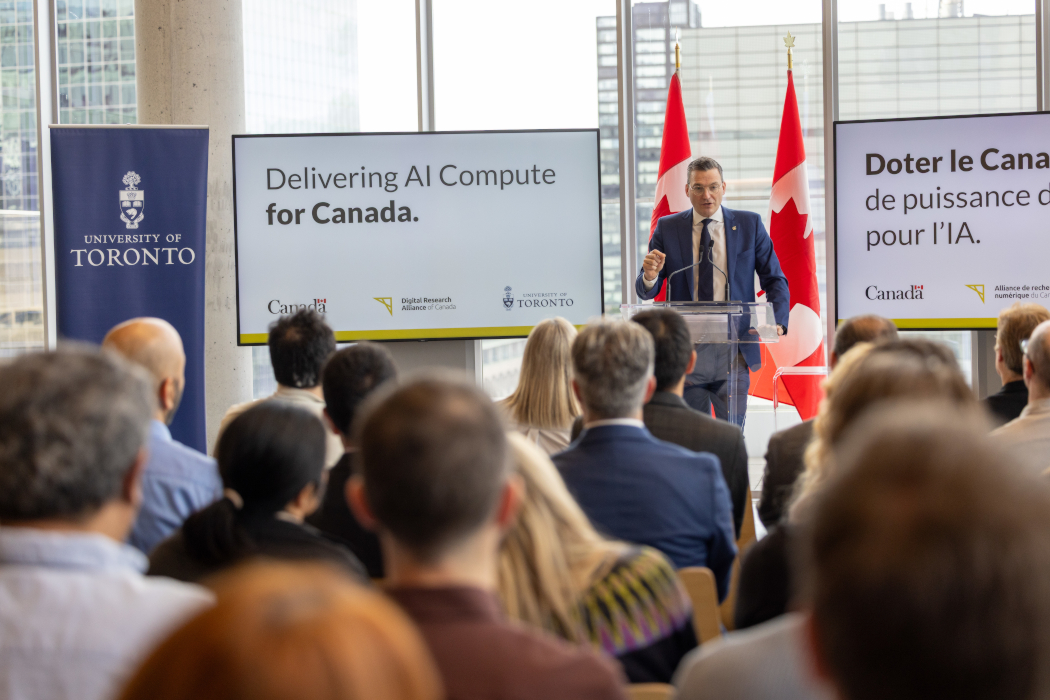
The Government of Canada has announced a significant investment of $42.5 million aimed at enhancing artificial intelligence (AI) computing infrastructure at the University of Toronto (U of T). This funding, revealed today by Canada’s Minister of AI and Digital Innovation Evan Solomon at the Toronto AI research hub, the Vector Institute, marks a vital step toward bolstering AI research capabilities nationwide.
This financial commitment will expand U of T’s AI compute capacity to support researchers across the country, allowing for the training of AI models with billions of parameters. Minister Solomon underscored the importance of this investment, stating, “This is an investment in our sovereignty. This is an investment in keeping Canadian data here in Canada.” He emphasized that countries that possess their own computing resources will have greater control over their future.
Concerns regarding Canada’s underinvestment in computing power have emerged, threatening the nation’s AI talent and research advantage. The federal government’s $2-billion Sovereign AI Compute Strategy is designed to address this issue. The funding for U of T represents the second major allocation from this strategy, following a commitment last year of up to $240 million to large-language model creator Cohere for a new data center in Cambridge, Ontario.
Timothy Chan, U of T’s associate vice-president and vice-provost of strategic initiatives, articulated the practical implications of the funding. He stated, “The practical takeaway is, we’re going to be able to train and validate these [AI] models that have billions of parameters, and this was not possible before in the Canadian academic ecosystem.” This initiative is set to be accessible to a wide range of researchers, enhancing the collaborative nature of AI research in Canada.
The funding is being allocated through the Digital Research Alliance of Canada, a federally-backed non-profit that provides essential digital tools and infrastructure to domestic researchers. The $42.5 million comprises a $40-million capital investment for the fiscal year 2025–2026 and an additional $2.5 million over the subsequent two years to operate, maintain, and staff the new facility.
In conjunction with the federal investment, U of T plans to contribute an additional $100,000 towards the initiative. The university’s supercomputing centre, SciNet, will oversee the new system, which aims to complement existing capabilities. This infrastructure is expected to empower researchers to apply AI across various fields, from healthcare to fundamental science and technology.
Most of the $42.5 million investment will be directed towards acquiring new graphics processing units (GPUs) from Nvidia, a leading American technology company. A smaller portion of the funding will be allocated for expanded storage capabilities. The new GPUs will be co-located with U of T’s existing Trillium system, a high-performance computing cluster that is one of the country’s most advanced supercomputers for academic research. Chan anticipates that this federal investment will triple the GPU computing capacity of the Trillium system, which is currently housed at a data centre in Vaughan, Ontario. The expansion is expected to be completed by spring 2026.
In addition to the U of T funding, the federal government is working on the upcoming AI Sovereign Compute Infrastructure Program (SCIP), which could allocate up to $705 million for establishing a Canadian-owned supercomputer aimed at supporting both researchers and industry. A request for proposals is anticipated in 2026.
While the investment at U of T aligns with Canada’s sovereign computing objectives, Minister Solomon has suggested that a range of partnerships, including those with foreign multinationals, is essential for achieving these goals. Recently, he highlighted Finnish telecommunications giant Nokia’s $340-million expansion in Ottawa, which is supported by $40 million from the federal government, as an example of successful sovereign AI initiatives.
In response to critiques from Canadian tech leaders, such as Shopify co-founder and CEO Tobi Lütke, who labeled government involvement as “toxic,” Solomon defended the need for international collaboration. He remarked on the positive impact of companies like Nokia, which have a long-standing presence in Canada and are investing significantly in local innovation and job creation. Solomon stated, “It is excellent to see companies who are investing hundreds of millions of dollars in Canada.”
As Canada navigates a complex global landscape, the government aims to ensure resilience and strengthen ties with international trade partners. Solomon concluded, “It is always surprising when a company chooses Canada like this, and this is a good story.” The investment at U of T represents a crucial turning point in Canada’s pursuit of AI research leadership and sovereignty.
See also UAE and Uzbekistan Launch AI Initiatives, Training 5 Million Prompt Engineers
 U.S. Government Launches $10B AI Supply Chain Initiative Amidst Global Competition
 Hong Kong Legal Week 2025 Launches with Focus on AI, Lawtech, and Global Collaboration
 Gartner Reports 74% of Global CIOs to Deploy AI, Boosting IT Budgets in 2026
 Australia Unveils AI Roadmap, Prioritizes Existing Laws Over New Regulations