














































SINGAPORE – Over the past year, Mabel Loh has immersed herself in the world of artificial intelligence (AI), attending more than 30 classes to develop an AI companion app aimed at helping women achieve their wellness goals. Driven by her passion, the fitness coach-turned-start-up-founder has gained insights into the limitations of large-language models and the significance of synthetic data, despite lacking a technical background.
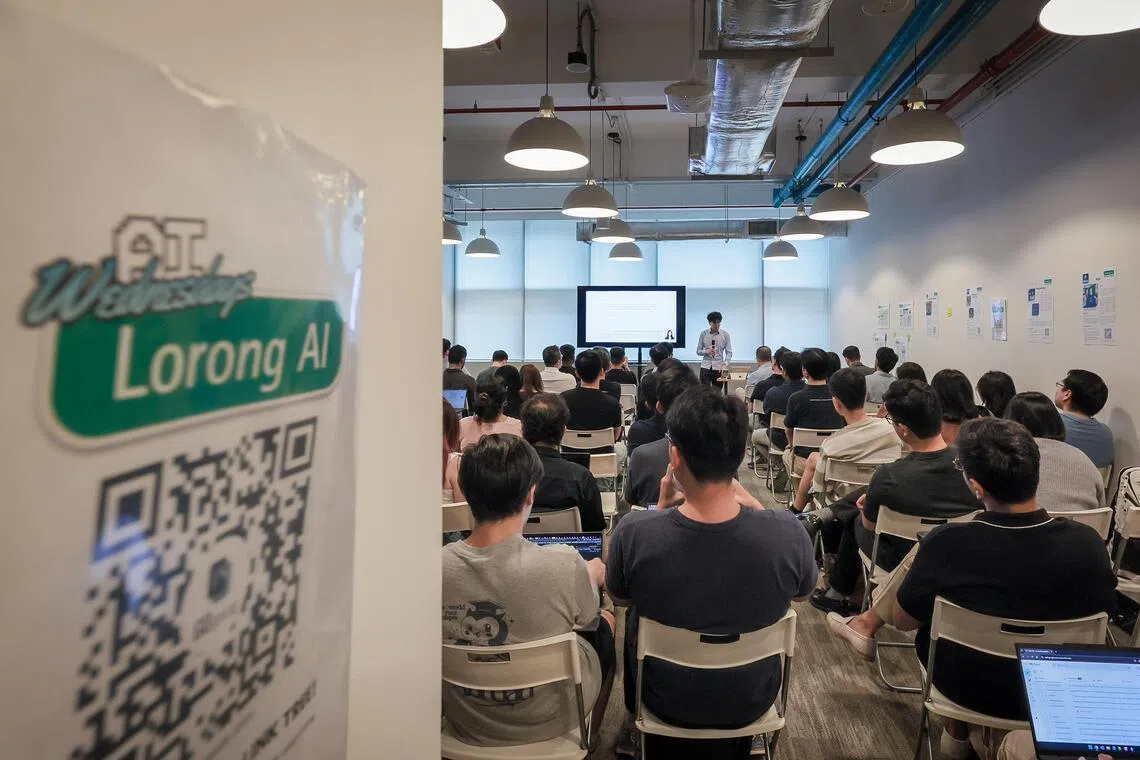
Loh is among the more than 4,000 participants who have frequented Lorong AI, an “iconic” AI hub in Singapore as described by Josephine Teo, Minister for Digital Development and Information. The hub, which started operations in January 2025, is located on the third floor of the WeWork office in Chinatown and aims to foster a collaborative environment for AI founders, practitioners, researchers, and innovators.
During a Budget speech on February 12, Prime Minister Lawrence Wong announced plans for a new AI park at one-north, which will build on the existing Lorong AI initiative. The park is designed to facilitate collaboration and translate ideas into practical solutions.
Lorong AI’s activities vary from hands-on workshops, known as Fri-DIYs, to open discussions on technical subjects during ThursTalks. AI Wednesdays are particularly popular, attracting attendees for classes led by scientists, engineers, and researchers covering topics from AI safety to interactive gaming experiences. Despite its capacity for 50, events often exceed 100 participants, especially when prominent speakers from companies like OpenAI are involved.
Edmund Zhou, director-in-charge of Lorong AI, noted that the team drew inspiration from established AI hubs, such as Cerebral Valley in San Francisco and Area 2071 in Dubai, to shape their operations. “In the AI space, thousands of research papers are published every week,” he told The Straits Times. “To know what is truly useful, people want to know what the ‘word on the street is’ and have a quick exchange of ideas.”
The hub offers a space where AI practitioners from various government agencies can collaborate on projects. Zhou highlighted that three in five participants are professionals like data scientists, researchers, and AI engineers, while others are “AI-curious” individuals seeking to learn more about the field. With over 250 paying members—membership tied to a WeWork co-working pass—some events remain free and open to the public.
While many classes currently focus on technical aspects, the team at Lorong AI is working to include more beginner-friendly sessions. Clear boundaries are maintained to prevent businesses from exploiting the platform for promotional purposes. “If they tell us that their speaker is the head of marketing, we remind them that our participants will likely ask more technical questions, so they must be prepared to engage accordingly,” Zhou said.
For Loh, her goal is to create a virtual AI “oppa,” a term used in Korean culture to refer to an older male figure, that can provide personalized responses to users working toward their wellness goals. This AI companion, powered by generative AI models, aims to help women, from those unfamiliar with fitness to caregivers managing stress, by allowing them to unlock storylines as they achieve personal health milestones.
However, early testing of the prototype on Telegram revealed challenges when users seeking workplace advice were met with unexpected suggestions related to video game strategies. Loh recognized the importance of understanding data set biases in AI development after a talk by a scientist from Nvidia. This led her to consider a new range of synthetic datasets designed to more accurately reflect Singapore’s diverse population.
“I might not use it now, but at least it’s good to build a bank of resources in my mind that I can tap on later,” she noted. Unlike traditional upskilling courses, Lorong AI’s modular system allows for greater flexibility in learning.
Several start-ups, including Singapore AI Safety Hub and Featherless.ai, also operate within the same space, facilitating networking and collaboration. Featherless.ai, which provides access to over 20,000 AI models for app creators, opened its local office in December 2025. Business lead Ron Tay emphasized the benefit of being co-located with Lorong AI, stating, “We are trying to move towards marketing to businesses as well, and being here allows us to learn about what the industry at large needs.”
After nearly a year since its inception, Lorong AI plans to expand to one-north. Teo announced the launch of the hub’s second site at Block 69 Ayer Rajah Crescent, set for February 23. “Ultimately, we want people to think about Lorong AI when they think about AI in Singapore,” Zhou concluded. “This is the place to come and speak with like-minded individuals, and the place to be if you have a problem to solve.”
See also Andhra Pradesh Partners with Gates Foundation for AI-Driven Healthcare Reforms
 UAE Unveils World’s First AI-Native Government with $3.5B Investment for Transformation
 Kyndryl Expands AI Training to 50,000 Students and 30,000 Youth in India
 UK Prime Minister Keir Starmer Unveils New Regulations for AI Chatbots to Protect Children
 Bharat-VISTAAR Launches Voice-First AI Tool for Farmers, Enhances Data Access and Decision-Making