
























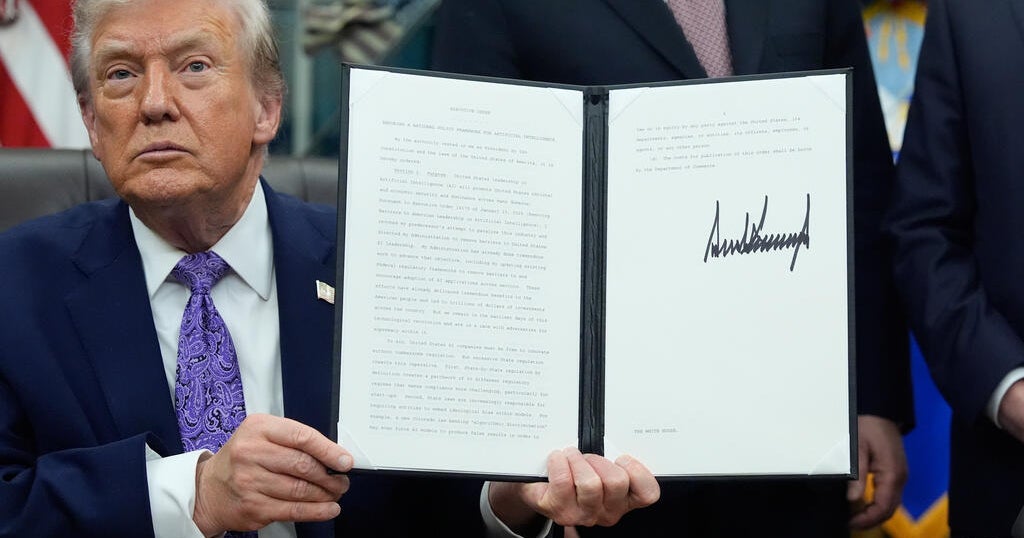
President Trump signed an executive order on Thursday aimed at consolidating federal oversight of artificial intelligence (AI) regulations, arguing that the rapidly evolving industry risks being hindered by a fragmented set of state rules. This move comes as the U.S. competes with China for dominance in the AI sector.
Trump’s order reflects growing concerns among bipartisan lawmakers and various advocacy groups, who have called for stricter regulations on AI due to its increasing influence on significant life decisions, including hiring practices, loan approvals, and medical care. The president emphasized that excessive state regulations could stifle innovation and investment, stating, “There’s only going to be one winner” in the global AI race.
In remarks made from the Oval Office, Trump criticized the logistical challenges posed by requiring companies to navigate approvals from 50 different states, arguing that this complexity would deter investment. “If they had to get 50 different approvals from 50 different states, you can forget it because it’s impossible to do,” he said.
The executive order tasks Attorney General Pam Bondi with establishing a new task force to challenge state-level AI regulations and mandates the Commerce Department to compile a list of regulations deemed problematic for the industry. The order also threatens to cut funding from broadband deployment programs and other grants to states that enact their own AI laws.
David Sacks, a venture capitalist and a key figure guiding Trump’s policies on cryptocurrency and AI, noted that the administration would focus on opposing only the most burdensome state regulations while not interfering with measures aimed at protecting children. Four states—Colorado, California, Utah, and Texas—have enacted laws that govern aspects of AI in the private sector, which include limitations on personal data collection and increased transparency requirements.
These state laws are responses to the pervasive nature of AI in daily life, with technology already influencing critical decisions. However, studies have indicated that AI systems can perpetuate biases, affecting outcomes based on gender or race. As a result, some states have proposed broader regulations requiring companies to assess and mitigate potential discrimination risks associated with their AI technologies.
In addition to these ambitious proposals, various states have instituted regulations targeting specific aspects of AI, such as banning deepfakes in elections and restricting the use of AI-generated content for nonconsensual pornography. Proponents of limiting state-level regulations, including some Republicans and advocates like Sacks, argue that a patchwork of differing rules would hinder technological progress and innovation, particularly for smaller startups that might struggle with compliance costs. “At best, we’ll end up with 50 different AI models for 50 different states,” Sacks warned on social media earlier this week, cautioning that such fragmentation could allow nations like China to surge ahead.
However, bipartisan resistance to Trump’s executive order is apparent. For instance, Florida Governor Ron DeSantis criticized the proposal as a “subsidy to Big Tech,” asserting that it undermines local governance. “The rise of AI is the most significant economic and cultural shift occurring at the moment,” he stated, emphasizing the importance of allowing states to manage the technology’s integration into society according to their specific needs.
Democratic Senator Ed Markey of Massachusetts also condemned Trump’s initiative, labeling it an “early Christmas present for his CEO billionaire buddies.” The debate underscores a growing tension between federal authority and state autonomy in regulating emerging technologies that increasingly shape society.
As the U.S. continues to grapple with the implications of AI, the balance between innovation and regulation remains a focal point of national discourse. The outcome of this executive order may significantly shape the future landscape of AI governance in America, raising questions about how best to foster a competitive environment while ensuring responsible use of technology.
See also Government Confirms No AI Regulation for Scriptwriting Amid Industry Concerns on Copyright
 Trump Bans State AI Laws, Igniting Legal Challenges and Civil Rights Concerns
 Elon Musk’s xAI Launches Grok in El Salvador for 1M Students Amid Controversy
 Governments’ Lack of Transparency on Data Centers Sparks Environmental Concerns
 Gene Simmons Calls for Federal AI Regulation to Protect Music Industry and IP Rights