





















































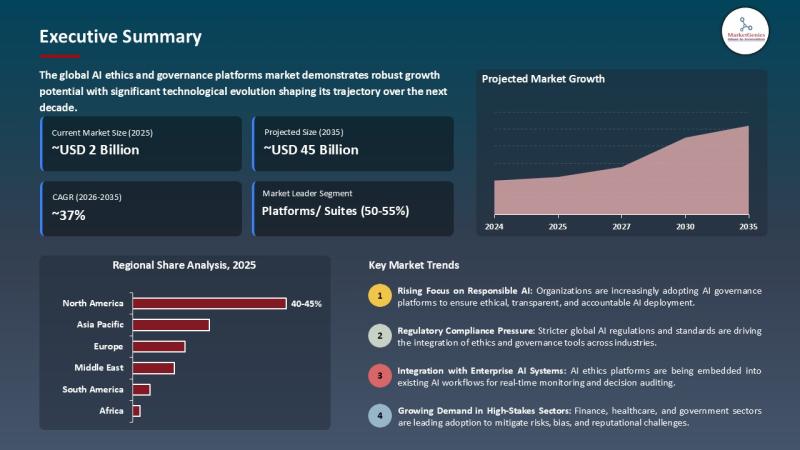
As artificial intelligence (AI) becomes integral to business operations, the urgency for effective governance and ethical oversight has surged, particularly in Europe. The AI Ethics and Governance Platforms Market is projected to grow from USD 1.9 billion in 2025 to USD 45.3 billion by 2035, achieving a compound annual growth rate (CAGR) of 37.1%. This reflects a critical shift as enterprises grapple with the transparency crisis surrounding AI decision-making.
The demand for accountability in AI systems is not merely a regulatory formality; it has become a cornerstone of competitive advantage in the European market. The European Union (EU) AI Act mandates that organizations ensure AI systems are fair, safe, and accountable. Enterprises are facing increasing pressure to implement frameworks that offer traceable and auditable AI decision-making, bias detection, and governance that complies with rigorous regulatory standards.
In sectors like Banking, Financial Services, and Insurance (BFSI), organizations must substantiate that credit decisions and fraud detection algorithms adhere to fairness and compliance benchmarks. Healthcare also requires explainable AI, where clinical decisions can significantly impact lives, necessitating a robust governance framework. Furthermore, public services now must ensure transparency in AI applications that affect citizen welfare, reflecting a broader societal expectation for ethical AI practices.
However, many enterprises are struggling to implement these systems effectively. The landscape is complicated by fragmented AI infrastructures across departments and outdated models lacking documentation. Additionally, talent shortages in AI risk management and ethics are prevalent, further complicating the integration of governance platforms. The failure to address these challenges could lead to rising internal risks, public mistrust, and regulatory non-compliance, which could result in significant fines or operational shutdowns.
Despite the hurdles, the market is witnessing transformative trends. Companies are embedding explainability modules into AI workflows and developing automated compliance solutions to monitor adherence to evolving regulations. Real-time drift detection is becoming increasingly important to prevent model failures, while dataset lineage tracing is being implemented to track the origins of training data and assess associated risks. This shift indicates a move from mere trust claims to the provision of tangible trust evidence.
Governance as a Business Imperative
The focus on AI governance has ascended to the boardroom, as AI failures can lead to comprehensive business failures. Governance platforms now play a crucial role in determining access to regulated markets, maintaining reputational capital, and ensuring shareholder confidence. As the market evolves, European enterprises that prioritize trust in their AI systems could unlock significant scale and resilience, positioning themselves as leaders in the responsible AI landscape.
Prominent players in this emerging market include governance suite providers that integrate with major cloud platforms like Microsoft Azure AI, Google Vertex, and AWS Sagemaker. Additionally, compliance-tech vendors are specializing in EU AI Act certification, while consulting firms like PwC, EY, Deloitte, and Accenture are adopting hybrid advisory and software models to assist clients in navigating this complex regulatory environment. The organizations that will thrive in this space are those that can operationalize governance rapidly and effectively.
Looking ahead, the future of the AI Ethics and Governance Platforms Market appears robust. By 2035, governance systems are expected to be embedded in every AI lifecycle, converting responsible AI certification into a market entry prerequisite. Compliant enterprises may benefit from lower risk premiums and enhanced trust premiums, further incentivizing the adoption of ethical AI practices.
Ultimately, Europe’s commitment to ethical AI governance is not merely a regulatory requirement; it is becoming a fundamental aspect of its digital economy. The transition from innovation-driven growth to governance-ensured development underscores the importance of transparency, safety, and accountability in AI applications. As the continent navigates this intricate landscape, trust will transform from a mere slogan into a vital infrastructural element necessary for sustainable growth.
See also India’s Privacy Law: Calls for Real-Time Accountability as AI Data Demands Shift
 UK Government Launches AI Growth Lab to Accelerate Adoption Amid Regulation Hurdles
 Florida Lawmakers Advance AI Bill of Rights Amid National Regulation Debate
 Trump Proposes Executive Order to Block State AI Regulations Amid Colorado Law Delays
 South Korea Mandates AI-Generated Ad Labeling to Combat Deceptive Promotions