

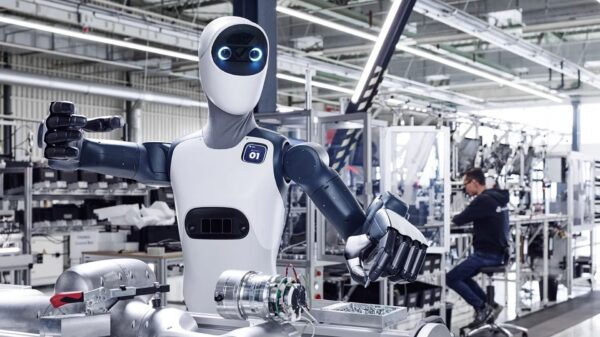



















































Artificial intelligence (AI) is transforming the landscape of robotics, evolving from an auxiliary function to a critical component that redefines how machines are designed, implemented, and governed. This shift, articulated in a recent report by the International Federation of Robotics (IFR), highlights the significant role AI plays across various sectors, from manufacturing to logistics and services.
The IFR’s report reveals that established AI techniques, including computer vision and supervised learning, currently drive most commercial value in robotics. However, the report notes that generative AI and reinforcement learning remain largely confined to specific tasks and supervised environments. As AI technologies continue to advance, their integration into robotics is becoming increasingly essential, facilitating automation beyond fixed tasks and addressing the growing demand for efficiency.
According to the IFR, factors such as safety, reliability, and integration challenges still pose constraints on AI’s broader implementation in robotics. The federation emphasizes that future growth will depend on addressing these challenges, alongside crucial concerns in cybersecurity, energy efficiency, and regulatory frameworks. The report advocates for a disciplined approach to AI deployment, prioritizing trust over rapid experimentation to ensure long-term benefits.
The report asserts that AI has long underpinned robotics, enabling machines to adapt to production variability and operate safely in shared environments. Recent advancements in data availability and computing power are now pushing AI into a central role, expanding the range of tasks robots can undertake and reducing barriers for adoption across industries.
Key AI capabilities in current robotic applications include machine vision, which allows robots to inspect quality and classify objects with greater precision, and autonomous mobility, where AI-driven navigation technologies facilitate reliable movement in dynamic environments. Predictive maintenance, powered by real-time diagnostics, is also reshaping how robotic systems are developed and maintained, promising reduced downtime and extended asset life.
The IFR highlights six core AI subfields critical to enhancing automation capabilities: Physical AI, which integrates sensory data for real-world understanding; machine learning, aimed at optimizing production schedules; computer vision for defect detection and precise guidance; reinforcement learning for complex tasks; natural language processing for voice-controlled interfaces; and large language models for automating documentation and operational decision-making.
Adoption of AI-enabled robotics varies by industry, with logistics and warehousing leading the way. Labor shortages and high throughput demands have accelerated the use of autonomous mobile robots in these structured environments. Likewise, manufacturing sectors, including automotive and electronics, utilize AI for precision tasks, while service industries, such as retail and healthcare, increasingly deploy robots to alleviate staffing pressures. In these contexts, AI is not replacing automation but enhancing it, allowing for the efficient handling of operations previously deemed uneconomical to automate.
Importantly, the IFR report refutes the notion that AI will simply displace human jobs. Instead, it argues that robots will continue to take on physically demanding tasks, while human roles will evolve toward supervision and strategic decision-making. This shift has created demand for new skill sets, including data literacy and AI model management, even as concerns about workplace monitoring and reduced employee autonomy emerge. Governments and businesses are responding with training programs, but the rapid pace of technological change is intensifying pressures on workers and employers alike.
Macroeconomic factors further drive the urgency for AI adoption in robotics. Labor shortages and rising costs are pushing companies to seek productivity gains through automation, while geopolitical pressures and trade disruptions emphasize the need for resilience and efficiency. Strategic investments in AI and robotics are increasingly seen as vital for long-term competitiveness, solidifying their role in industrial strategy.
However, as the integration of AI in robotics deepens, significant safety and security challenges arise. The IFR report identifies key concerns, including cybersecurity vulnerabilities posed by cloud-connected robots, data privacy issues stemming from the vast data collection in workplaces, and the opacity of deep learning systems complicating accountability. The federation stresses the importance of isolating safety-critical functions from AI capabilities, enhancing validation processes, and establishing clear liability frameworks as robots become more integrated into human environments.
AI’s role in sustainability discussions is also complex. While it can enable more efficient resource use and extend robot lifespans through predictive maintenance, the energy demands of large models pose challenges to environmental goals. The report underscores the need for energy-efficient processing and circular-economy applications to address these trade-offs in the design and deployment of AI-driven robots.
Amid regulatory fragmentation, the report notes that Europe is advancing with the EU AI Act, while China has created a comprehensive regulatory framework. In contrast, the United States lacks a cohesive approach, relying on a patchwork of federal and state regulations, which introduces uncertainty for developers. The IFR warns that inconsistent standards could stymie deployment and inflate compliance costs for global manufacturers.
Looking ahead, the IFR forecasts that by 2030-2035, AI will be a standard feature in most robotic systems, enhancing efficiency and reducing error rates. The advancements in simulation and virtual commissioning are expected to shorten development cycles and mitigate deployment risks. Beyond this period, a shift toward more versatile and mobile robots, including humanoid systems, is anticipated, although they will face significant challenges related to cost, safety, reliability, and governance.
See also New York Proposes NY FAIR News Act Requiring Disclaimers for AI-Generated Content
 AI Governance in Banking QA Becomes Crucial as Regulatory Scrutiny Intensifies
 Legislation Introduces 15 AI Bills Across U.S. States for Enhanced Transparency and Safety
 DISCO Launches Scaled Agentic AI Tool for E-Discovery with Multi-Step Reasoning
 European Commission Charges Meta with Antitrust Violations for Blocking Third-Party AI on WhatsApp