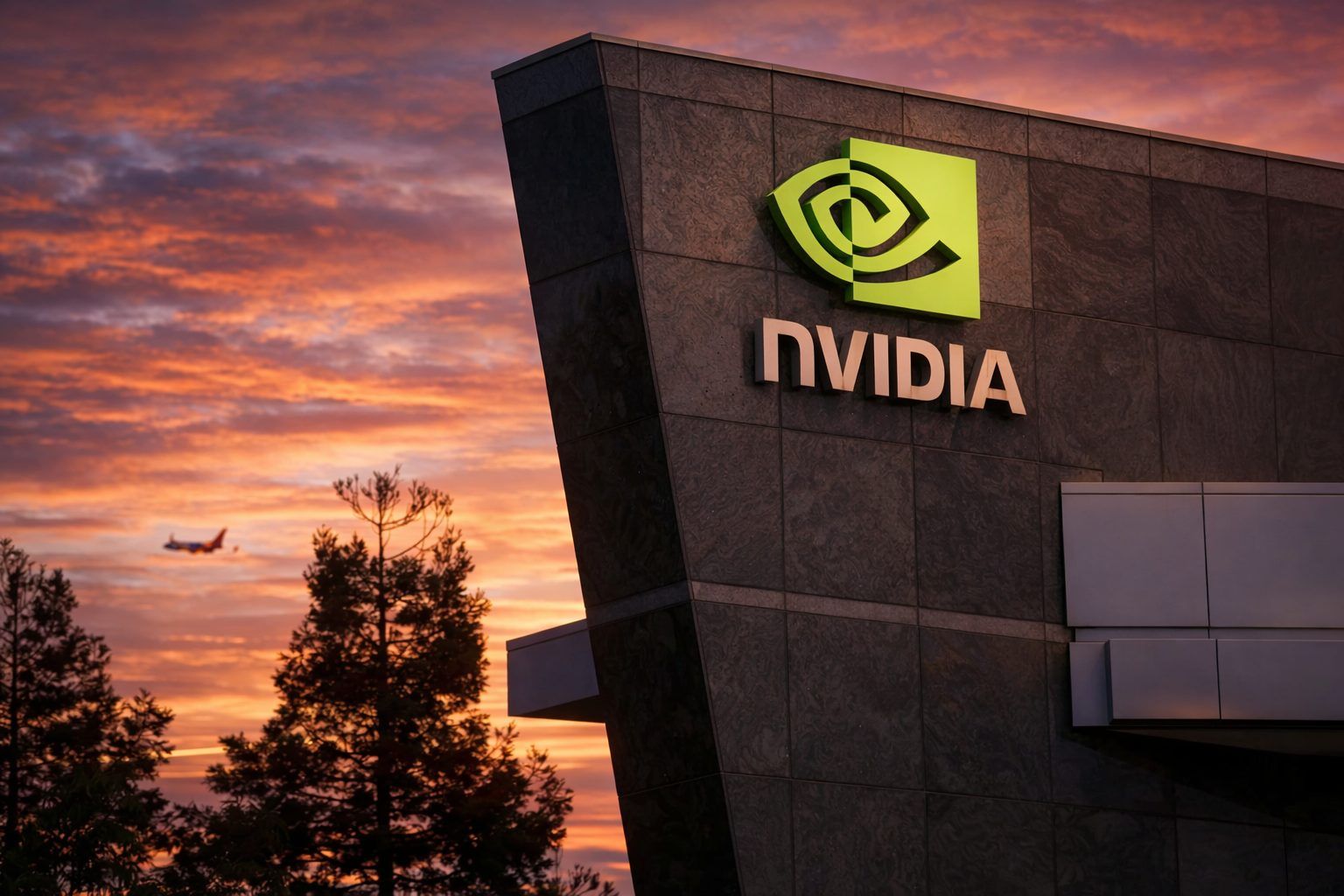
As of 7:12 p.m. ET on Friday, December 26, 2025, NVIDIA Corporation (NASDAQ: NVDA) was trading around $190.53 in after-hours activity, with roughly 139.5 million shares traded during the day. Friday’s session unfolded in a quiet, post-holiday market that kept major U.S. indexes close to recent highs. The Dow slipped to 48,710.97, the S&P 500 to 6,929.94, and the Nasdaq Composite to 23,593.10, with overall exchange volume notably lighter than recent averages.
For Nvidia stock investors, the late-week focus has narrowed to a familiar set of themes—AI infrastructure spending, export controls, and supply-chain strategy—but with new urgency following a non-exclusive AI inference technology licensing agreement with Groq and recent developments surrounding U.S.–China chip policy.
The most significant driver of near-term sentiment around NVDA stock is Nvidia’s partnership with Groq, an AI-chip startup known for its inference-focused technology. Groq announced it has entered a non-exclusive licensing agreement with Nvidia aimed at “accelerating AI inference at global scale.” The agreement will see Groq founder Jonathan Ross, Groq President Sunny Madra, and other key team members join Nvidia to help advance and scale the licensed technology.
Nvidia’s stock saw an uptick in Friday’s session following the licensing agreement with Groq, interpreted as a clear signal that Wall Street is acknowledging Nvidia’s efforts to extend its lead beyond AI training into the increasingly competitive domain of AI inference. The market consensus recognizes the importance of inference, but discussions are now centered on what the economics of inference will entail as hyperscalers and competitors pursue specialized chips and custom silicon.
The Groq partnership is being framed as a strategic move to hedge against the rising demand for inference workloads. However, it also raises concerns that broadening into inference-optimized solutions could challenge Nvidia’s premium profitability over time. Investors are particularly attentive to the deal structure, as Nvidia clarified it has not outright acquired Groq, despite market speculation regarding possible asset purchases and the strategic value of Groq’s capabilities.
While deal headlines can influence stock price fluctuations, Nvidia’s longer-term valuation debate hinges on two critical questions: how sustainable is AI infrastructure spending, and can Nvidia maintain its margins and growth rates amidst rising competition? In its third quarter of fiscal 2026 (ended October 26, 2025), Nvidia reported revenues of $57.0 billion—a 22% increase quarter-over-quarter and a 62% rise year-over-year. Data Center revenue accounted for $51.2 billion, marking a 25% increase quarter-over-quarter and a 66% year-over-year jump. The company’s GAAP gross margin stood at 73.4%, with diluted earnings per share at $1.30.
Nvidia’s guidance for the fourth quarter of fiscal 2026 indicates projected revenue of $65.0 billion, plus or minus 2%, and a gross margin of approximately 74.8% (±50 basis points). This combination of rapid revenue growth and stable margins explains why Wall Street remains willing to assign Nvidia a market-leading valuation multiple, even as investors debate the longevity of AI capital expenditures at current levels.
Amid ongoing concerns about an “AI bubble,” Nvidia’s CEO Jensen Huang has pushed back, emphasizing the company’s extensive footprint across cloud and enterprise deployments. Notably, Nvidia has referenced $500 billion in bookings through 2026 for advanced chips, yet it also faces the reality that 61% of its revenue is derived from just four major customers, underscoring the potential impact of changes in hyperscaler purchasing behavior.
A second significant factor influencing Nvidia’s stock forecasts is geopolitical dynamics, particularly regarding U.S. export controls to China. Reports indicate that the Biden administration may permit exports of Nvidia’s H200 processors to China, subject to a 25% fee. However, this comes with concerns about national security implications. Nvidia recently informed Chinese clients that it aims to begin shipments of H200 chips by mid-February 2026, pending Beijing’s approval.
In addition to geopolitical factors, Nvidia’s strategic positioning will also hinge on its manufacturing capabilities. Recently, the U.S. antitrust agencies cleared Nvidia’s $5 billion investment in Intel, which could have implications for Nvidia’s supply chain. However, reports indicate Nvidia halted plans to manufacture chips through Intel’s 18A production process, highlighting ongoing concerns about advanced manufacturing capacity.
As Nvidia navigates these complex dynamics, insider sales also merit attention. Recently, Nvidia board member Harvey Jones sold over $44 million worth of shares, drawing scrutiny due to the company’s widespread ownership and ongoing debate over its market valuation.
Looking ahead, analysts remain generally constructive on Nvidia, with a mean price target around $254, compared to its recent trading prices. However, the wide range of forecasts reflects sensitivity to various factors, including the pace of AI spending, competition in inference silicon, and the sustainability of profit margins as Nvidia broadens its platform. As Nvidia prepares for the next regular trading session on Monday, December 29, 2025, investors will focus on the clarity of the Groq deal structure, developments in export controls, and the upcoming fourth-quarter financial results scheduled for February 25, 2026.
Nvidia concludes 2025 with a clear core investment premise centered on AI compute demand. However, with shifting landscapes in competitive dynamics, export policies, and internal growth strategies, the question remains whether these strategic moves will be enough to sustain NVDA’s stock growth in the competitive AI market.
See also AI-Powered Tax Tools Simplify Expat Compliance, Reducing Filing Stress by 70%
 Texas Lawmakers Defy Trump’s AI Regulation Order, Seek $3.3B Broadband Funding
 Taiwan Proposes AI Basic Act to Boost Regulation Amid Semiconductor Industry Growth
 China Proposes Draft AI Regulations to Enhance Safety and Ethical Standards for Human-Interactive Services