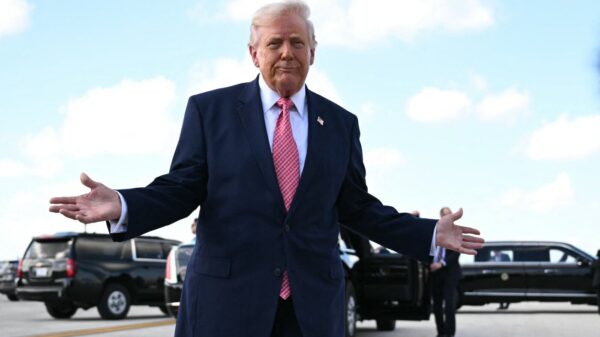


















































Artificial intelligence (AI) is experiencing rapid advancements in the United States, yet state-level regulations pose a significant threat to the industry’s growth. As of July 2025, 38 states had enacted approximately 100 AI-related measures, according to the National Conference of State Legislatures. In response, President Donald Trump is urging Congress to implement a federal preemption of state AI regulations, although the prospects for such legislation appear increasingly dim.
Before Thanksgiving, Trump took to Truth Social to advocate for a uniform federal standard rather than a multitude of local laws, emphasizing the need for the U.S. to maintain its competitive edge over China in the global AI landscape. The President called on congressional Republicans to either incorporate federal preemption into the National Defense Authorization Act (NDAA) or pass a separate bill to ensure “nobody will ever be able to compete with America.”
Shortly thereafter, an executive order titled “Eliminating State Law Obstruction of National AI Policy” was leaked. According to Public Citizen, a progressive consumer rights nonprofit, the order would have mandated the Justice Department to form a task force aimed at challenging state laws that contravene the Constitution or federal preemption. Similar to a failed AI moratorium in an earlier Senate version of the One Big Beautiful Bill Act (OBBBA), the order also directed the Commerce Department to withhold federal broadband funding from states with laws that conflict with the President’s AI Action Plan.
In light of backlash from GOP lawmakers who criticized the rumored order as infringing on federalism, the White House opted to withhold its publication. Despite this, Trump has persistently pushed for language in the NDAA that would nullify technology-specific state and municipal AI regulations through federal preemption. This proposal faces opposition from notable Republicans including Reps. Marjorie Taylor Greene (R–Ga.), Thomas Massie (R–Ky.), and Chip Roy (R–Texas), who argue that it represents federal overreach and undermines federalism instead of serving as a rational regulation of interstate commerce. House Majority Leader Steve Scalise remarked that the NDAA “wasn’t the best place for [preemption language] to fit.”
Meanwhile, in the Senate, resistance is mounting from Senators Marsha Blackburn (R–Tenn.)—who previously opposed the OBBBA moratorium—and Josh Hawley (R–Mo.), who has introduced four bills this year aimed at strictly regulating AI technology and its applications. This opposition suggests that a standalone preemption bill currently lacks the necessary 60 votes to overcome a filibuster.
While concerns regarding federal overreach are valid, the potential pitfalls of state-level regulation are also significant. Kristian Stout, director of innovation policy at the International Center for Law and Economics, argues that a fragmented patchwork of state AI regulations “threatens to impose substantial costs while failing to achieve the consumer protection goals that motivate such regulation.” Policymakers wary of Big Tech may believe regulations will rein in these companies, but companies like Anthropic are actively advocating for regulation. Incumbent firms with substantial legal resources can navigate a complex web of state-specific AI laws; this compliance burden stifles innovation, ultimately harming the American economy and jeopardizing national security by effectively shutting out capital-poor startups.
Trump’s recently unveiled Genesis Mission, framed as a “Manhattan Project for AI,” aims to “launch coordinated funding opportunities…to incentivize private-sector participation in AI-driven scientific research.” The future of American AI does not necessitate industrial policy, but rather a cohesive nationwide regulatory framework that offers both nascent and established AI developers the clarity necessary for ongoing private investment and development. Unfortunately, given the current Congressional landscape, the likelihood of such legislation passing remains low.
See also Vertex Expands AI Tax Compliance Partnership with CPA.com, Targets $27.86 Fair Value
 Rubrik Announces 24.5% Surge After Launching AI Agent Governance and Q3 Revenue Update
 NHTSA Expands Tesla FSD Probe, Documents 80 Violations of Traffic Laws