









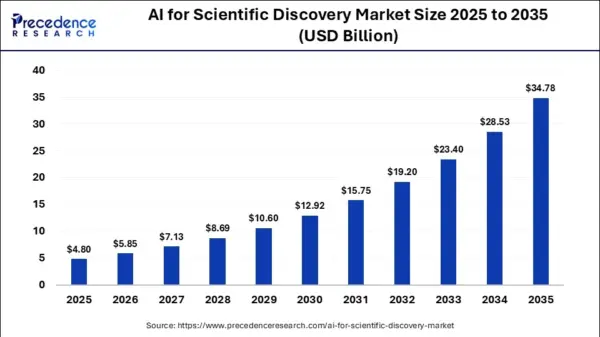






































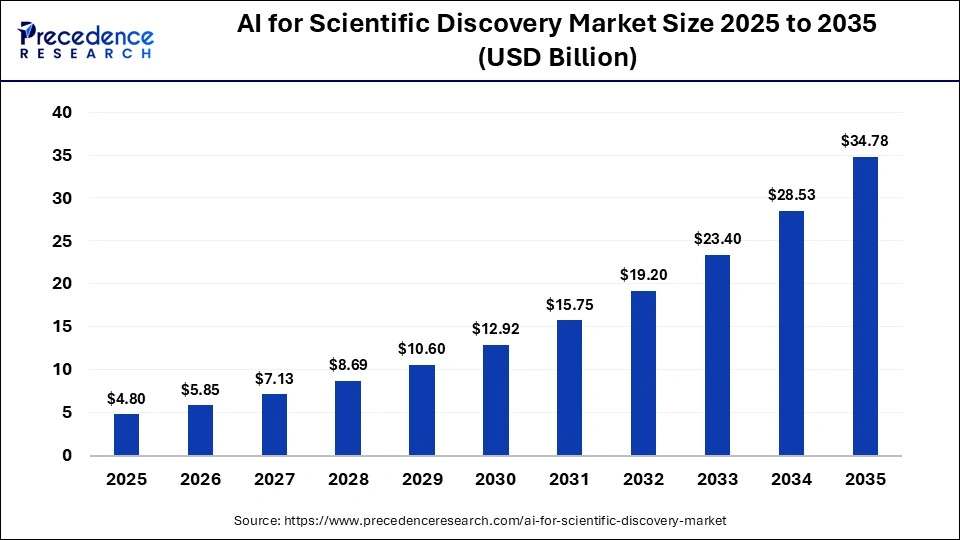
The global market for AI-driven scientific discovery is set for significant growth, with projections estimating an increase from USD 4.80 billion in 2025 to approximately USD 34.78 billion by 2035. This marks a compound annual growth rate (CAGR) of 21.90% from 2026 to 2035, driven by advancements in high-performance computing, massive data generation, and the rising use of generative AI in drug discovery.
Key regions are showing varied growth trajectories, with North America holding nearly 40% of the market share in 2025, while the Asia Pacific is expected to expand at the fastest rate during the same period. The strong foothold of North America can be attributed to its robust technological advancements and extensive research and development integration across various scientific sectors. Major companies in this space, like NVIDIA and IBM, are actively collaborating with pharmaceutical firms to accelerate innovation.
In terms of market segments, AI software platforms captured the largest share at approximately 44% in 2025. This dominance is linked to their ability to efficiently manage complex datasets, especially in drug discovery and material sciences. The data infrastructure and high-performance computing (HPC) platforms are expected to exhibit the fastest growth, as they provide essential processing power and networking capabilities necessary for training massive AI models.
Machine learning algorithms led the technology segment with around 36% market share in 2025, thanks to their effectiveness in large-scale data analysis and pattern recognition. These algorithms automate time-consuming tasks, enabling researchers to focus on more complex issues. Meanwhile, generative AI models are projected to see rapid growth, as they can simulate experiments and predict outcomes with minimal human intervention, ultimately reducing research costs and timelines.
In terms of applications, the drug discovery and biomedical research segment held a substantial market share of nearly 34% in 2025. This segment benefits from AI’s ability to analyze complex datasets for faster and more cost-effective drug development. The materials science and chemistry discovery segment, however, is anticipated to grow at the fastest CAGR during the forecast period due to its increasing demand for advanced AI technologies that can predict material properties before physical synthesis.
Pharmaceutical and biotechnology companies dominated the end-user segment, holding approximately 36% of the market share in 2025. This trend is driven by their focus on improving research and development outcomes through AI technology, which helps optimize clinical trials and analyze extensive biological datasets. Notably, reports indicate that around 53% of industry leaders in pharmaceuticals prioritize AI and advanced analytics to enhance operational efficiency.
Looking ahead, the North American market, estimated at USD 1.92 billion in 2025, is projected to reach approximately USD 14.09 billion by 2035, growing at a CAGR of 22.06%. The U.S. alone is expected to grow from USD 1.44 billion to nearly USD 10.63 billion in the same period, bolstered by governmental initiatives that promote AI and scientific research.
In contrast, the Asia Pacific region is emerging as a powerhouse, aided by substantial government investments in AI and a burgeoning R&D ecosystem in sectors such as pharmaceuticals and biotechnology. China, in particular, is rapidly expanding its AI capabilities, supported by a growing number of researchers and an increasing number of patents in the AI domain.
Meanwhile, Europe is also making strides in this competitive landscape, leveraging strong government-backed initiatives and collaborations among academic institutions, tech firms, and the pharmaceutical industry. Programs like Horizon Europe are pushing the envelope in AI adoption across various scientific sectors, positioning the region as a vital player in AI-driven breakthroughs.
As the AI for scientific discovery market continues to evolve, it is clear that these technological advancements will not only shape the future of research but also influence broader sectors, including healthcare, materials science, and climate modeling. The acceleration of AI adoption across various domains indicates a shift towards more efficient, data-driven scientific exploration that promises to revolutionize traditional methodologies.
See also AI Study Reveals Generated Faces Indistinguishable from Real Photos, Erodes Trust in Visual Media
 Gen AI Revolutionizes Market Research, Transforming $140B Industry Dynamics
 Researchers Unlock Light-Based AI Operations for Significant Energy Efficiency Gains
 Tempus AI Reports $334M Earnings Surge, Unveils Lymphoma Research Partnership
 Iaroslav Argunov Reveals Big Data Methodology Boosting Construction Profits by Billions