









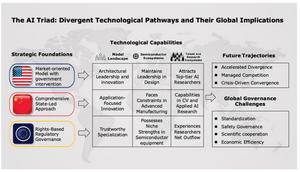









































A new international study has revealed that the development of artificial intelligence (AI) is increasingly diverging into three distinct global systems dominated by the United States, China, and the European Union. Each system is shaped by varying policy priorities, innovation models, and governance philosophies, suggesting a fundamental shift in the technological landscape that could complicate global cooperation on AI safety, standards, and innovation.
Published in the journal Artificial Intelligence & Environment, the study employs a combination of policy analysis, technical benchmarking, and industry data to illustrate how national strategies influence real-world AI capabilities and ecosystems. The authors characterize this emerging framework as an “AI Triad,” where each region is navigating different technological pathways and experiencing increasing structural separation.
“The key insight is that AI development is not converging toward a single global model,” stated the study’s corresponding author. “Instead, policy frameworks are reinforcing distinct technological trajectories that could become increasingly incompatible over time.”
The research indicates that the United States maintains a significant lead in foundational AI models and semiconductor design, propelled by robust private-sector innovation and substantial investment. This market-driven approach has facilitated rapid advancements in AI architecture, multimodal models, and extensive computing infrastructures. However, the concentration of resources within a limited number of firms and regions raises issues related to equity and resilience.
Conversely, China has focused on the rapid deployment and integration of AI technologies across various sectors, including industry, governance, and infrastructure. The state’s coordinated efforts and long-term planning have fostered large-scale adoption in areas such as manufacturing, urban management, and digital services. While this application-centric strategy has expedited commercialization, China continues to face challenges, particularly due to restrictions on access to advanced semiconductors.
The European Union represents a third pathway that prioritizes regulation, trust, and standard-setting. Its risk-based governance model is designed to ensure transparency, accountability, and the ethical deployment of AI technologies. While this regulatory approach may decelerate certain types of innovation, it positions the EU as a potential global leader in trustworthy and safety-critical AI systems.
“Each region is optimizing for different values,” the authors explained. “The United States prioritizes innovation speed, China emphasizes deployment scale, and the European Union focuses on governance and societal safeguards.”
The study highlights that these regional differences are already manifesting in measurable technological fragmentation across architectures, data regimes, talent flows, and application ecosystems. Such fragmentation could elevate costs for multinational companies, diminish the interoperability of AI systems, and complicate international collaboration in critical domains like climate research and healthcare.
Looking to the future, the researchers outline several potential scenarios. One scenario involves an acceleration of divergence, wherein technological systems become increasingly incompatible. Another envisions managed competition, where limited cooperation occurs in specific areas such as safety standards. A third scenario contemplates the possibility of a global crisis prompting rapid convergence on governance frameworks.
Despite the inherent risks, the authors maintain that collaboration remains feasible. They advocate for the establishment of minimum interoperability standards, the expansion of shared safety research initiatives, and the creation of controlled channels for scientific exchange. These measures, they argue, could help preserve collaboration while acknowledging the geopolitical realities at play.
“The window for coordinated governance is narrowing,” the authors cautioned. “Decisions made in the next few years may determine whether AI evolves into fragmented spheres of influence or a system of managed coexistence.”
In conclusion, the authors stress that a comprehensive understanding of these divergent pathways is crucial for policymakers, industry leaders, and researchers navigating the rapidly evolving global AI landscape. Ensuring that technological progress continues to serve shared human interests requires deliberate and informed engagement in the ongoing discourse surrounding AI development.
Journal reference: Lin JY; Hua P; Ying G-G. The AI triad: divergent technological pathways and their global implications. AI Environ. 2026, 1(1): 4−10. DOI: 10.66178/aie-0026-0002
See also AI Study Reveals Generated Faces Indistinguishable from Real Photos, Erodes Trust in Visual Media
 Gen AI Revolutionizes Market Research, Transforming $140B Industry Dynamics
 Researchers Unlock Light-Based AI Operations for Significant Energy Efficiency Gains
 Tempus AI Reports $334M Earnings Surge, Unveils Lymphoma Research Partnership
 Iaroslav Argunov Reveals Big Data Methodology Boosting Construction Profits by Billions