




















































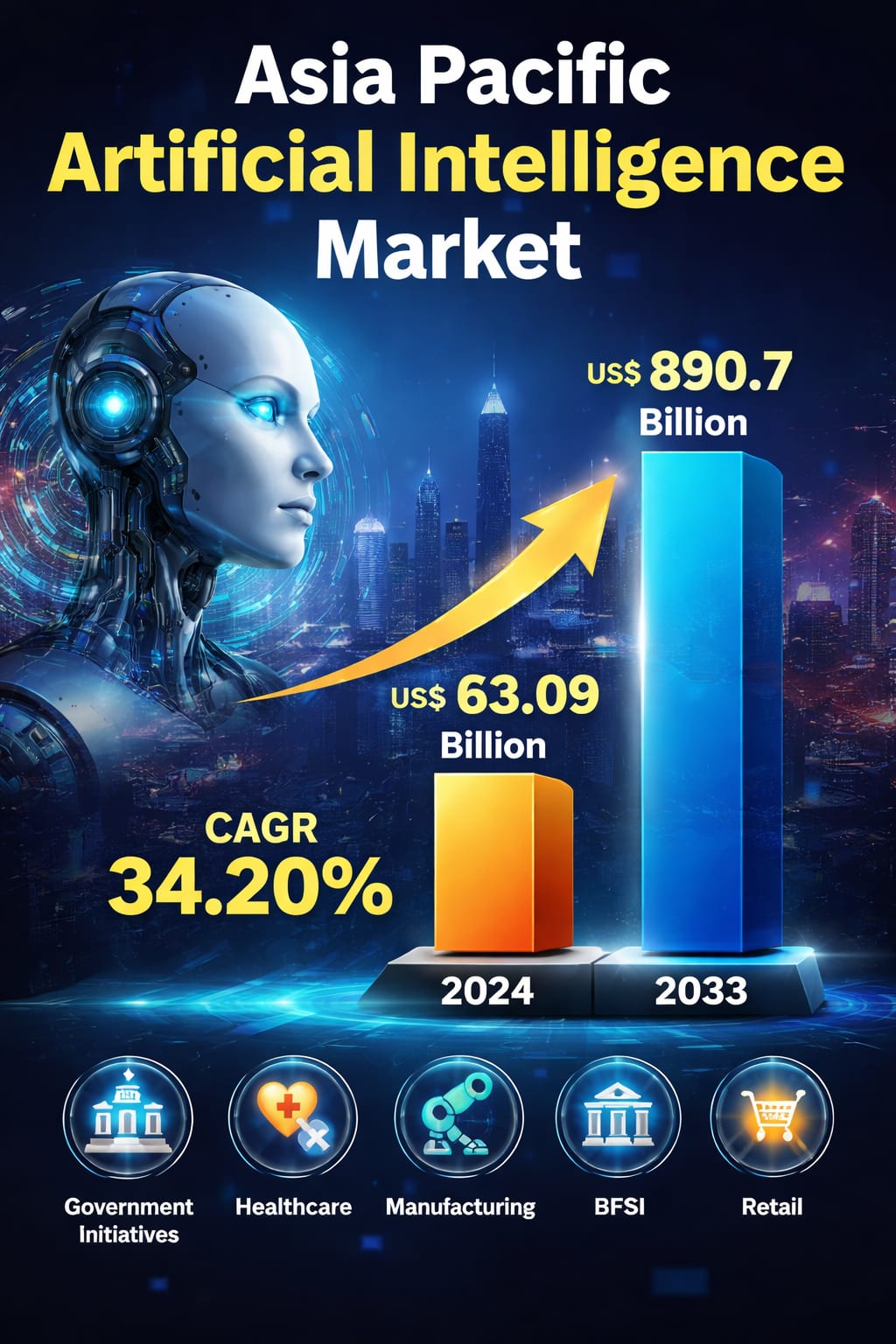
The Asia Pacific region is witnessing a significant transformation in its technological landscape, rapidly emerging as a major hub for artificial intelligence (AI) innovation and investment. By 2033, the Asia Pacific Artificial Intelligence Market is projected to soar to US$ 890.7 billion, up from US$ 63.09 billion in 2024, reflecting a remarkable compound annual growth rate (CAGR) of 34.20% from 2025 to 2033, according to Renub Research. This growth is underpinned by a confluence of government initiatives, private sector innovation, and advancements in digital infrastructure.
Once considered a fast follower in technological advancements, Asia Pacific is now transforming AI from a competitive edge to a foundational component of economic activities. AI applications have proliferated beyond research labs into vital industries like banking, healthcare, and manufacturing. As digital infrastructures mature—fueled by the rise of cloud computing and 5G networks—AI is becoming integral to how economies function and compete on a global stage.
A pivotal driver of this shift is government support, with countries like China, Japan, South Korea, and India implementing national AI strategies and funding programs. China aims to establish itself as a global AI leader by 2030, backed by substantial public investment and infrastructure development. Meanwhile, South Korea’s “I-Korea 4.0” initiative promotes AI integration across various sectors, while Japan focuses on automation and robotics to enhance manufacturing capabilities.
These government-led initiatives are not merely funding vehicles; they facilitate the creation of innovation ecosystems that include universities, startups, and research institutions. Such collaboration aims to reduce regulatory hurdles and attract investments in AI development, thereby enhancing the region’s technological landscape.
The private sector is equally pivotal in driving AI advancements. Major players like Baidu, Alibaba, and Tencent are leading the charge in AI research and commercialization, notably in cloud services and smart city solutions. Notably, Nvidia‘s recent partnership with Indosat Ooredoo Hutchison to establish a US$ 200 million AI center in Indonesia underscores the growing importance of Southeast Asia in the global AI ecosystem.
AI’s adoption across various sectors is becoming increasingly evident. In healthcare, it is utilized for diagnostics and treatment planning; in banking, for fraud detection and risk management; and in manufacturing, for predictive maintenance and quality control. Retailers are leveraging AI for personalized content and supply chain optimization, while the automotive industry invests heavily in autonomous driving technologies. The launch of Google’s Search Generative Experience (SGE) beta further illustrates the expanding role of generative AI in everyday digital interactions across the region.
Despite the impressive growth trajectory, the Asia Pacific AI market faces considerable challenges, particularly concerning data privacy and cybersecurity. AI systems rely on vast amounts of data, often sensitive, raising concerns over data breaches and compliance with varying national regulations. The complexity of differing data governance laws complicates the ability of multinational companies to implement AI solutions effectively.
Moreover, ethical questions surrounding AI, such as algorithmic bias and accountability, are coming to the forefront. The absence of harmonized AI governance frameworks heightens uncertainty for businesses and policymakers alike, prompting governments to balance innovation with responsibility in AI development.
Country-specific insights reveal distinct dynamics within the Asia Pacific AI markets. China stands out for its robust backing and data availability, with companies like Alibaba spearheading smart city projects. In contrast, India’s AI sector is buoyed by government initiatives and a burgeoning IT services industry. The collaboration between India’s Ministry of Electronics and Information Technology and Meta exemplifies the country’s ambitions to establish itself as a leader in next-generation AI technologies. Japan, on the other hand, is leveraging AI to maintain competitiveness amid demographic challenges, utilizing its strengths in robotics and advanced manufacturing.
As the Asia Pacific AI market continues to evolve, characterized by a mix of global tech giants and regional players, the competitive landscape remains intense. Companies such as Microsoft, IBM, and Amazon are heavily investing in AI platforms and industry-specific solutions, further driving innovation across the sector.
In conclusion, the Asia Pacific region is entering a defining decade for AI-driven transformation. With a projected market growth from US$ 63.09 billion in 2024 to US$ 890.7 billion by 2033, the convergence of government ambition, private sector innovation, and expanding industry adoption positions AI as a central pillar of future economic growth and social development in the region.
See also OpenAI’s GPT-5.2 Reveals Simple Gluon Collision Formula, Transforming Physics Calculations
 USU Students Develop AI to Identify River Rapids Using 280K Satellite Images
 AI Study Reveals Generative AI Boosts Productivity in 650 Indian IT Firms, Not Mass Layoffs
 ASEAN Foundation Reveals AI Readiness Gap: 95% of Students Use AI, Only 46% of Educators Do
 AI Models Revolutionize Data Analysis in Neuroscience and Materials Science