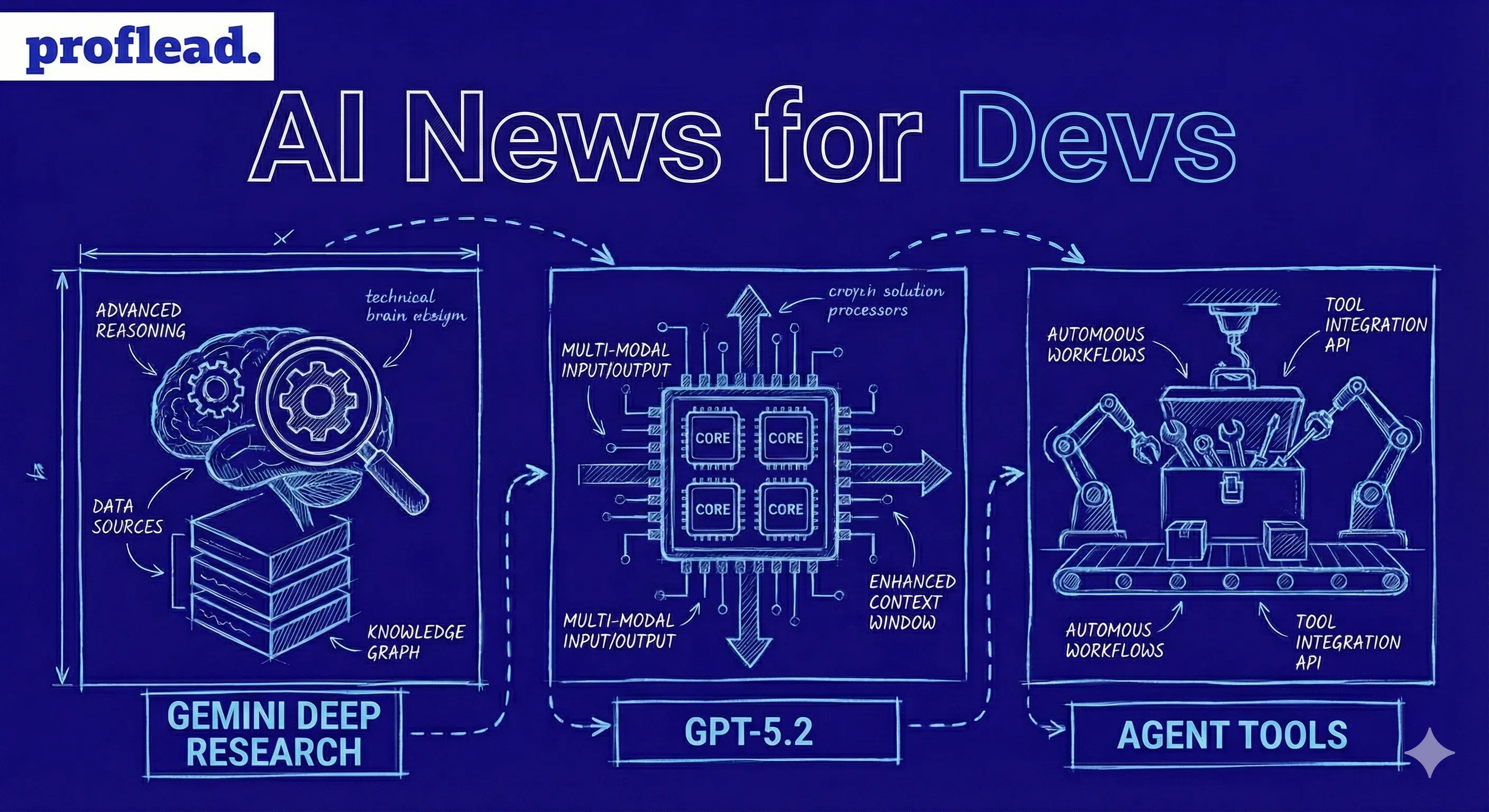
From December 8 to 13, 2025, several major updates in artificial intelligence were unveiled, showcasing advancements aimed at developers. These enhancements included new AI models, improved tools for building AI agents, and innovative design and developer platforms aimed at streamlining workflows and enhancing capabilities.
Google introduced the Gemini Deep Research & Interactions API, powered by Gemini 3 Pro. This AI agent can process extensive information and generate clear, citation-rich reports. Developers can integrate this functionality through the Interactions API, a singular REST interface that facilitates the management of conversations, memory, and tool usage in AI agent development.
Meanwhile, OpenAI launched GPT-5.2, a model touted as their most powerful to date, designed to enhance its capabilities in several key areas. These include improved writing and understanding of code, better handling of long conversations and documents, adeptness with images and diverse inputs, and a more accurate use of external tools. The release includes three different versions: Instant for quick tasks, Thinking optimized for coding and planning, and Pro for complex problem-solving.
At the Microsoft Ignite conference, the tech giant released Foundry, a platform designed to facilitate the building and management of AI agents at scale. Among its features are Foundry IQ for knowledge search and application, the Foundry Control Plane for security and compliance, and an Agent Framework that integrates Semantic Kernel and AutoGen. The platform also includes Hosted Agents for production deployment and model routing that supports integration with Anthropic’s Claude, allowing for more flexible AI agent management.
In a collaborative effort, OpenAI, Anthropic, and Block established the Agentic AI Foundation (AAIF), aimed at fostering open standards and neutral governance for AI agents. This initiative includes contributions of pivotal technologies like the Model Context Protocol (MCP) and AGENTS.md, a standard for describing agent behavior, which are intended to enhance interoperability among various tools and platforms.
Google Labs unveiled Disco, an experimental AI tool that features GenTabs, a functionality allowing users to convert browser tabs and chat histories into functional web applications. Users can employ natural language to create dashboards, small tools, and interactive pages without any coding requirements, leveraging the capabilities of Gemini 3.
In an update to its design tool, Google has enhanced Stitch with Gemini 3, enabling the generation of high-quality user interfaces. The new Prototypes feature allows developers to link screens into interactive flows seamlessly, expediting the testing of design concepts.
Mistral made strides by releasing Devstral 2, an open-source coding model known for its exceptional performance on coding benchmarks. Alongside this, they introduced Vibe CLI, a command-line interface that allows users to navigate and modify code using natural language, thus simplifying the coding process.
Google also enhanced its Gemini CLI, introducing session management features that automatically save prompts, responses, tool calls, and token usage within project-based sessions. This functionality is designed to aid developers in managing long-running workflows more efficiently.
On the research front, Microsoft Research launched Agent Lightning, an open-source framework designed for training AI agents through reinforcement learning. This framework distinguishes between agent execution and training, enabling developers to incorporate reinforcement learning without significant alterations to their existing code structures while also tracking agent actions and reward assignments.
As December 2025 drew to a close, the rapid evolution of AI tools for developers was starkly evident. With the introduction of new models, the establishment of open standards, and the development of comprehensive agent frameworks, the landscape for building intelligent AI systems continues to advance, promising enhancements in reasoning capabilities, user interfaces, and greater control for developers moving forward.
See also Machine Learning Enhances Lumbar Disc Degeneration Classification, Promises Personalized Treatment
 TCU Launches $10M AI² Initiative with Dell to Expand AI Research and Education
 University of Surrey Reveals AI Tool Predicting Osteoarthritis Progression in Knee X-Rays
 Deep Learning Transforms Kidney Transplant Success Rates by Enhancing Outcome Predictions